





TL;DR
- AR management software does not remove the finance team’s job. It changes the job from chasing individual accounts to reviewing what the system already scored and flagged.
- The weekly routine shifts to reading a handful of reports: recovery rate movement, the exception queue, and any account the model flags for drift or dispute.
- Reconciliation still needs a person to sign off, even when the matching runs automatically. A sign-off is an accountability record.
- Exception handling becomes the main daily task once scoring is automated. Finding the problem accounts turns into clearing the queue the system already built.
- Buying this kind of software shifts what to evaluate toward configurable reporting cadence and role-based access.
- This piece covers the operating rhythm once the software is running. The report names below illustrate the pattern rather than list a fixed set every deployment will match.
A finance team does not stop managing receivables once the software starts scoring accounts and timing contact. The work moves. Before automation, the team spends its time finding which accounts need attention. After automation, the system has already found them, and the job becomes reviewing the list, signing off on what it means, and keeping evidence that a person looked. That shift from searching to reviewing is what “AR management software” manages once live, a different question from what the software must be capable of on day one.
What changes for a finance team once scoring and contact timing run automatically
Before this kind of platform is in place, a finance team’s week runs on manual triage. Someone pulls an aging report, sorts by days overdue, and works down the list by hand, deciding which accounts need a call, a letter, or an escalation.
Once propensity scoring and contact timing run on their own, that triage step disappears. The system has already ranked every account by risk of default and queued the next contact action. The week starts with a smaller, already-prioritized list instead of a full ledger.
The job that remains is judgment. A team member checks whether the ranking still holds against anything it could not see: a payment promise made on a call, a dispute filed that morning, a hardship request outside the system. The software ranks the accounts. The person decides what to do with the cases the ranking cannot resolve alone.
The reports a finance team pulls every week from AR management software
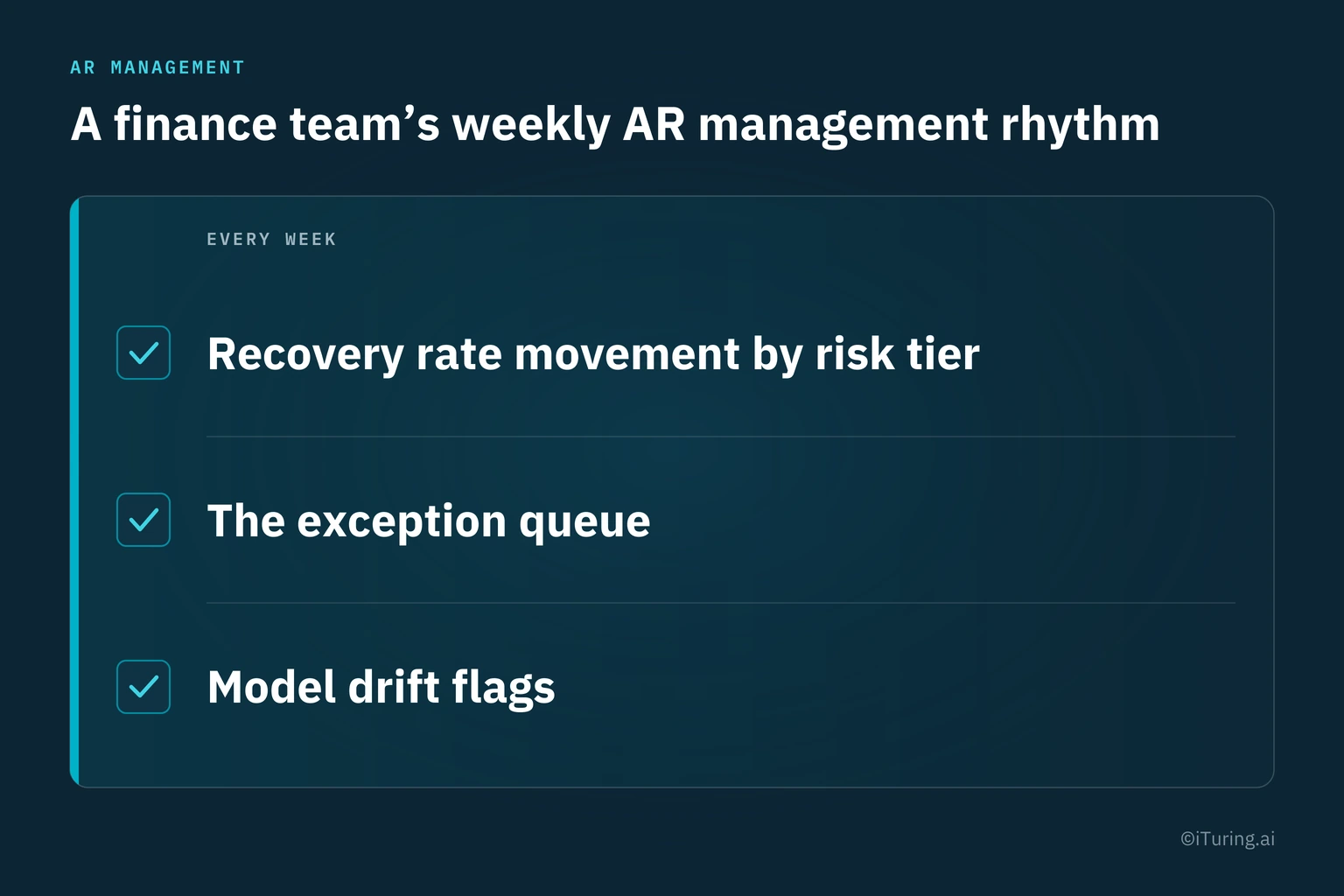
A recurring weekly routine replaces the old daily manual sort. Three reports carry most of the work.
Recovery rate movement. How the collections recovery rate trends week over week, broken out by risk tier. A tier that starts underperforming signals a shift before it shows up in a monthly total.
The exception queue. Every account flagged for a person’s attention rather than an automated next step: a dispute, a hardship claim, a payment plan renegotiation, or a confidence score below the usual threshold.
Model drift flags. Accounts where predictions have started missing more often than historical accuracy would suggest, telling the team a retraining cycle or a manual review is due.
These reports exist because the platform generates them as part of its normal operation. The finance team’s job is to read them and act, not assemble them from raw data.
Reconciliation still needs a human sign-off
Automated matching closes most reconciliation work on its own, tying a payment to the right account and updating its status without anyone touching it. That is a data-matching problem, and software handles it well.
A sign-off is a different task. It is the record that a specific person reviewed a batch of reconciled accounts and stands behind the result, which matters when an examiner or auditor asks who checked the numbers. Automating the matching does not remove the need for that record. It changes what the person signs off on, from checking every line to reviewing the system’s output.
The system does the matching. A person owns the accountability for the result. That split is the same automation boundary a finance team draws everywhere else in the process.
What exception handling looks like when the system flags the account first
Before automation, finding a problem account was itself the work. A team member had to notice a payment pattern change, a lapsed promise to pay, or an unanswered dispute.
After automation, the system surfaces these cases directly into a queue. Finding them stops being the task. Clearing the queue becomes it. The skill the role requires shifts too, putting less weight on spotting problems in a large ledger and more weight on a fast, consistent judgment call on each flagged case: a renegotiated plan, a compliance-sensitive pause, or an escalation.
A queue that grows faster than it clears is its own signal worth watching. It usually means the model’s thresholds need adjusting, since automation exists to reduce the volume that reaches a person at all.
The audit trail a finance team has to keep ready to produce on demand
An AI-driven collections or receivables platform logs every score, every contact decision, and every model version automatically. That log existing is one thing. Being ready to produce it on demand is another.
A finance team’s ongoing job is confirming the audit trail stays complete and current. That means checking it covers the reporting period, confirming no manual override went unrecorded, and keeping a plain-language explanation ready for any decision someone might question later.
What to check before you buy for ongoing management
The evaluation questions that matter for day one, whether the software scores correctly and integrates with the core system, belong to a different conversation. Buying for the operating rhythm described here means checking a different set of things.
Reporting cadence should be configurable. A finance team should set what gets reported weekly versus monthly, and to whom, without a vendor ticket every time the calendar changes.
Role-based access should match how the team works. A team lead who signs off on reconciliation needs different access than an analyst clearing the exception queue, and the platform should support that natively rather than treat every user the same.
The system should fit an existing close and reporting calendar. A platform that runs its own reporting rhythm, disconnected from month-end and quarter-end schedules, adds a second calendar to track instead of fitting the one that already exists.
A leading NBFC in India ran this kind of automated scoring and contact-timing system and raised its collections recovery rate by 116%, reaching 86% predictive accuracy, deployed in two weeks. The regulator in that case was the RBI rather than South Africa’s own instruments, but the operating shift, from a team searching for problem accounts to a team reviewing what the system already found, is the one described throughout this piece.
Book a working session with iTuring to see how the platform’s reporting, exception handling, and audit trail fit an existing finance team’s routine.
Sources
- iTuring case study, “Improve Collections and Optimize Efforts” (Leading NBFC in India): 116% collections improvement, 86% predictive accuracy, two-week deployment. https://ituring.ai/case-study/improve-collections-and-optimize-efforts/