





TL;DR
- FSCA and the Prudential Authority have named SHAP and LIME directly, in their first joint report on AI in the financial sector, as explainability methods institutions are encouraged to adopt.
- SHAP and LIME are not the same tool doing the same job. SHAP explains a decision by weighing every feature’s contribution. LIME explains it by testing a simpler model around that one case.
- A supervisor does not want a description of how the model works in general. A supervisor wants to see why one specific account got the decision it did, in language a customer could also understand.
- Explainability sits inside a wider governance framework, alongside board oversight and a documented model risk structure, not as a standalone technical add-on.
- This piece draws its regulatory grounding from two independent secondary reviews of the FSCA/Prudential Authority report rather than the primary PDF itself, which could not be fetched directly. Treat the quoted language as secondary-sourced.
South African banks and insurers are being asked, for the first time from a joint regulatory source, to name the method behind an AI-driven decision rather than describe the decision alone. FSCA and the Prudential Authority’s first joint report on AI in the financial sector points to two specific techniques, SHAP and LIME, as the explainability methods institutions should be adopting. Neither is new in machine learning circles. What is new is a regulator naming them directly rather than leaving “explainability” as an abstract governance principle for an institution to interpret on its own.
What “explainability” means once a regulator asks for it
In most machine learning discussions, explainability is a design conversation. Teams weigh a more accurate but harder-to-interpret model against a simpler, more transparent one, and pick based on the trade-off that suits the use case.
Once a regulator asks for explainability, that framing changes. The question is no longer whether a model can be understood in principle. It is whether a specific decision, the one that denied this loan applicant or flagged this insurance claim, can be explained to the person it affected and defended to an examiner who reviews it afterward. That is an account-level requirement rather than a model-level one, and it is the distinction that separates a governance slide deck from something a supervisor will accept.
SHAP and LIME in plain terms
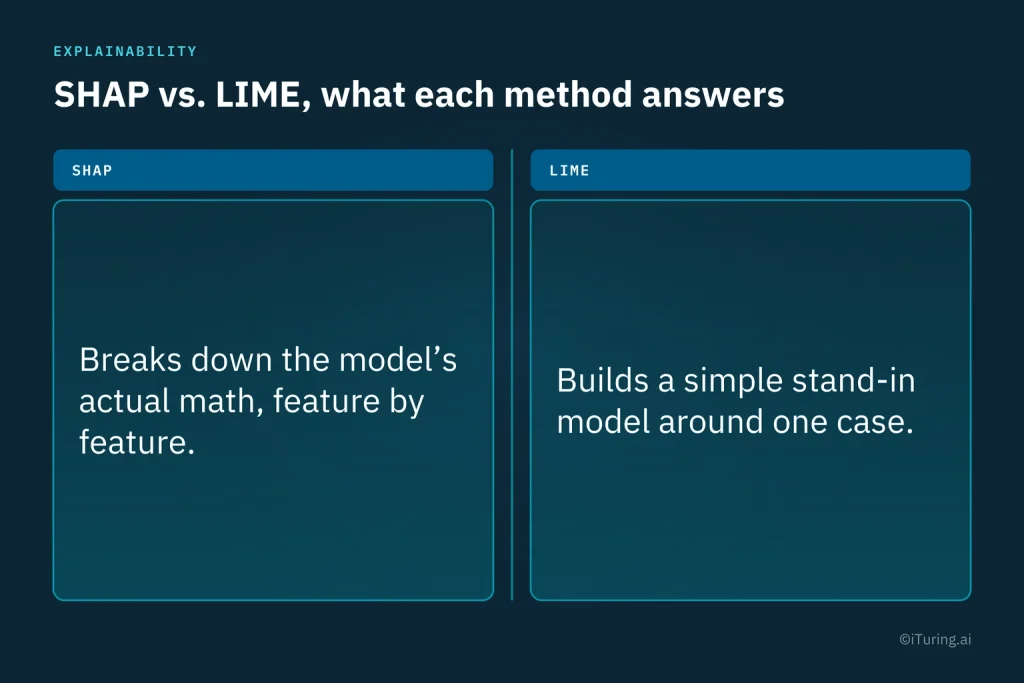
SHAP and LIME solve the same underlying problem, making a model’s output legible, but they get there differently.
SHAP (SHapley Additive exPlanations) assigns every input feature a share of the credit or blame for a specific prediction. If a credit model declines an applicant, SHAP can show that a thin credit history contributed most to the decision, a short employment tenure added a smaller amount, and a stable income history pushed slightly the other way. The output is a consistent breakdown, feature by feature, that adds up to the model’s actual prediction.
LIME (Local Interpretable Model-Agnostic Explanations) takes a different route. Rather than breaking down the original model’s math directly, it builds a small, simple model around one specific case, one that behaves like the original model in that narrow neighborhood, and reads the explanation off that simpler stand-in. It answers a slightly different question: not “how did the real model weigh each factor,” but “what simple rule would produce roughly this same answer for this case.”
Neither method is universally better. SHAP tends to give a more mathematically grounded answer and is often the default choice for models trained on structured financial data. LIME can run faster and adapts more easily across different types of models, which matters when a bank’s AI portfolio includes more than one model architecture. Institutions that need to justify method choice to an examiner should be able to say which one they use, why, and for which model types, rather than defaulting to one without a documented reason.
Why FSCA and the Prudential Authority pointed to these two methods
South Africa runs a twin peaks regulatory model. FSCA supervises market conduct, and the Prudential Authority, housed within the South African Reserve Bank, supervises prudential safety and soundness. Their first joint report on AI in the financial sector, published 24 November 2025 and based on roughly 2,100 survey responses from banks, insurers, investment firms, and payment providers, is where this specific guidance appears.
Per two independent secondary reviews of the report, it states plainly that “institutions are encouraged to adopt recognised explainability methods such as SHapley Additive exPlanations (‘SHAP’) and Local Interpretable Model-Agnostic Explanations (‘LIME’).” That is a specific, named recommendation, not a general call for “transparency” left to each institution to define.
The report itself is not yet legally binding. Both regulators describe their current approach as principle-based and outcomes-focused, and both have signaled that a discussion paper will follow for further stakeholder engagement, with no date given. That status matters for how an institution should treat this guidance today: as the clearest signal available of where supervisory expectations are heading, not yet as an enforceable rule with a compliance deadline attached. Building toward it now costs less than retrofitting it later under a firmer instrument.
What a supervisor expects for one account-level decision
A model risk document that describes SHAP or LIME in the abstract will not satisfy an examiner asking about a specific customer’s outcome. What a supervisor expects is narrower and more concrete.
For the account in question, that means the specific features that drove the decision, in the order of their contribution, generated by whichever method the institution has documented as its standard for that model type. It means the explanation is available in language the affected customer could understand, not only in a data science team’s internal notation. It means the explanation was generated close to the point of decision, not reconstructed weeks later when a complaint arrives. And it means the record ties back to a specific model version, since a model retrained since the decision was made cannot produce a reliable after-the-fact explanation of an earlier prediction.
An institution that can produce this record on demand, for any account, on request, has met the bar this guidance is pointing toward. An institution that can only describe its explainability approach in general terms has not, whatever training or documentation exists behind the scenes.
Where explainability sits inside a bank’s broader AI governance framework
Explainability is not a standalone technical feature bolted onto a model. The same joint report frames it as one part of a wider set of governance expectations that also includes board-level oversight of AI use, a documented model risk management structure, and data governance aligned to POPIA, with consumer disclosure required when an automated decision affects someone directly.
An institution that has already built the governance readiness this report calls for, board sign-off on AI use, a model inventory, a defined risk management structure, has the natural home for an explainability standard to sit inside. One that has not will find explainability difficult to bolt on in isolation, since the account-level record described above depends on knowing which model version made which decision and having a governance process that already tracks that.
What this looks like running in production
A leading NBFC in India built exactly this kind of account-level explanation into its collections decisioning, generating a reasoned explanation for every automated contact decision alongside the underlying score. The result was a 116% increase in its collections recovery rate, with 86% predictive accuracy, deployed in two weeks. The regulator in that case was the RBI rather than FSCA or the Prudential Authority, but the underlying requirement, an explanation a supervisor and a customer can both follow for one specific decision, is the same one this report signals for South Africa.
Book a working session with iTuring to see how account-level explainability fits into a broader AI governance readiness program.
Sources
- FSCA and Prudential Authority, “Artificial Intelligence in the South African Financial Sector,” 24 November 2025. Primary source page confirmed by direct fetch of resbank.co.za. The SHAP/LIME quotation itself is sourced from two independent secondary legal reviews (ENSafrica, Mondaq) since the full PDF exceeds the fetch tool’s URL-length limit.
- iTuring case study, “Improve Collections and Optimize Efforts” (Leading NBFC in India): 116% collections improvement, 86% predictive accuracy, two-week deployment. https://ituring.ai/case-study/improve-collections-and-optimize-efforts/