
TL;DR
- AI model stress testing means testing how a model behaves under edge cases, adversarial inputs, and manipulation attempts before it goes live. It is a different discipline from RBI’s balance-sheet capital stress tests.
- RBI’s June 2026 draft guidance, still draft, with the comment period closed, is understood from secondary industry commentary to expect adversarial and out-of-sample testing, red-teaming for customer-facing or generative models, and independent Second Line of Defence validation before deployment.
- This post covers testing rigor at the pre-deployment gate, separate from how often models get revalidated afterward.
- SR 11-7, a 14-year-old US Federal Reserve and OCC guidance, describes a parallel logic around outcomes analysis and sensitivity testing, with no confirmed lineage to RBI’s draft.
- iTuring’s Model Governance module builds this gate into deployment: pre-deployment validation checkpoints, maker-checker approval, and an audit trail that captures test evidence directly.
Stress Testing Your Balance Sheet and Stress Testing an AI Model Are Two Different Exercises
When a risk officer at an Indian bank hears “stress testing,” the reflex is capital adequacy: RBI’s macroprudential scenarios, liquidity coverage under shock conditions, provisioning against a stressed balance sheet. That discipline is well understood, well documented, and audited annually.
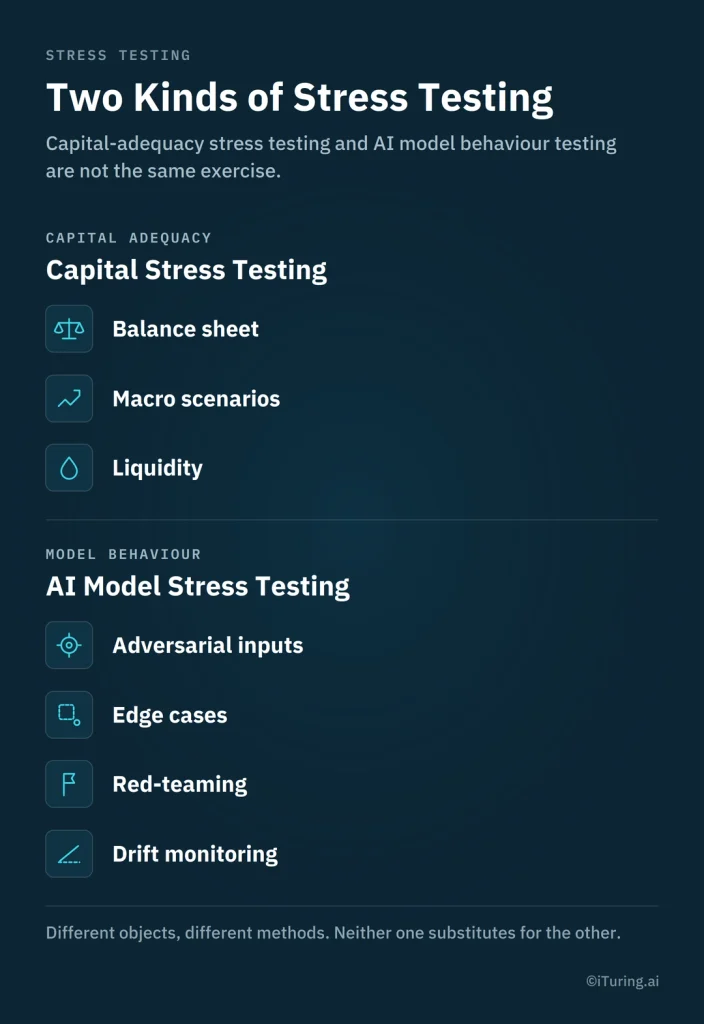
AI model stress testing software for banks in India is a different question entirely. It asks how a specific model, the one scoring collections propensity or approving credit, behaves when it is fed data it has never seen, inputs designed to confuse it, or conditions engineered to expose a weakness. A model can pass every capital stress test the bank runs and still fail this second kind of testing, because the two exercises are checking for entirely different failure modes.
This post is about the second kind: testing model behavior before deployment.
What Testing a Model’s Behavior Under Stress Actually Means
Stripped of any regulatory citation, model stress testing is a specific set of practices:
Edge cases. Inputs at the extreme boundaries of what a model normally sees, a borrower with an unusually thin credit file, a claim filed at an atypical time of year, a transaction pattern that sits at the tail end of the training distribution.
Abnormal inputs. Data that is malformed, incomplete, or structurally different from what the model was trained on, testing whether the model degrades gracefully or produces a confident wrong answer.
Adversarial manipulation. Inputs deliberately constructed to trick the model, a customer learning which answers move a fraud score down, or a chatbot prompted to say something it should not say.
Red-teaming. A structured, adversarial exercise where a team’s explicit job is to try to break the model or make it behave badly, before a customer or regulator has the chance to do the same thing after launch.
None of this requires an RBI citation to be sound practice. It is the same logic that applies to any system making consequential decisions about people: know how it fails before it fails on someone’s account.
What RBI’s Draft Guidance Is Understood to Expect Before Deployment
A note on sourcing before going further: RBI released draft guidance on June 24, 2026 (prid=63006), and the comment period closed on July 24, 2026. It remains a draft today. It has not been finalized as a Master Direction. What follows is drawn from multiple converging secondary sources, legal commentary and industry analysis discussing the draft, rather than a direct citation of RBI’s own primary text, and no section numbers are cited because none have been independently verified against the source document.
With that caveat stated plainly, the draft is understood to expect institutions to:
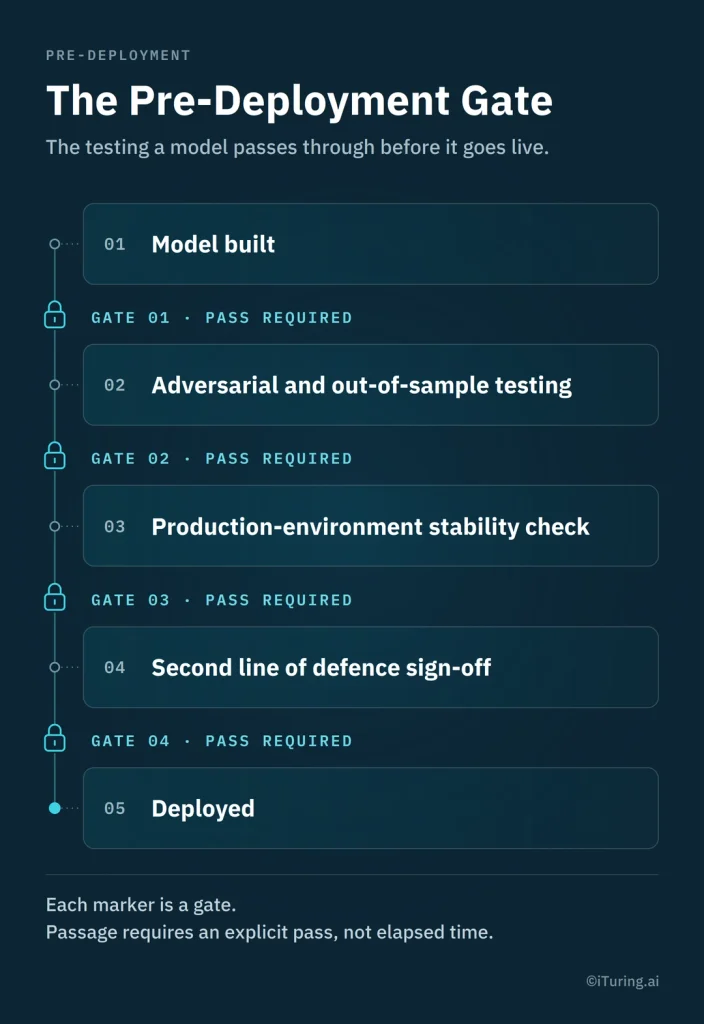
- Test models under atypical or stressed scenarios so that vulnerabilities do not surface only after deployment, covering edge cases, abnormal inputs, manipulations, and adversarial conditions.
- Run structured challenge processes, including red-teaming or an equivalent testing discipline, with particular emphasis on models that involve customer interaction or generative capabilities.
- Perform out-of-sample assessment as a distinct exercise from historical backtesting, testing against data the model has not been trained or tuned on rather than replaying past performance.
- Confirm that a model’s outputs are replicated and stable in the actual production environment before it goes live, catching gaps between a validated test environment and the live system.
- Route models through independent validation by the Second Line of Defence before initial deployment, following any material modification, and at predefined periodic intervals after that.
Institutions should treat this as directional intelligence to prepare for. A confirmed compliance checklist will only exist once RBI publishes a final version.
Four of the Seven AI Risk Dimensions Map Directly to This Testing Requirement
An earlier post in this series laid out seven AI risk dimensions relevant to regulated deployments: hallucination, bias and discrimination, overfitting, spurious correlations, output variability, data risk, and explainability gaps.
Of those seven, sources on the draft guidance explicitly name four as testing or monitoring targets: hallucination, bias and discrimination, spurious correlations, and explainability gaps. These are the dimensions the guidance points to directly.
A fifth connection is worth naming as inference rather than fact: out-of-sample testing, as described in the draft, is a natural tool for detecting overfitting, since a model that has memorized its training data rather than learned generalizable patterns will typically perform poorly on data it has never seen. That link is editorial reasoning on iTuring’s part. RBI has not stated this framing itself.
Output variability and data risk are not tied to stress testing specifically in the sources reviewed for this post, and this piece does not claim otherwise.
Why This Is Different From How Often You Revalidate a Model
A previous post in this series covered revalidation frequency: how often a live model needs to be checked again after it is already in production, and what triggers an off-cycle review.
This post covers a different moment in the model’s life. Stress testing, as described here, is about the rigor and methodology applied at the gate before a model is allowed into production in the first place, adversarial testing, out-of-sample assessment, and production-environment stability confirmation, all completed and signed off before go-live.
iTuring’s Model Governance module treats this as a distinct checkpoint: the pre-deployment validation gate sits ahead of the revalidation schedule, as a separate checkpoint.
How a 2011 US Framework Approached the Same Testing Problem
SR 11-7, joint supervisory guidance from the US Federal Reserve and the OCC, was published in 2011. It is now 14 years old, it applies to US bank holding companies and banks under Federal Reserve or OCC supervision, and it carries no binding authority for Indian entities. No lineage between SR 11-7 and RBI’s 2026 draft has been confirmed, and this section is offered strictly as comparative context for readers familiar with US model risk management practice.
SR 11-7 describes a similar underlying logic through different mechanics:
- Outcomes analysis, comparing what a model predicted against what actually happened, under both normal and stressed conditions.
- Benchmarking, comparing a model’s outputs against alternative models or alternative data sources to see whether results hold up.
- Sensitivity analysis, deliberately varying key assumptions and inputs to see how much the model’s output moves, and whether that movement is proportionate and explainable.
The overlap with what RBI’s draft is understood to expect is conceptual: test the model under conditions it will actually face. The specific mechanisms and the regulatory weight behind them differ, and institutions should not assume compliance with one implies compliance with the other.
Building the Pre-Deployment Gate Into the Platform Instead of Into a Spreadsheet
The practical objection to all of this is predictable: rigorous pre-deployment testing sounds like it slows deployment down, at a time when the same institutions are under pressure to ship models faster.
iTuring’s Model Governance module is built to answer that objection directly. It puts a pre-deployment validation gate in front of every model going live, so adversarial testing, out-of-sample assessment, and production-stability checks happen as a required step in the workflow rather than as a manual task someone has to remember to schedule. A maker-checker approval workflow routes each model through an independent reviewer before deployment, matching the Second Line of Defence pattern described in RBI’s draft. And the audit trail captures the test evidence itself, adversarial test results, out-of-sample performance, sign-off records, as a single system of record, rather than scattered spreadsheets and email approvals that are hard to produce on demand during an examination.
Institutions using this workflow have gone 97% faster to production, evidence that building the gate into the platform is what makes rigorous testing and deployment speed compatible.
iTuring.ai also holds SOC 2 Type II and ISO 27001 certifications. These are security and data-handling compliance certifications, and they do not certify model-testing or model-validation rigor specifically; institutions should evaluate iTuring’s Model Governance workflow on its own terms for that purpose.
What This Looked Like in Production
iTuring.ai’s Model Governance module is live today across 16 banks and insurers, supporting 200+ use cases in production. These figures speak to the platform’s scale and credibility. They say nothing about testing outcomes at any specific institution.