
TL;DR
- The RBI’s 2022 Regulatory Framework for Microfinance Loans (amended 2023-2024, per secondary reporting) sets requirements beyond general NBFC recovery norms: household-level income assessment, a debt-to-income cap, mandatory credit bureau checks, and a narrower 9am-6pm contact window.
- A February 2026 draft circular reportedly would add a “designated place” requirement for recovery attempts before field visits are permitted. This is a draft under discussion, not confirmed finalized law.
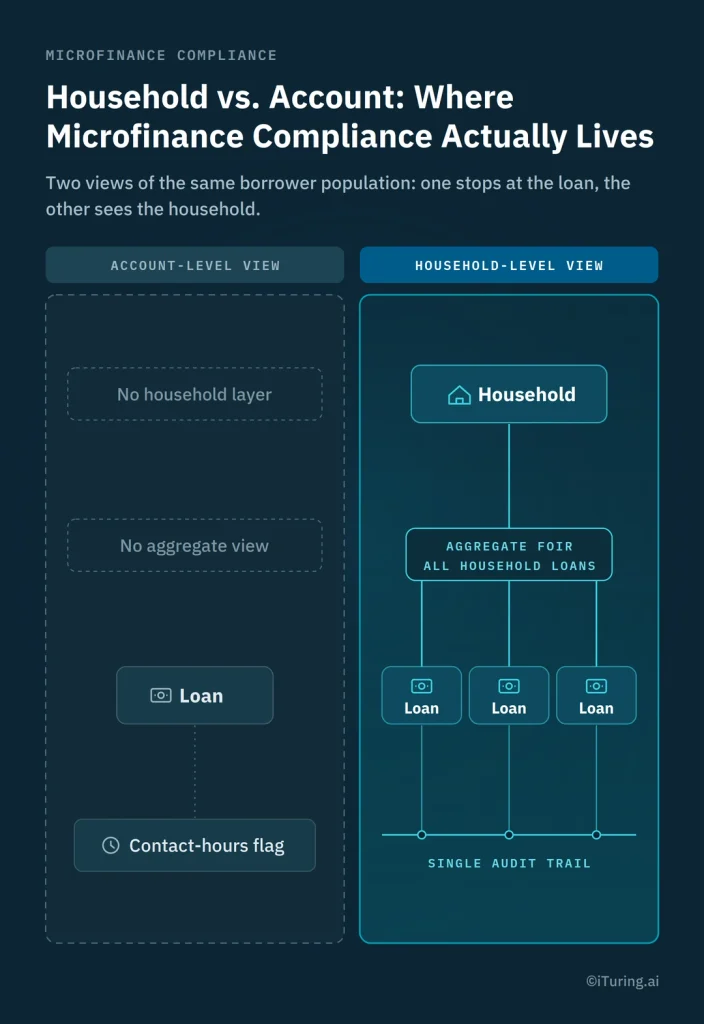
- Most recovery-agent compliance tooling built for general NBFC rules applies contact-hour and disclosure logic at the account level. Microfinance regulation is fundamentally household-level, a gap account-level systems don’t close without deliberate design.
- Model Governance with account- and household-level audit traceability is the structural way to demonstrate this compliance layer to an examiner, not just track it internally.
If you’ve read the earlier posts in this series, your recovery-agent compliance stack probably already handles the basics: contact-hour windows, call recording, mandatory disclosure scripts, agent conduct logging. For a general NBFC book, that’s a reasonably solid foundation.
But if any part of that book is microfinance lending, here’s the question worth asking your compliance software vendor directly: does the system know that microfinance loans sit under a separate regulatory layer, with its own income assessment rules, its own debt cap, its own contact-hour window, and its own conduct requirements? Or is it quietly applying the same general NBFC logic to every account in the portfolio, microfinance included?
For a lot of tooling built to a general NBFC recovery spec, the honest answer is the latter. That’s the gap this post covers.
The 2022 Microfinance Framework Sits Alongside General Recovery Rules, Not Inside Them
This is not a new rule. The RBI Master Direction on the Regulatory Framework for Microfinance Loans dates to 2022, with amendments reported through 2023 and 2024. It exists alongside general NBFC recovery-agent norms, applying additional, more specific requirements to microfinance lending. The provisions below are drawn from secondary regulatory reporting and should be confirmed against the current Master Direction text before use in a compliance filing.
- Household income assessment. Lenders are reported to be required to assess a borrower’s household income over a minimum one-year period, corroborated through documentation such as bank statements or local inquiry, rather than relying on a single-point income declaration.
- A debt-to-income cap at the household level. Reporting describes a fixed obligation-to-income (FOIR) cap of a maximum 50% of monthly household income, calculated across all loans, both collateral-free microfinance loans and collateralized loans, held by that household. Households already at or above the threshold are reportedly blocked from new microfinance lending.
- Mandatory credit bureau verification before disbursal. Lenders are reported to be required to check a borrower’s credit information company (CIC) report before disbursing, specifically to identify multi-lender exposure across the household.
- Specific conduct rules for recovery agents. Reporting describes prohibitions on threatening or harassing a borrower’s relatives or coworkers, publishing a borrower’s name, using threats of violence, or misrepresenting the amount owed. Recovery agents are reportedly required to carry police verification, an authorization letter, and identification when making a field visit.
The pattern across all four provisions: this framework treats the household as the unit of risk, not the individual loan.
The Contact-Hours Window Is Narrower Than General NBFC Rules
This is the most easily checkable difference, and the one worth testing against your own system’s configuration today.
Reporting on the microfinance framework describes a permitted contact window of 9am to 6pm. General NBFC recovery norms, covered earlier in this series, describe a wider 8am to 7pm window. If your compliance software applies a single, portfolio-wide contact-hours default, a microfinance account inside that general window but outside the narrower microfinance window generates a call the borrower is entitled to flag as noncompliant, even though the system logged it as approved.
A February 2026 Draft Would Add a Designated-Place Step Before Field Recovery
Vinod Kothari Consultants has reported on a draft circular, dated February 2026, that would introduce a sequencing requirement before field visits: recovery would first need to be attempted at a mutually agreed designated place, with a field visit permitted only after repeated non-appearance by the borrower.
This is a draft under industry discussion at the time of writing. It has not been confirmed as finalized and should not be treated as current law or built into a compliance filing as settled fact. What it does signal is a direction of travel toward more structured, staged recovery sequencing, worth designing for now rather than retrofitting later if it is finalized.
Why Household-Level Exposure, Not Just the Single Loan, Should Drive Recovery Strategy
Here’s the part most recovery workflows miss entirely, and it follows directly from the FOIR cap above.
Every delinquent microfinance borrower already went through a household-level exposure check at origination. The FOIR cap, the multi-lender CIC check, the corroborated household income assessment, all of that happened once, at the point of disbursal. Once the loan turns delinquent, recovery teams typically work from account-level data alone: this loan, this borrower, this contact history.
That’s a meaningful loss of context. A household already at 45% FOIR across three lenders behaves differently under recovery pressure than a household with a single loan and no other exposure, and a recovery strategy built without that difference is working with less information than the lender had at origination.
To be clear: no circular currently requires a lender to re-query CIC or household exposure data specifically at the recovery stage. That would be a reasonable design choice. It has not been established as a regulatory mandate. But it’s worth naming as a design gap, because most recovery-agent compliance systems aren’t built to represent a household as a unit at all. They’re built around the loan.
What Microfinance Recovery Agent Compliance Software Actually Needs to Do
This is where the gap becomes an actionable checklist. Genuinely capable microfinance recovery agent compliance software needs to handle at least four things a general NBFC-built system typically doesn’t:
- Contact-hour logic configured per loan category, not per portfolio. The system needs to know that a microfinance account runs on the 9am to 6pm window while a general NBFC account runs on the wider window, applying the correct one automatically based on loan type, not a single portfolio-wide default.
- Audit trail at both the account and household level. Every contact attempt, disclosure, and recovery action needs to be traceable to a single loan and rolled up to the household, so an examiner can see the full exposure picture behind any single recovery decision.
- Explainability tied to household-level inputs. If a recovery decision was informed by household-level data, such as aggregate FOIR or multi-lender exposure, the system needs to show that link explicitly, not bury it in a separate report.
- A configurable designated-place-first workflow. Given the February 2026 draft, building the capacity to record and attest a designated-place attempt before a field visit now means the workflow is ready to activate if the rule is finalized, avoiding a rebuild under a compliance deadline.
This is precisely what iTuring’s Model Governance module is built to do: an immutable audit trail, account- and household-level explainability on demand, and maker-checker approval workflows already structured for RBI MRM-style review. A system built around these questions from the start answers them faster than one retrofitting a report after the fact.
Building Household-Level Audit Traceability Before an Examiner Asks For It
Most compliance gaps in microfinance recovery don’t show up in a routine internal review. They show up when an examiner asks a question the system wasn’t built to answer, such as whether a specific recovery decision accounted for a borrower’s total household exposure, not just the single loan in front of the agent.
If your current recovery-agent compliance tooling was built for general NBFC rules and extended to cover microfinance loans as an afterthought, it’s worth a direct conversation about where the household-level view actually lives in that system, and whether it can be shown, not just described, on demand.