



TL;DR
- The job collections software does: it takes an account that has already been scored and turns that score into a managed, auditable workflow, not a bigger contact list.
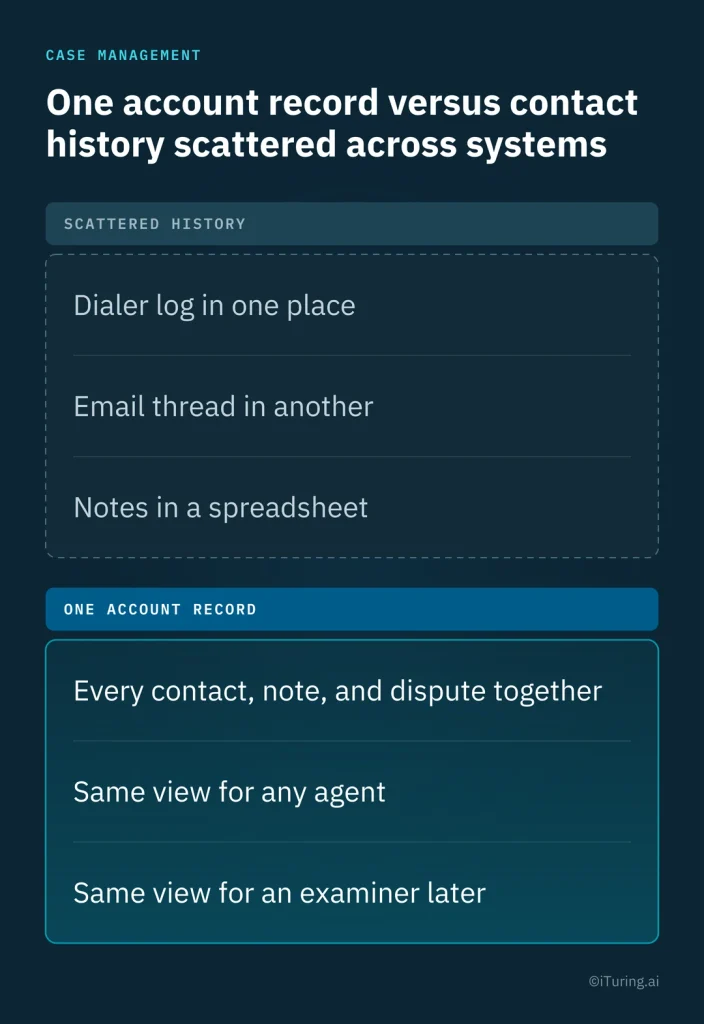
- Case management is the foundation. Every account needs one record covering its full history, not scattered notes across a dialer, an email tool, and a spreadsheet.
- A workflow engine decides what happens next. Escalation rules, queue assignment, and automatic removal of disputed or hardship accounts all belong here.
- Integration matters more than any single feature. The software has to talk to the scoring layer that ranks accounts and the channels that reach them, or the workflow runs on stale information.
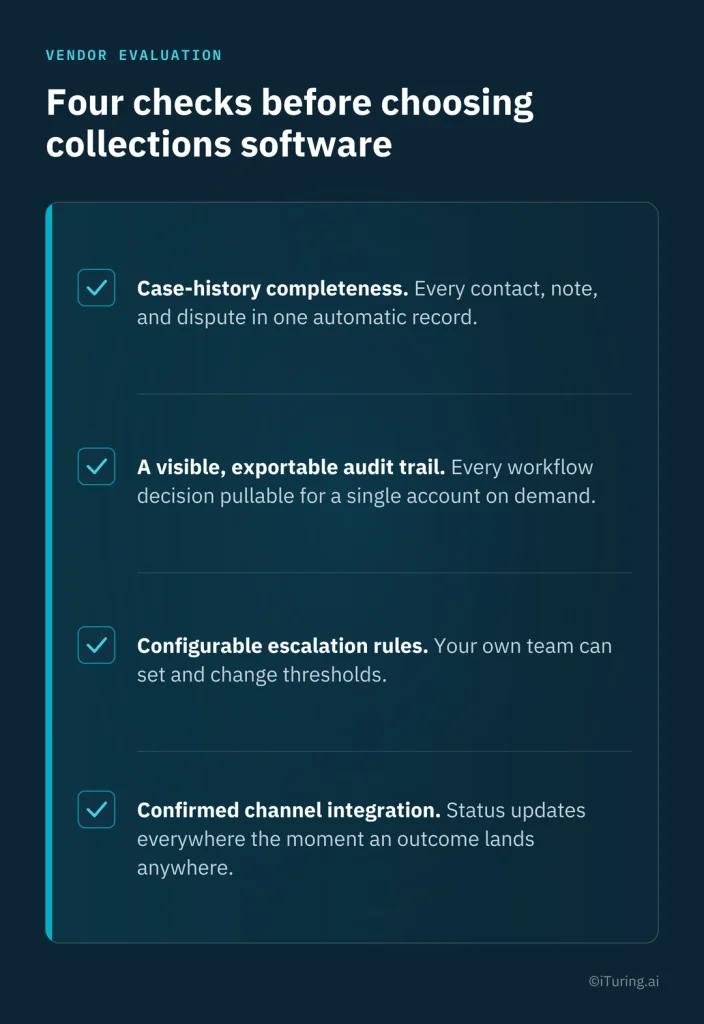
- What to check before buying: case-history completeness, a visible audit trail, configurable escalation rules, and confirmed integration with the channels you already use.
- Honest caveat: this piece describes the platform capabilities a South African credit provider should evaluate, not a ranked comparison of named vendors, since no independent South African benchmark of collections software exists yet.
An account gets scored. Now what. That question is where accounts receivable software and its automation boundary hand off to a different system, the one that manages the account day to day. Collections software is that system, and most of what makes one good or bad has nothing to do with how many contact channels it supports.
What collections software has to do once accounts are already scored
Collections software takes a scored, prioritized account and turns it into a managed process: who owns it, what happens next, and what gets recorded along the way. A system that only dials down a list in score order is not managing collections. It is running a slightly smarter contact list. The difference shows up the first time an account gets disputed, a customer requests hardship terms, or an examiner asks to see what happened on a specific account six months ago.
Case management: where an account’s history lives
Every account needs one continuous record: every contact attempt, every promise to pay, every dispute, and every note, in one place rather than split across a dialer log, an email inbox, and whatever a collections agent wrote in a spreadsheet. Without this, two things go wrong at once. An agent working an account has no idea what already happened on it, and an examiner reviewing that account later has no single source to check against.
A workflow engine decides what happens to an account next
A workflow engine takes a scored account and decides what happens to it beyond the next contact attempt. It assigns accounts to the right queue based on risk tier and account type, applies escalation rules when a promise to pay is broken, and pulls disputed or hardship accounts out of the standard flow automatically, before someone has to notice and intervene manually. This is the system-level version of the automation boundary a South African credit provider already has to draw at the scoring stage. Some routing decisions run without a person, and a dispute or hardship flag has to interrupt that routing the moment it appears, at the point of contact rather than at the next scheduled review.
A workflow engine built this way changes what an escalation looks like day to day. Instead of a supervisor scanning a report at week’s end to catch accounts that broke a promise to pay, the system flags the break the moment it happens and moves the account to the queue a senior agent works, with the full history already attached.
Where this system needs to talk to the scoring layer and the contact channels
Collections software that runs as its own silo, disconnected from the system that scores accounts and the channels that reach customers, works on stale information by the time an agent opens it. A score calculated overnight and a workflow that only reads it once a day means an account that should have been pulled from contact this morning, because a payment posted or a dispute came in, keeps moving through the queue anyway. The workflow engine needs a live connection to both ends: the scoring system feeding it prioritization, and every contact channel feeding it outcomes, so the record any agent or examiner sees is the current state of the account, not yesterday’s.
What to evaluate before choosing collections software for a South African credit provider
Case-history completeness. Ask whether every contact, note, and dispute lands in one account record automatically, or whether agents have to manually consolidate information from separate tools.
A visible, exportable audit trail. Ask whether every workflow decision, who was contacted, when, why, and what happened, can be pulled for a single account on demand.
Configurable escalation rules. Ask whether escalation thresholds and dispute-handling rules can be set and changed by your own team, rather than requiring a vendor engagement for every adjustment.
Confirmed integration with your existing channels. Ask how the system connects to the phone, SMS, email, and any portal you already use, and how quickly an outcome on one channel updates the account’s status everywhere else.
What this looks like running in production
A leading NBFC in India built its collections workflow on exactly this foundation, a single account record feeding a rules-based workflow tied to continuously updated scores, and raised its collections recovery rate by 116% with 86% predictive accuracy, deployed in two weeks. For a deeper look at the scoring and treatment-routing mechanics behind a system like this, see how AI collections technology works for South African credit providers.
If your team is still piecing an account’s history together from three different tools before a difficult call, book a working session with ours to see what a single workflow would change.
Sources
- iTuring case study, “Improve Collections and Optimize Efforts” (Leading NBFC in India): 116% collections improvement, 86% predictive accuracy, two-week deployment. https://ituring.ai/case-study/improve-collections-and-optimize-efforts/