
TL;DR
- AI collections replaces manual queue-working with data-driven treatment routing
- Propensity scoring ranks accounts by actual payment likelihood today
- NCA and POPIA compliance must be built into the AI architecture
- Right-party contact rates improve when timing is borrower-specific
- Debt review early identification prevents unlawful contact downstream
A collections supervisor at a South African credit provider starts most Monday mornings the same way. She opens the delinquency report. She looks at the accounts between 30 and 90 days past due. She divides them into calling batches for the week, organised by balance with the larger balances worked first. Her team moves through the list. By Friday they have reached about 60% of the accounts. The remainder carries over to the following week.
Somewhere in that list is a borrower who will self-cure by Wednesday without any contact. There is a borrower under debt review who should not be contacted at all under NCA Section 86. There is a borrower who has never answered a call in eight months but replies to a WhatsApp message within minutes on weekday afternoons. There is a borrower who always pays within 48 hours of month-end salary credit and whose account will resolve itself if the team simply sends a payment link on the 28th.
The delinquency report cannot surface any of this. The calling batch treats all of these accounts the same because the information that would differentiate them is not organised or accessible in a form the supervisor can act on before she builds the week’s queue.
AI collections technology is what surfaces that information before the first contact is made. This blog explains how it works for South African credit providers, covering propensity scoring, treatment routing, contact execution, NCA and POPIA compliance, and right-party contact optimisation.
What AI Collections Technology Does
AI collections is the application of machine learning models and automated decisioning to three core collections functions: account prioritisation, treatment routing, and contact execution.
Most South African credit providers currently manage collections with some combination of manual queue management, balance or DPD-based prioritisation, basic dialler automation, and outsourced collections agencies with limited real-time data sharing between the agency and the credit provider’s own systems.
AI collections replaces or augments each of these with data-driven alternatives.
Manual queue management gives way to propensity scoring that ranks every account by its actual likelihood of payment within a defined window. The collections team no longer works in balance order. They work in order of where their contact is most likely to produce a recovery outcome.
Balance-based prioritisation gives way to multi-factor scoring that incorporates payment behaviour history, contact response patterns, self-cure probability, debt review status, and account context. A R3,000 account with high self-cure probability and a documented month-end payment pattern may rank higher for early digital contact than a R30,000 account with low propensity and an active debt review application.
Basic dialler automation gives way to intelligent contact scheduling that selects the channel, timing, and message content for each borrower based on their individual response history, not a uniform contact strategy applied across the portfolio.
Outsourced agency models with limited data sharing give way, where appropriate, to in-house AI automation with full decision logging, real-time account status checking, and direct integration between the collections engine and the credit provider’s core systems.
The technology does not replace collections agents for all account types. It handles the accounts that can be resolved through digital and automated contact, directs the highest-complexity accounts to trained agents with full account intelligence pre-loaded, and ensures every contact attempt is made at the right time, through the right channel, with the right message.
AI collections does not replace every collections agent. It handles the accounts that can be resolved digitally, directs complex accounts to trained agents, and ensures every contact attempt is made at the right time, through the right channel.
Propensity Scoring in the South African Context
Propensity scoring produces a probability estimate for each account reflecting how likely a specific borrower is to pay, respond to contact, or self-cure within a defined window. These estimates replace the implicit scoring system of balance rank or DPD order with one that reflects actual borrower behaviour.
Three scores drive the collections routing decision.
Propensity to pay estimates the likelihood of payment within a defined number of days following a specific type of contact. This score determines which accounts should receive active outreach and which treatment intensity is appropriate given the probability of recovery.
Propensity to respond estimates the likelihood that a borrower will answer a call, reply to a message, or engage with outbound contact. A borrower with high pay propensity and low response propensity needs a different contact strategy from a borrower who is easy to reach but slow to commit. The first problem is a channel and timing problem. The second is a negotiation and arrangement problem. They require different treatments.
Propensity to self-cure estimates the likelihood of payment without any outbound contact. Identifying self-cure accounts before the contact cycle begins prevents unnecessary outreach on accounts that will resolve independently, and directs the cost of that contact toward accounts where intervention changes the outcome.
Four signal categories are particularly relevant for South African portfolio scoring.
Month-end salary concentration creates a predictable payment propensity window. Many South African borrowers receive salary on the last working day of the month. Payment propensity peaks in the 48 to 72 hours following salary credit. A propensity model that incorporates salary credit date alignment and historical payment-to-salary-credit lag produces more accurate scores for these accounts than one that treats all days of the month equivalently.
Debt review pipeline signals are a critical eligibility input, not just a scoring input. NCA Section 86 prohibits enforcement action once a debt review application has been made. NCR debt review data, where accessible through credit bureau feeds or direct registry checks, must feed the scoring system as a hard suppression trigger rather than a propensity adjustment. An account in the debt review pipeline should not receive a propensity score and a treatment assignment. It should receive a suppression flag and a compliance note.
Multiple credit agreement exposure provides stronger delinquency prediction than single-account behaviour. South African borrowers frequently carry credit agreements across banks, furniture retailers, clothing retailers, and micro-lenders. Deterioration across two or more agreements simultaneously is a materially stronger forward-looking signal than deterioration on a single account, because it indicates a household cash flow constraint rather than a product-specific payment issue.
POPIA data use constraints shape which signals can be used and how. The input features used to train propensity models must be sourced in compliance with the Protection of Personal Information Act, with documented processing records maintained and available to the information officer. This applies to credit bureau data, internal payment history, contact response data, and any third-party data sources incorporated into the model.
Month-end salary concentration in South Africa creates a predictable payment propensity window that AI collections systems can optimise contact timing around, at the moment borrowers are most likely to act.
Treatment Routing and Contact Execution
Propensity scores drive treatment routing: the assignment of each account to a defined combination of contact channel, message content, timing, and escalation path. Four treatment tiers cover the range of account types in a South African credit provider’s delinquency portfolio.
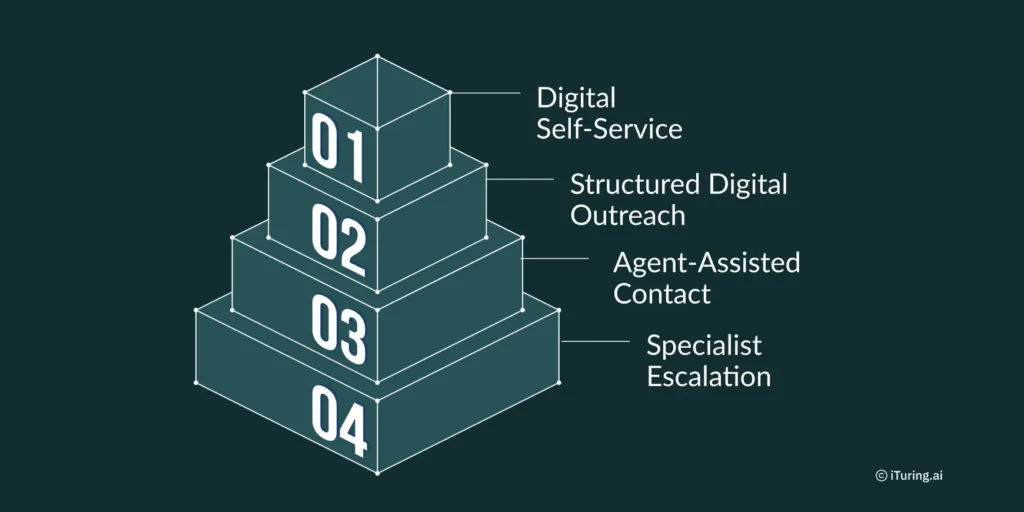
Digital Self-Service Treatment
Accounts with high pay propensity and high self-cure probability are either suppressed from active outreach entirely or receive a single low-friction digital reminder with a payment link. These are borrowers who are likely to pay independently, or who are within the month-end salary window and will act on a simple reminder without further intervention.
This treatment tier has the lowest cost per contact and preserves the borrower relationship by avoiding unnecessary calls and messages on accounts that will resolve without pressure. It also frees agent and digital contact capacity for accounts where intervention produces a genuine recovery lift.
Structured Digital Outreach
Accounts with mid-to-high pay propensity receive a WhatsApp or SMS sequence with a payment link, followed by escalation to voice contact if no response is received within a defined window. Message content is tailored to the account’s payment behaviour profile. A borrower with a long history of on-time payments who has missed a single instalment receives a different message tone and content from a borrower with a pattern of late payments and two prior broken PTPs.
Channel sequencing within this tier is driven by the borrower’s historical response data. A borrower who has never answered a voice call but has responded to WhatsApp in prior cycles receives WhatsApp as the lead channel regardless of the credit provider’s default contact strategy.
Agent-Assisted Contact
Accounts with mid propensity and a history indicating that a negotiated payment arrangement is the most likely resolution path are routed to a trained collections agent. Before the call is connected, the AI system pre-populates the agent’s screen with the account’s propensity scores, payment history, prior PTP record and fulfilment rate, contact history, and documented language preference.
The agent enters the conversation with full account intelligence rather than a bare account number and a balance. This reduces handle time, improves the quality of the arrangement conversation, and increases PTP fulfilment rates because the agent can reference specific account history in the negotiation rather than working from generic scripts.
Specialist Escalation
Accounts with low propensity, extended DPD, or active legal hold status are routed to a specialist collections team or referred into the legal process under NCA guidelines. The AI system handles the routing decision and generates the referral documentation. The specialist team or legal process handles the account from that point. AI contact attempts on these accounts cease at the point of referral.
NCA and POPIA Compliance in AI Collections
NCA and POPIA compliance is not a layer added on top of AI collections technology after the core system has been designed. It must be built into the architecture of the decisioning system from the ground up. Four specific compliance requirements directly shape how the technology works.
Debt Review Contact Suppression
NCA Section 86 prohibits enforcement action against a borrower once a debt review application has been made. In an AI collections system, compliance with this requirement means running a real-time check against debt review status at every contact trigger point. A static suppression list updated periodically is not sufficient. Debt review status can change between update cycles. The check must run at the moment each contact is generated, so that an account entering debt review between cycles is suppressed before the next contact attempt rather than after the next batch update.
NCR Registration and Operational Scope
Debt collectors operating under the Debt Collectors Act must be registered with the Council for Debt Collectors. AI systems that automate contact functions previously performed by registered collectors, or that generate contact on behalf of NCR-registered collectors, operate within a framework that intersects with these registration requirements. The credit provider’s legal and compliance team should confirm the specific governance configuration appropriate to their operating model before deploying AI contact automation.
POPIA Data Processing
Every data input used to train or score propensity models must be sourced, processed, and retained in compliance with POPIA. This includes credit bureau data, internal payment history, contact response data, and any third-party enrichment sources. Data processing records must be maintained and available to the information officer. The purpose for which each data source is used must be documented and consistent with the purpose for which the data was originally collected and consented to.
Contact Documentation for Consumer Protection
NCA’s consumer protection provisions require that collections contact is documented, transparent, and does not constitute harassment. AI collections systems must generate contact logs that record each contact attempt, the channel used, the message content or template reference, the time of contact, and the outcome. This log is the evidence base for any consumer complaint investigation, NCR audit, or consumer court proceeding. It must be retained in a format that the credit provider’s compliance team can access and produce on request.
Right-Party Contact Optimisation for SA Credit Providers
Right-party contact rate is the proportion of outbound contact attempts that reach the intended borrower at a moment when they can engage with the collections conversation. A contact attempt that reaches an unanswered line, reaches the borrower at the wrong moment, or reaches the wrong person entirely produces no recovery value and consumes contact capacity.
AI collections improves right-party contact rates for South African credit providers through three mechanisms.
Per-Borrower Timing Optimisation
Each borrower’s contact response profile is built from their historical interaction data: answer rates by channel, response rates by time of day, and response rates by day of week. The AI system uses this profile to select the contact window that maximises the probability of reaching this specific borrower. A borrower who consistently answers between 5pm and 7pm on weekday evenings should not receive a contact attempt at 10am because that is when the batch fired. A borrower who reliably pays within 48 hours of month-end salary credit should receive a payment link message at the appropriate point in that window, not a generic mid-month contact.
Language-Appropriate Routing
South Africa has 11 official languages plus widely used community languages. Contact in a borrower’s preferred language improves engagement and meets NCA’s plain language requirement for consumer credit communications. AI collections systems should route each contact to a language-appropriate message template based on the borrower’s documented language preference from prior interactions. A borrower whose interactions have consistently been in isiZulu should receive isiZulu-language contact. Applying English-language templates uniformly across a South African portfolio reduces engagement rates for a significant proportion of the borrower base.
Load-Shedding and Connectivity Awareness
South Africa’s ongoing electricity supply challenges affect mobile and data connectivity for many borrowers, particularly in township and peri-urban areas. Contact timing that accounts for typical load-shedding schedules in specific regions can improve right-party contact rates for affected borrower segments. A contact attempt sent during a scheduled outage in a specific area will fail to deliver if the borrower is offline. Scheduling that accounts for these windows, where regional load-shedding data is accessible, reduces failed delivery rates and improves the effective reach of the contact programme.
Better Information Before the First Contact Changes Every Contact After It
The collections supervisor who starts her Monday with a delinquency report and a balance-ordered queue is not making a poor decision given the information available to her. She is making the best decision she can with a report that does not tell her what she needs to know.
AI collections technology changes what she knows before she builds the queue. Which accounts are likely to self-cure. Which are in the debt review pipeline. Which borrowers respond to WhatsApp on Wednesday afternoons. Which accounts are in the month-end salary window. With that information organised and acted on automatically, the queue she builds is a different queue, directed at different accounts, through different channels, at different times.
The recovery outcomes from that queue are different too.
Five markers of a well-implemented AI collections programme for South African credit providers:
- Separate propensity scores for pay, respond, and self-cure, each driving a distinct routing decision
- Debt review status checked in real time at every contact trigger, not at the last batch update
- Treatment matrix that reflects NCA escalation constraints, NCR registration requirements, and POPIA data governance at the design stage, not as a post-deployment compliance review
- Contact logs generated natively at every attempt and retained for NCA consumer protection, NCR audit, and POPIA accountability requirements
- Per-borrower timing, language, and channel optimisation driven by historical response data rather than a uniform contact strategy
iTuring’s AI collections platform is configured for South African regulatory requirements, with real-time NCA debt review suppression, POPIA-compliant data processing, native contact log generation, and per-borrower contact optimisation built into the core decisioning architecture.