
TL;DR
- “Software” alone does not make it AI governance software: a real platform inventories every model, tiers it by risk, enforces approval, and produces evidence. Two quick tests separate that from a monitoring tool with a governance label added on.
- Five criteria carry the most weight: prediction-level explainability, governance of vendor-embedded models, configurable multi-tier approval, an audit trail that survives staff turnover, and lineage tracing back to the source data.
- The best questions come from a demo: ask a vendor to pull up an audit trail for a model decommissioned two years ago, or explainability for a single decision by itself.
- The same feature sheet hides very different products: two vendors can both claim “explainability” and “audit trail” while one demos it at the aggregate level and the other at the level of a single decision.
- The honest caveat: no checklist replaces a pilot. Criteria narrow the shortlist. Running real models through the platform for a few weeks is what confirms the rest.
Financial institutions shopping for AI governance software usually start with a feature list and end up comparing marketing pages that all use the same five words: explainable, audit-ready, governed, compliant, automated. The words do not tell you which platform tiers a model by risk and which one displays a list of models someone typed in manually.
This piece sets out the criteria that separate a real AI governance platform from a monitoring tool with a governance feature bolted on, the questions worth asking in a demo, and the red flags that show up there but never make it onto a comparison chart.
“AI governance software” gets marketed onto things that were not built for it
AI governance software is software built specifically to inventory, tier, monitor, and produce evidence for every AI model an institution runs, with policy enforcement built into the day-to-day workflow. A general MLOps platform, a BI dashboard, or a monitoring tool with a governance module added later can carry the same label in a sales deck without meeting that bar.
The confusion is not accidental. Governance is a growth feature for adjacent categories, and a vendor selling model monitoring or MLOps tooling has an incentive to describe the same product as AI governance software once a “policy” tab gets added to the interface. A buyer comparing feature sheets side by side sees the same checkmarks on both.
Two tests narrow the field fast:
- Does the product tier models by risk and route them to different levels of validation, or does it list every model in one flat inventory?
- Does it enforce an approval chain before a model change ships, or does it only show who approved something after the fact, in a log nobody checked before deployment?
A product that fails either test is a monitoring tool with a governance label attached.
The evaluation criteria that separate a real platform from a checkbox tool
Five criteria do the most work when comparing AI governance software: prediction-level explainability, governance that extends to vendor-embedded models, a configurable multi-tier approval chain, an audit trail immutable enough to survive staff turnover, and lineage tracing that runs back to the source data. A platform missing two or more of these is worth a harder look before it goes on the shortlist.
- Explainability at the level of a single prediction. A feature-importance chart for the model as a whole tells an examiner nothing about why one specific loan was denied. The software has to explain individual decisions, on demand.
- The same governance standard for vendor-embedded models. A model your team never built, sitting inside a vendor’s software, still carries the same regulatory exposure as one built in-house. Governance software that only tracks internally built models leaves a real gap.
- Configurable, multi-tier maker-checker approval. A single sign-off field is not an approval chain. A credit decisioning model and a low-risk internal tool should not route through the same one-step process.
- An audit trail immutable enough to survive the person who built the model leaving. Who approved a model, on what evidence, and under what conditions has to be retrievable years later, independent of whether that engineer still works there.
- Lineage tracing back to the source data. When a model’s output looks wrong, the platform should trace the decision back through the data that produced it. Flagging that a metric moved is not enough on its own.
Questions worth asking in a demo, before the contract is signed
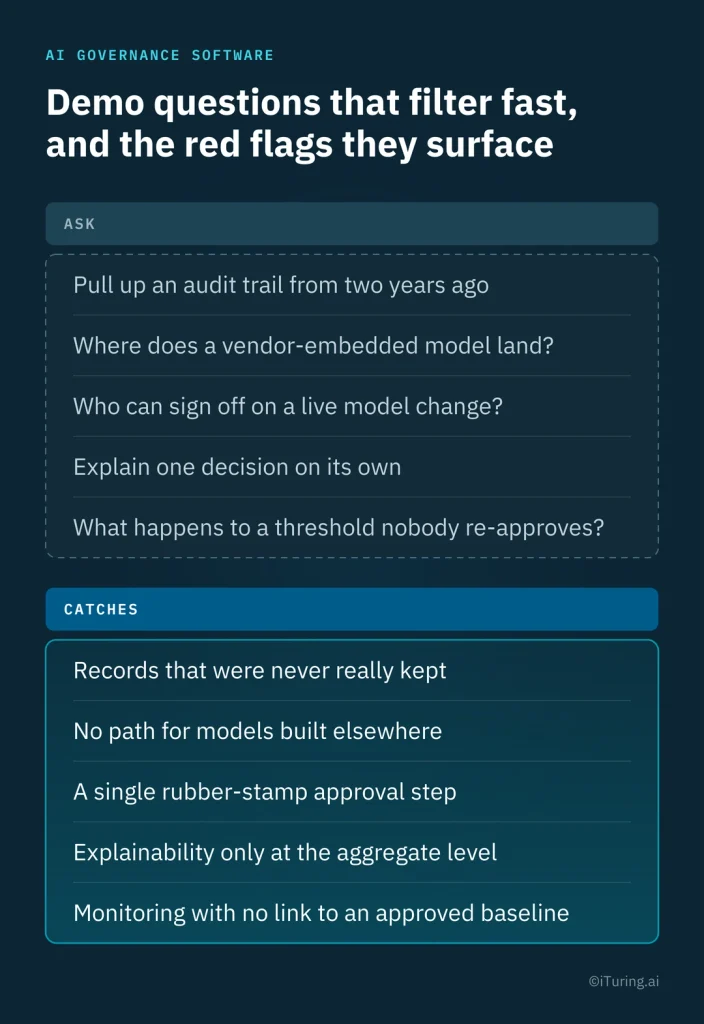
A demo answers questions a feature sheet cannot. A vendor has to show the mechanism live, with the product open. Five questions do most of the filtering.
- “Pull up the audit trail for a model your team decommissioned two years ago.” A real platform retrieves it in seconds. A newer or thinner product struggles.
- “Walk me through what happens when we buy software with an embedded AI model inside it. Where does that model land in your inventory?”
- “Show me the approval chain for a change to a model already in production, and tell me whether I can configure who sits on it.”
- “Pull up explainability for one specific decision, by itself.”
- “What happens to a monitoring threshold if nobody re-approves it for a year? Does it silently keep running against a stale baseline, or does the system flag it?”
A vendor who answers all five in the room, with the product open, has usually built the thing. A vendor who redirects to a roadmap slide has not.
Red flags that show up in a demo but never make it onto a feature sheet
A feature sheet can claim explainability, audit trail, and governance without any of them working the way a buyer assumes. The gap only shows up once someone is in the room asking for a live example.
- Explainability demoed only at the aggregate or model level, never for a single prediction.
- A model inventory that has to be manually re-synced, with no automatic update when a new model deploys.
- A monitoring dashboard full of metrics with no link back to the threshold a model was approved under.
- No stated path for bringing a vendor-embedded or externally built model into the same governance flow as an in-house model.
- An approval workflow that turns out to be a single sign-off field on a form, with no configurable multi-tier chain behind it.
Where iTuring’s platform fits against this checklist
iTuring covers all five criteria through three modules built to work together as one governance layer. Data Accelerator carries lineage from source to decision across more than 25,000 pre-built financial signals. AutoML+ runs models through a structured competition process with prediction-level explainability built into that process from the start. Model Gov handles the rest: a configurable maker-checker chain, an immutable record of who approved what, and the same tiering and evidence standard for a vendor-embedded model as for one built in-house.
One iTuring client, a leading NBFC in India, ran this stack end to end and shipped a governed model into production in two weeks, with a 116% improvement in collections recovery, 86% predictive accuracy, and an audit trail intact from the day it went live.
This piece sits inside iTuring’s AI Governance content, alongside the full breakdown of what an AI governance solution has to cover as a category. A build-versus-buy comparison for this category is next in the cluster. Book a working session with iTuring to run your own model inventory against these five criteria.
Sources
- Improve Collections and Optimize Efforts (case study), iTuring.ai. https://ituring.ai/case-study/improve-collections-and-optimize-efforts/
- AI Governance Solutions for Regulated Financial Institutions: What the Category Covers, iTuring.ai, 2026. https://ituring.ai/ai-governance-solutions/