
TL;DR
- Two different jobs: an AI governance solution is software that inventories, tiers, monitors, and evidences your AI models. The policy work, deciding what your institution will and won’t do with AI, still belongs to your board and risk committee.
- Six things a real solution has to cover: model inventory, risk tiering, ongoing monitoring, an audit trail, vendor and third-party AI risk, and policy enforcement built into the workflow. Anything short of that list is a partial tool.
- The document banks used to check against is gone: SR 11-7, the Federal Reserve’s 2011 model risk guidance, was rescinded in April 2026. The institution buying the tool now owns the evaluation criteria a regulator’s checklist used to hand over.
- A spreadsheet and a policy binder run out of road fast: manual inventory tracking breaks down once an institution passes a few dozen models, usually well before anyone notices it happening.
- The honest caveat: no platform decides your institution’s risk appetite or writes your policy for you. It automates the evidence trail behind that policy, so none of it has to be reconstructed at exam time.
“AI governance solutions” is a crowded search term because two different things get sold under it. One is software: model inventory, tiering, monitoring, and an audit trail. The other is consulting or policy work: writing the rules for what your institution will and won’t let AI do. Buying one when you meant the other is how a bank ends up examination-ready on paper and unable to produce evidence when an examiner asks for it.
This piece works through what the software category has to cover to earn the name, why the ground under model risk evaluation shifted earlier this year, and where iTuring’s own platform, Data Accelerator, AutoML+, and Model Gov, fits against that checklist.
“AI governance solution” and “AI governance policy” mean two different things
An AI governance solution is software that tracks every AI model your institution runs, tiers it by risk, monitors it after deployment, and keeps an evidence trail an examiner can pull. An AI governance policy is the set of decisions the software enforces: what your institution allows, who signs off, what triggers escalation. One doesn’t stand in for the other.
Vendors sell both under the same search term, and buyers sometimes assume the software will write the policy for them. It won’t. A governance platform can enforce a maker-checker approval step, but a person still has to decide what counts as a high-risk model at your institution and who sits on the approval chain. Skip that decision and the software has nothing to enforce.
The confusion runs the other way too. A policy document, however well written, produces no evidence on its own. It states intent. An examiner asking for proof of monitoring wants a record they can pull up on the spot. A paragraph promising that monitoring happens somewhere does not count as evidence.
Picture a bank that bought a governance platform to satisfy an examiner and also hired outside counsel to write an AI policy. The platform tracks models and produces logs. The policy sets the rules for what the bank will approve and who signs off on it. Each piece does its own job, and a bank that expects the software to generate the policy, or expects the policy to produce its own evidence trail, still has a gap an examiner will find on the next exam.
What an AI governance solution has to cover, at minimum
Six components separate a real governance solution from a partial tool: a model inventory covering every AI system in production, risk tiering that sets validation and monitoring intensity by impact, ongoing monitoring against the thresholds set at approval, an audit trail that survives staff turnover, vendor and third-party AI risk management, and policy enforcement built into the day-to-day workflow.
- Model inventory, including the AI nobody bought on purpose. A complete inventory covers models your team built, models embedded in vendor tools, and generative AI employees adopted on their own, often called shadow AI. A spreadsheet someone updates when they remember is a snapshot from whenever it was last touched, and it ages fast.
- Risk tiering that changes what happens next. A credit decisioning model and a grammar checker carry different risk, and a real solution routes each to a different level of validation and monitoring automatically. Treating every model the same, or leaving the tier as a label nobody acts on, defeats the point of tiering in the first place.
- Monitoring measured against the thresholds set at approval. Drift detection and performance tracking only mean something when they’re read against the specific baseline a model was approved under. A dashboard showing metrics with no approved threshold behind them is a chart, and a chart is not evidence of monitoring.
- An audit trail that survives the person who built the model leaving. Who approved a model, on what evidence, and under what conditions has to be retrievable months or years later, independent of whether the engineer who built it still works there.
- Vendor and third-party AI risk, extended to the models you didn’t build yourself. A governance solution has to hold AI embedded in vendor software to the same tiering, monitoring, and evidence standard, since a regulator does not distinguish between a model your team wrote and one a vendor sold you.
- Policy enforcement built into the workflow people already use. The escalation rules, approval chains, and prohibited-use boundaries a policy sets down only matter if the software routes work through them. A policy that lives in a document separate from the tools people use is a policy nobody follows under deadline.
The document banks used to evaluate against doesn’t exist anymore
On 17 April 2026, the Federal Reserve, the OCC, and the FDIC jointly rescinded SR 11-7, the 2011 guidance that gave US banks a specific checklist for model risk management. Its replacement, SR 26-2 and OCC Bulletin 2026-13, sets no enforceable standard and explicitly excludes generative and agentic AI models from scope. Our full breakdown of what changed and what it means for ongoing monitoring covers the rescission in depth.
For a buyer evaluating solutions, there is no longer a single document to hold a vendor’s feature list against and call the comparison done. An examiner still expects the six components above to be demonstrated, letter or no letter, regardless of what any single piece of guidance requires. A solution that only checks boxes against a specific rescinded document is evaluating against a target that moved.
Where a spreadsheet inventory and a policy binder stop working
Most institutions start AI governance with a spreadsheet inventory and a written policy, and both work fine at three or four models. The wheels come off somewhere between ten and thirty, usually well before anyone in the building notices it happening.
Nobody remembers to add a model a business unit deployed without routing it through the intake process. Risk tiers assigned at launch never get re-scored as a model’s use expands, so a model that started as a low-risk pilot can end up making high-stakes decisions under a tier nobody revisited. An examiner’s document request turns into a week of reconstructing history from engineering tickets, email threads, and whoever still remembers the project, because nothing was captured as evidence at the time it happened.
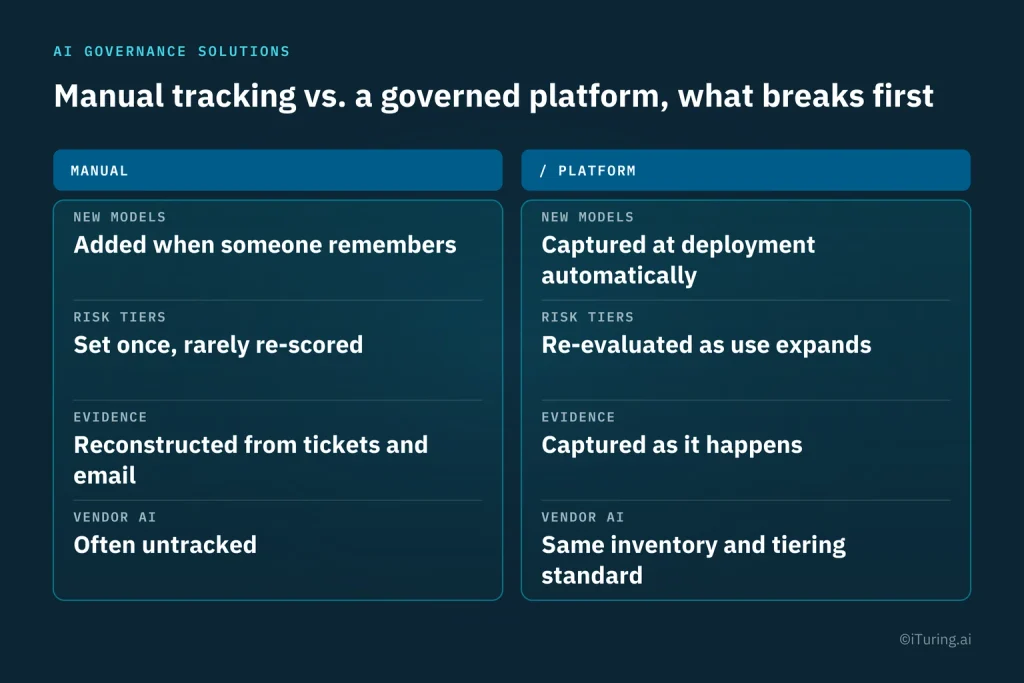
The failure is rarely dramatic. It is a spreadsheet with one stale row, a policy binder nobody has opened since it was written, and a monitoring dashboard that shows numbers with no approved threshold behind them. None of that shows up until an examiner, or a bad model, forces the question.
How iTuring’s platform maps to each building block
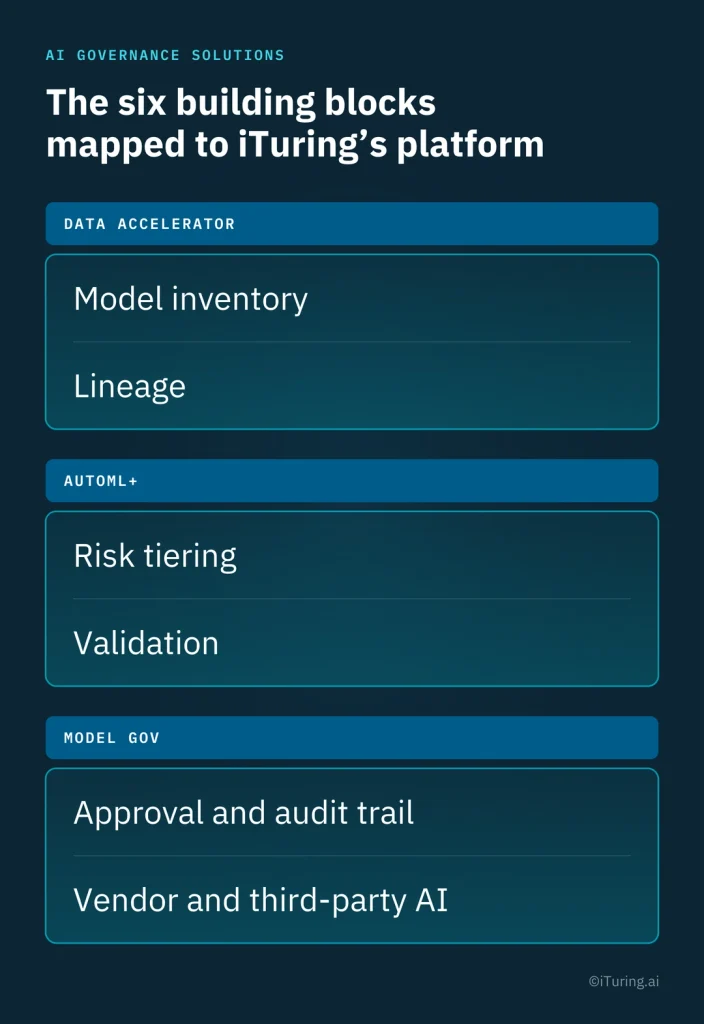
iTuring covers the six components above with three modules working together: Data Accelerator for inventory and lineage, AutoML+ for tiered validation, and Model Gov for maker-checker approval and an immutable audit trail. Coverage doesn’t stop at deployment. Monitoring runs continuously against the thresholds set at approval.
Inventory and lineage. Data Accelerator tracks every model’s data lineage from source to decision, with more than 25,000 pre-built financial signals already mapped, so a model built on top of them starts with documented lineage already in place.
Tiering and validation. AutoML+ runs models through a structured competition process with audit-grade explainability built in. Risk tiering and validation happen inside that build process, at the moment a model is created.
Approval and the audit trail. Model Gov routes every model change through a configurable maker-checker chain. The person building a model is never the person who clears it for production. The system captures an immutable record of who approved what, on what evidence, and under what monitoring thresholds, so audit preparation that used to take weeks of reconstruction becomes a records pull.
Vendor and third-party models. Model Gov’s inventory and approval workflow cover models regardless of where they were built: iTuring’s own platform, Python, SAS, or a third-party vendor tool. A vendor-embedded model gets the same tiering and evidence standard as one built in-house.
That structure is what let one client, a leading NBFC in India, ship a governed model into production in two weeks, with a 116% improvement in collections recovery and 86% predictive accuracy, and an audit trail intact from the first day it went live.
This piece is part for iTuring’s AI Governance content. The SR 11-7 rescission and what it means for ongoing monitoring gets the full breakdown separately. Later pieces in this cluster cover how to evaluate AI governance software as its own category, what a model governance program needs beyond the technology itself, and how the leading data governance frameworks for AI models compare against each other. Book a working session with iTuring to see how the platform maps against your own model inventory.
Sources
- SR 26-2: Revised Guidance on Model Risk Management, Board of Governors of the Federal Reserve System, 17 April 2026. https://www.federalreserve.gov/supervisionreg/srletters/SR2602.htm
- Model Risk Management: Revised Guidance, OCC Bulletin 2026-13, Office of the Comptroller of the Currency, 17 April 2026. https://www.occ.gov/news-issuances/bulletins/2026/bulletin-2026-13.html
- SR 11-7: Guidance on Model Risk Management, Board of Governors of the Federal Reserve System, 4 April 2011 (rescinded 17 April 2026). https://www.federalreserve.gov/supervisionreg/srletters/sr1107.htm
- Improve Collections and Optimize Efforts (case study), iTuring.ai. https://ituring.ai/case-study/improve-collections-and-optimize-efforts/