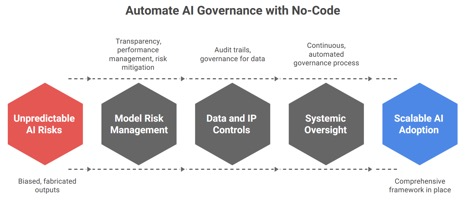
Gen AI governance fails in the gap between a policy document and a system that enforces it. For US financial institutions, a top-down committee and manual checks do not scale across many models, each able to produce biased or fabricated output. A no-code platform closes the gap by automating the core governance pillars, model risk management, data and IP controls, and systemic oversight, so the policy becomes something the infrastructure enforces on every decision in real time.
The promise of generative AI is everywhere, but for leaders in US financial services, the reality is far more complicated. While the C-suite is setting bold policies for responsible AI use, the technology teams are struggling to translate those abstract principles into a tangible reality. The gap between a well-intentioned governance document and a scalable, auditable system is where risk lives.
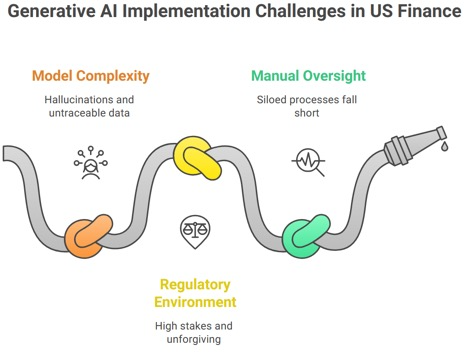
This isn’t a theoretical problem; it’s a high-stakes challenge amplified by an unforgiving US regulatory environment. The AI models are complex, they can “hallucinate” or produce fabricated output, and their reliance on vast, often untraceable, data sets create immense legal and reputational risk. The old ways of managing this risk by relying solely on manual oversight and complex, siloed processes, simply falls short.
This is the very problem our platform, iTuring.ai, was built to solve. We believe that robust governance isn’t a checklist; it’s a built-in feature of your AI infrastructure.
From Manual Oversight to Automated Management
Manual AI governance relies on a top-down committee and a series of checks, which works for a handful of simple models but breaks down across an enterprise running many complex ones. Automated governance shifts that burden to a system that monitors, audits, and manages the whole AI portfolio in real time, so oversight keeps pace as the model estate grows.
The traditional approach to AI governance often involves a top-down oversight committee and a series of manual checks. This may have worked for a handful of simple AI models, but it’s not scalable when you have many AI models across the enterprise and many of those models have multi-layered complexity.
Our no-code platform provides the critical bridge between the governance policies and their practical application. It shifts the burden from a single committee to an automated system that can monitor, audit, and manage your entire AI portfolio in real-time. This dynamic oversight ensures that as your AI ecosystem grows, your governance capabilities keep pace.
Automating the Core Pillars of Gen AI Governance
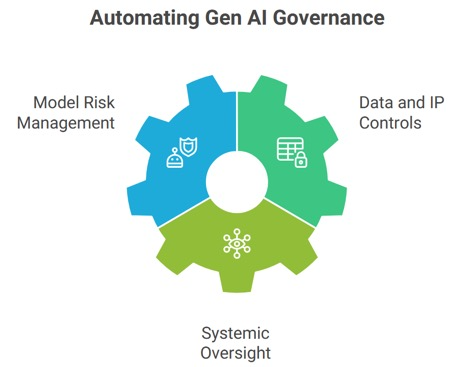
A bank’s Gen AI governance framework covers three areas: model risk, data and IP, and systemic oversight. A no-code platform automates each one, turning the written policy for that area into a control that runs on every model without a manual review step.
A bank’s AI governance framework address areas related to risk, data, and compliance. Here’s how a no-code platform can automate these functions, making your policies actionable:
Model Risk Management (MRM)
The most significant risk with generative AI is its unpredictability. Models can produce biased or fabricated outputs, creating legal and ethical landmines. Our no-code platform provides built-in Model Risk Management and Explainable AI capabilities that address these challenges head-on. It provides transparency to see how a model arrived at a decision and the tools to manage its performance and mitigate risks.
Data and IP Controls
Generative AI models are trained on massive datasets, creating complex legal liabilities around data privacy and intellectual property. Manually tracking the origin and use of every data point is impossible. Our platform automates these controls by establishing clear audit trails and governance for every piece of data used in model development. It gives you the ability to ensure data is used correctly, reducing the risk of a lawsuit or a regulatory penalty.
Systemic Oversight
A single committee cannot oversee every AI initiative across a large organization. By embedding governance directly into the platform, the bank can create a system where oversight isn’t an occasional event, it’s a continuous, automated process. This facilitates AI adoption across the enterprise with confidence, knowing that a comprehensive framework is in place to manage everything from a simple predictive model to a high-stakes generative AI application.
What Ties Automated Gen AI Governance Together
The piece that makes automated governance hold is a single auditable system of record across all three pillars. When model risk, data controls, and oversight report into one place, a bank can show a regulator the whole AI portfolio’s governance state at any moment, and does not have to assemble it by hand from siloed processes.
For too long, the conversation around automating AI governance has been stuck in the boardroom. It’s time to bring that vision to life. iTuring.ai no-code platform not only makes model development faster and easier, but also enables embedding of the high-level governance policies into the model development process thus ensuring that the processes and practices are auditable, scalable, and effective.
It’s the final piece of the puzzle that allows a bank to unlock the power of ML models and generative AI and be confident about ensuring its AI governance policies is being executed diligently across the enterprise.