
TL;DR
- What it is: Customer churn prediction in retail banking has to catch customers quietly reducing their relationship with the bank, alongside the ones closing an account outright.
- The real signal: A redirected direct deposit or falling app engagement usually says more than a formal closure ever will.
- Why one label doesn’t work: Checking, credit cards, and personal loans churn differently, and a model built on one product’s definition misses the other two.
- What triggers it: Fees, service friction, and life events are documented triggers, not guesses.
- Why it has to run at scale: retail’s volume means no relationship manager can watch every account the way a commercial banker watches a portfolio.
- Honest caveat: predicting the risk doesn’t retain the customer. Only a matched, timely response does.
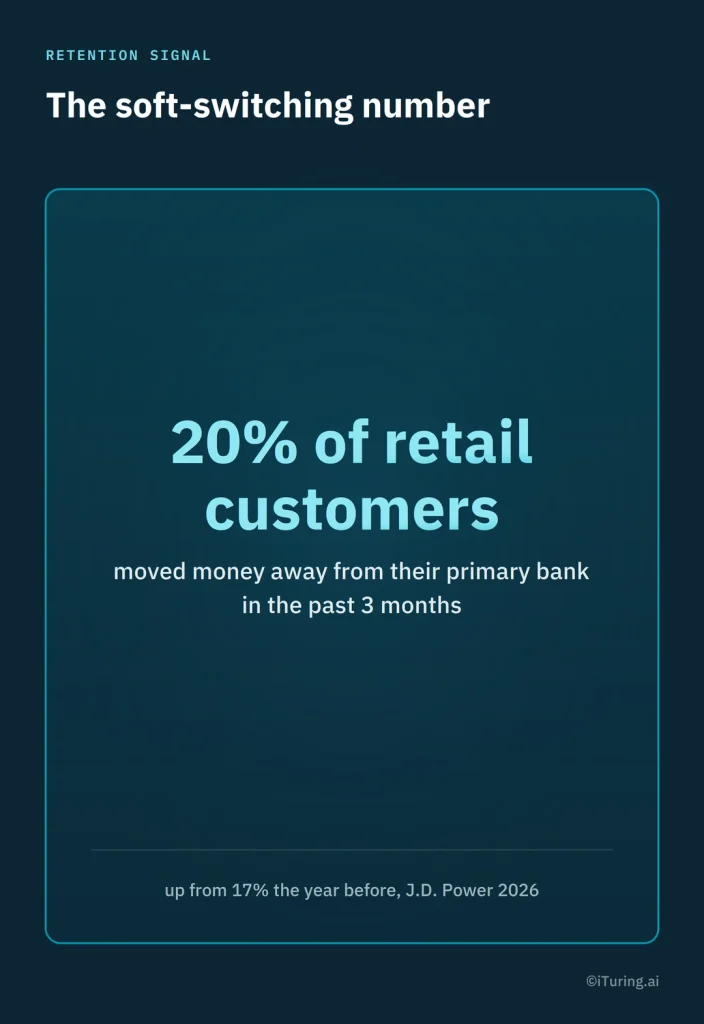
Ask a retail bank how many customers it lost last quarter, and most will pull up a report of closed accounts. That number is real. It is also increasingly beside the point. J.D. Power’s 2026 U.S. Retail Banking Satisfaction Study found that 20% of retail bank customers moved money away from their primary bank in the past three months, up from 17% the year before, while keeping the account open. The industry has a name for this now: soft switching.
Customer churn prediction in retail banking has to catch this kind of loss on top of the closure a core banking system already reports. That means treating churn as a spectrum: a customer moving a salary deposit elsewhere, letting a credit card go inactive, or quietly building a bigger balance at a second bank are all forms of leaving that a closure-only model misses entirely.
This piece stays scoped to retail: checking and savings accounts, credit cards, and personal loans, the products a household actually holds, and the behavioral signals specific to each one. The broader mechanics of building and validating a churn model and the business case for churn scoring across banking and insurance are covered separately.
What silent attrition means for a retail bank’s churn number
Silent attrition, also called soft switching, is when a retail customer keeps an account open but stops using it as their primary bank, redirecting salary deposits, bill payments, or everyday spending elsewhere. J.D. Power’s 2026 study put this at 20% of retail customers in the past three months, up from 17% a year earlier.
That definition matters because a closed-account model would never catch it. The account stays open, sometimes for years, holding a small balance while functioning as a backup rather than a primary relationship. Direct deposit is usually the clearest tell. Once a paycheck lands somewhere else, mobile logins, debit card use, and bill pay tend to follow it there within months.
The customers most likely to do this are not the ones a collections team would flag as at risk. J.D. Power found customers under 40 (23%), mass-affluent customers (25%), and financially healthy customers (24%) were the most likely to have moved money away in the past three months, ahead of financially vulnerable customers. The bank’s own assessment of the pattern is direct: the risk is not immediate attrition, it is gradual erosion of share of wallet.
That reframes what a retail bank should actually be modeling. Predicting who will close an account catches the customers already gone. Predicting who is quietly reducing their share of wallet catches them while there is still a relationship left to save.
Why checking, cards, and personal loans need different churn definitions
Churn means something different for each retail product. Checking and savings churn as a balance drawn down to near zero. Credit cards churn as usage that quietly stops, often long before a formal closure. Personal loans do not churn the same way at all, since they amortize to zero on schedule regardless of relationship health.
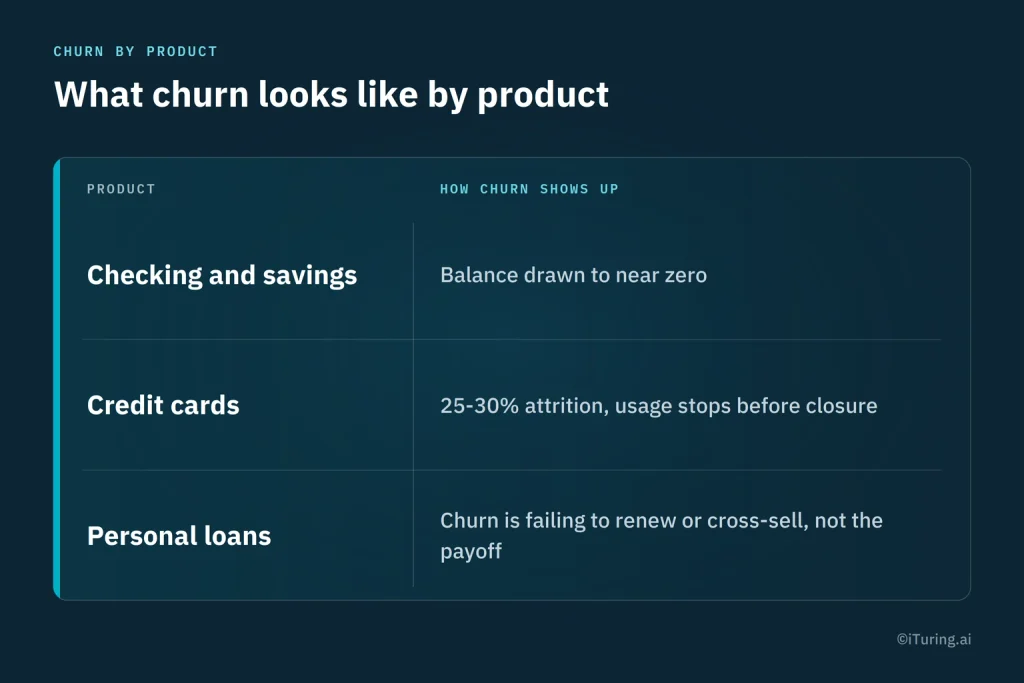
Checking and savings. A closed account is only one kind of loss. A balance that drifts toward zero over several months, alongside falling transaction counts, is the more common and more reversible version of the same problem.
Credit cards. Contract-bound products like mortgages and CDs keep customers for years, with attrition in the 5% to 7% range, according to UXPressia’s benchmark data. Cards see far more turnover, reaching 25% to 30%, since a customer can simply stop using a card without ever calling to close it.
Personal loans. A personal loan matures to zero whether the relationship is healthy or not, so the churn event isn’t the loan itself. It’s whether the customer takes the next product. A loan that pays off with no renewal or cross-sell is where retail banking quietly loses the relationship, one product at a time.
A single churn label applied across all three products either overstates card risk or misses it entirely on checking, since the two behave nothing alike.
The behavioral signals that catch it early
The clearest early signal is a direct deposit that stops landing or shrinks in size, usually the first sign a paycheck has moved elsewhere. Falling mobile app logins, declining bill-pay activity, and a shrinking transaction count round out the picture, each one a proxy for a primary relationship that is quietly ending.
Direct deposit. The single strongest signal of primary-relationship status. A redirected or reduced deposit tends to lead every other change in behavior, not follow it.
Digital engagement. Mobile app login frequency and digital service enrollment substitute for the judgment a relationship manager would otherwise apply. A retail customer rarely talks to a banker, so the app is where the relationship actually shows up.
Transaction and balance trend. Falling ATM, card, and check activity, measured against that same customer’s own recent history rather than a population average, catches the slow drift a single month’s snapshot would miss.
What triggers churn in the first place
Fees, service friction, and life events are the three documented triggers behind most retail churn. A 2015 FICO survey found 45% of customers aged 25 to 34 named high fees as a reason for leaving their bank. Rivel’s 2025 research found life events, a new job, a marriage, a home purchase, are consistent switching triggers across every age group surveyed.
Fees. Fee sensitivity skews younger. FICO’s survey found customers aged 25 to 34 were two to three times more likely than other age groups to close every account with their primary bank, with high fees the most cited reason.
Service friction. UXPressia’s research names poor service as the single most cited reason customers give for leaving a bank, ahead of pricing or product fit.
Life events. Rivel found a career or job change drove switching for 37% of Millennials and 32% of Gen Z, marriage for 32% of Millennials, and a home purchase for 24% of Millennials and 27% of Gen X. A life event is a predictable moment to intervene, not a surprise.
Why this has to run at retail’s scale, not a relationship manager’s judgment
Retail banking churns customers by the millions, at low individual value, with no one able to review each account the way a relationship manager reviews a portfolio of commercial clients. Commercial and SME churn gets caught by a banker noticing a pattern. Retail churn only gets caught by a model, because there is no banker watching that closely.
iTuring’s Data Accelerator draws on transaction, digital engagement, and servicing signals with full lineage back to source, giving a retail churn model the breadth of behavioral data an individual analyst could never assemble by hand. AutoML+ selects a champion model based on how well it separates customers actually reducing their relationship, not on raw accuracy, and Model Gov’s maker-checker approval keeps a record of every model and label change, the same evidence a model risk function will ask for regardless of which product line the score is applied to.
iTuring’s own growth-and-retention deployments, which run this kind of scoring across banking and insurance clients, show a 29% reduction in churn and lapse.
If your retail churn dashboard only tracks closed accounts, it’s missing the customers already halfway out the door. Book a working session with our data science team to see what a share-of-wallet model would catch that your current one doesn’t.
Sources
- J.D. Power, 2026 U.S. Retail Banking Satisfaction Study, 2026. https://www.jdpower.com/business/press-releases/2026-us-retail-banking-satisfaction-study/
- UXPressia, “Customer Churn Measurement in Banking: Preventing Customer Loss,” 2026. https://uxpressia.com/blog/how-to-approach-customer-churn-measurement-in-banking
- FICO, survey via PR Newswire, “Millennials 2 to 3 Times More Likely to Switch Banks,” 2015. https://www.prnewswire.com/news-releases/fico-survey-millennials-2-to-3-times-more-likely-to-switch-banks-300312393.html
- Rivel Banking Research, “Banking on Life: How Life Events and Generational Differences Shape Financial Decisions,” April 2025. https://www.rivel.com/banking-research/why-customers-switch-banks
- iTuring platform pages: Data Accelerator, AutoML+, Model Gov; and Growth & Retention use case page (29% reduction in churn and lapse), confirmed by direct fetch 2026-09-21. https://ituring.ai/platforms/open-data-accelerator/, https://ituring.ai/platforms/automl/, https://ituring.ai/platforms/model-gov/, https://ituring.ai/use-cases/growth-retention/