
Two Borrowers in Identical Distress Shouldn’t Get Different Outcomes Because They Reached Different Agents
TL;DR
- Manual hardship identification depends on individual agent judgment, and identical borrowers routinely get different outcomes depending on which agent, and which day, they happen to reach
- Regulators expect consistent, timely access to hardship programmes, and inconsistency itself is the exposure, not just an outright denial
- AI hardship signals, payment pattern change, contact behaviour shifts, engagement with prior offers, can route a borrower to forbearance, modification, or a payment plan faster than manual triage
- The routing decision needs its own documentation trail, showing what signals were present and why a specific programme was selected, not just that a programme was eventually offered
- Fast, consistent hardship routing reduces both compliance exposure and customer attrition, since a borrower routed to the wrong programme, or routed too slowly, is a borrower more likely to be lost entirely
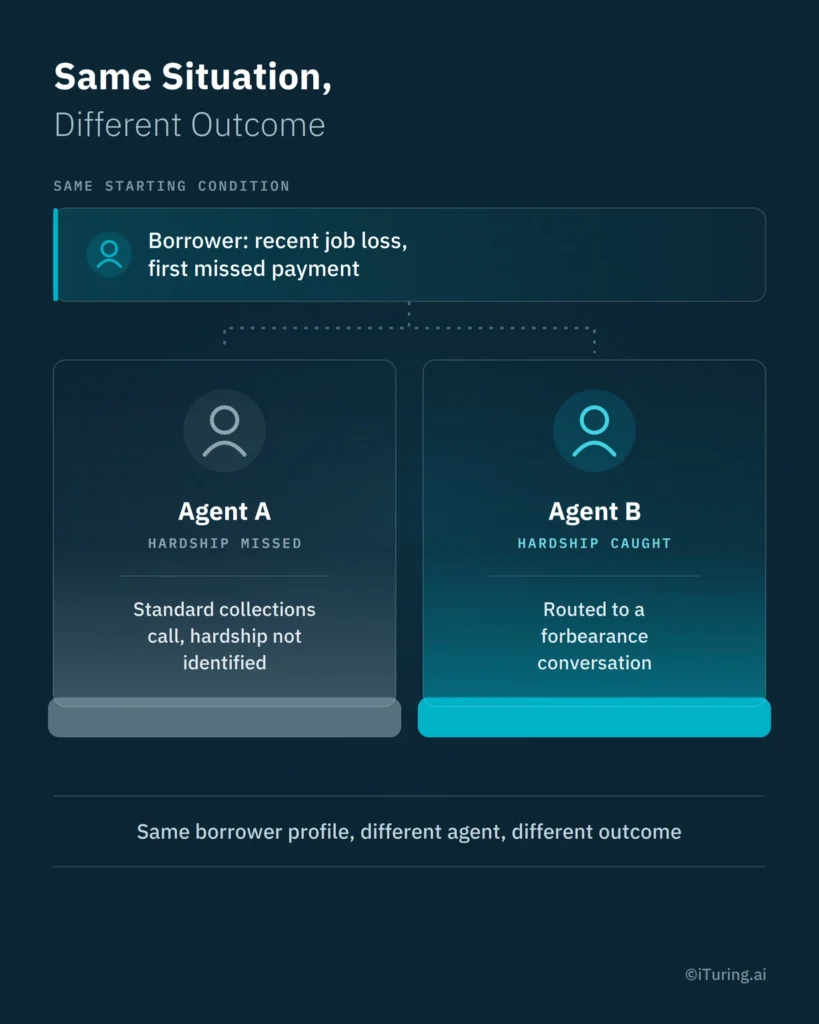
A borrower calls in genuinely struggling. Depending on which agent picks up, on their training, their caseload that day, their read of an ambiguous situation, that borrower gets routed to a forbearance conversation, a payment plan pitch, or nothing more than a generic “we’ll note that.” Two borrowers in materially the same situation get materially different outcomes, and the only variable is who answered the phone.
That inconsistency isn’t just an operational quality problem. It’s the exact pattern regulators look for when assessing whether hardship programme access is genuinely available, or only available to borrowers lucky enough to reach the right agent.
Why Manual Hardship Identification Creates Inconsistent Outcomes
Hardship identification through a manual process depends on an agent recognising the signal in real time, during a live call, often while also handling the standard collections conversation. Agents vary in training, experience, and how they interpret ambiguous cues, a borrower who mentions a job loss in passing gets a different response depending on whether the agent catches it and knows what to do next.
This isn’t a training problem that better scripts fully solve. It’s a structural limitation of asking a human to reliably catch and correctly route a signal, live, on every call, across every agent, every day. The inconsistency isn’t a failure of any individual agent. It’s the expected outcome of a process built entirely around individual judgment in the moment.
What Signals Actually Predict Genuine Hardship vs Routine Delinquency
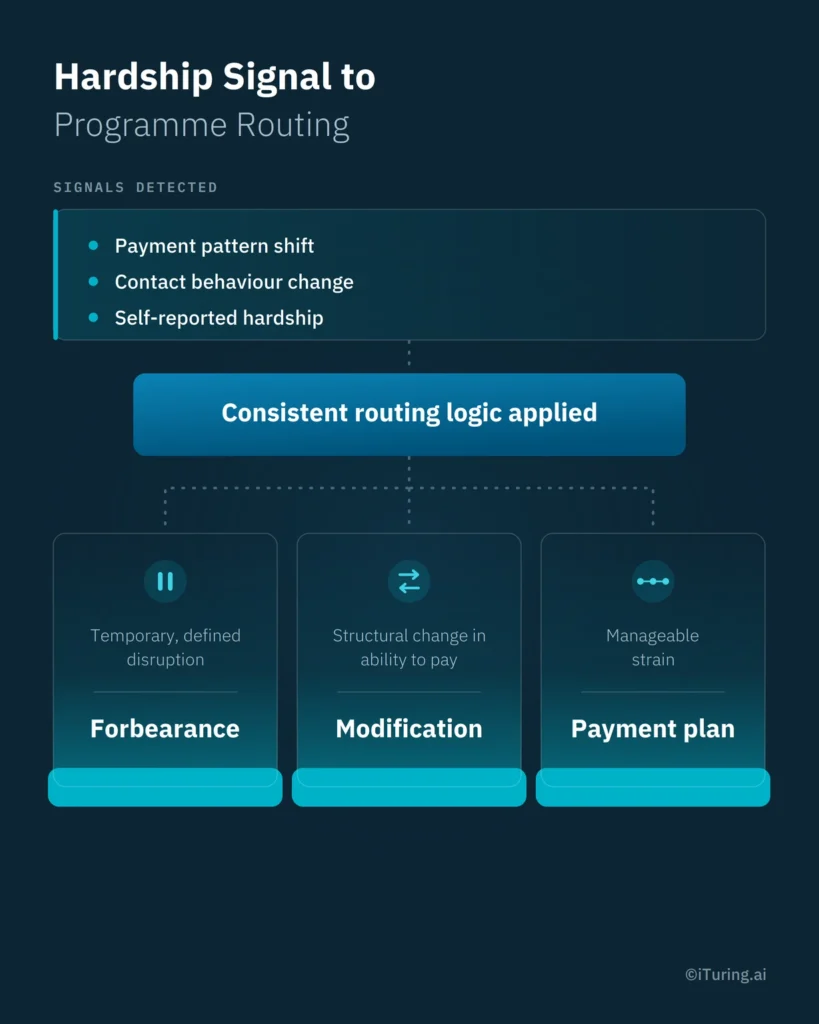
Hardship detection improves when it stops depending entirely on what a borrower says on a call and starts incorporating what the account data shows. A sudden change in payment pattern following a period of consistent on-time payment reads differently than chronic, gradual drift. Contact behaviour matters too: a borrower who becomes suddenly unresponsive after a long history of engagement is signaling something different than a borrower whose contact pattern hasn’t changed at all.
Prior engagement with offers is itself a signal. A borrower who previously accepted and maintained a payment plan, then fell off it, is in a different position than one who’s never engaged with any offer at all. None of this replaces what the borrower says directly, self-reported hardship still matters, but it adds a layer of detection that doesn’t depend entirely on a single conversation going well.
Building the Routing Logic: Forbearance vs Modification vs Payment Plan
Once hardship is identified, the routing decision itself benefits from consistency. A temporary, well-defined income disruption points toward forbearance. A more structural change in ability to pay points toward modification. A borrower experiencing manageable but real strain may be best served by a straightforward payment plan rather than a more involved programme that adds friction without adding benefit.
Building this as decision logic, rather than leaving it to individual agent judgment case by case, means every borrower with a similar profile gets routed the same way, and that routing can be reviewed and improved as a system rather than coached agent by agent.
Documenting the Decision for Examination Readiness
The routing decision needs a record that shows what signals were present and why a specific programme was chosen, not just a note saying a programme was offered. This matters for two audiences at once: an examiner assessing whether hardship access was applied consistently across the portfolio, and the institution’s own ability to review and improve its routing logic over time.
A documentation standard built this way also protects the borrower relationship. If a routing decision is later questioned, whether by the borrower, a regulator, or an internal audit, a system that can show its reasoning stands on much firmer ground than one that can only show an outcome.
The Retention Case for Fast, Accurate Hardship Routing
Compliance risk isn’t the only cost of getting this wrong. A borrower who’s genuinely distressed and doesn’t get routed to the right programme quickly is a borrower more likely to be lost entirely, either to default or to simply disengaging from the institution. Fast, accurate routing is a retention mechanism as much as a compliance one: the borrower who gets the right offer at the right moment is far more likely to stay a customer than one who falls through the gap between a generic collections call and the hardship programme that could have helped.
Where iTuring Fits
iTuring’s Agentic AI and Collections & Recovery modules build hardship detection into the standard scoring pipeline rather than depending on it being caught live during a call. Routing logic runs consistently across the portfolio, and every routing decision generates its own documented reasoning automatically, so the record exists whether or not anyone goes looking for it later.
Sources
- CFPB supervisory guidance on loss mitigation and hardship programme access (general regulatory framework, verify current specific guidance at time of publication)
- Industry data on hardship programme engagement and retention outcomes (source specific figures at drafting if included in final copy)