
TL;DR
- Model governance covers inventory, approvals, change management, and retirement
- Most US banks have partial coverage across these four areas, not complete coverage
- Vendor-hosted and self-learning models are the most common inventory gaps
- Material versus minor change definitions must exist before any model goes live
- Board reporting on AI collections governance is a documented OCC examination requirement
Who owns your AI collections propensity model?
Who approved the last parameter update, and where is that approval documented? When the model retrains next month, who decides whether that constitutes a material change requiring full revalidation or a routine update that can proceed under expedited review? If your collections AI includes agents hosted by a third-party vendor, are those models in your institution’s model inventory?
These are not trick questions. They are the questions OCC and Federal Reserve examiners ask during model risk management reviews of banks running AI collections systems. And for a significant number of institutions, the honest answer to at least one of them is: we are not entirely sure.
That uncertainty is what model governance is designed to eliminate. Governance is not the same as validation, and it is not the same as monitoring. Validation assesses whether a model works. Monitoring tracks whether it continues to work. Model governance is the institutional infrastructure that determines who owns the model, who authorizes changes to it, how its lifecycle is tracked from deployment through retirement, and what the board knows about all of the above.This article covers what a complete, examination-ready governance framework looks like in practice.
The Four Components of AI Collections Model Governance
SR 26-2 describes model risk management as supported by clear policies and effective controls. It says it is common industry practice to maintain a comprehensive inventory of models under development or in use, that adequate documentation supports effective model risk management, and that model risk management benefits from clear roles and responsibilities with well-defined accountability. The guidance is non-binding and expected to be most relevant to banks with over $30 billion in total assets.

Those requirements map to four distinct operational components of a complete ai model governance program. Most US banks have built meaningful capability in one or two of them. Very few have all four operating systematically for their AI collections portfolio.
Model inventory. A complete, maintained record of every model in use, including its purpose, owner, validation status, deployment date, tier classification, and risk assessment.
Approval workflows. Documented, enforceable processes governing who must review and authorize a model before initial deployment, before any material change, and before retraining.
Change management and version control. Governance of what happens when a model changes, including the criteria for distinguishing routine updates from material changes, documentation of every version transition, and maintenance of model lineage across the full deployment history.
Retirement and decommission procedures. Documented processes for taking a model out of production, including a final performance review, archiving of all governance records, and confirmation that downstream systems no longer rely on the retired model’s outputs.
Each component has specific gaps that AI collections models create. Understanding those gaps is the starting point for building a governance program that holds up under examination.
Model Inventory Management: Where Most Governance Programs Break Down
On inventory, SR 26-2 says an effective model inventory includes sufficient information to understand model risks, individually and in aggregate. Equinox Compliance’s analysis identifies inventory completeness as a common gap in AI governance, noting that “many organisations have AI models in production that have never been added to the model inventory.”
For AI collections models, three specific inventory gaps appear consistently.
Self-learning components that evolve without a formal deployment event. A traditional scorecard enters the model inventory at a discrete point: it is built, validated, approved, and deployed. An AI collections model that updates its parameters based on production data does not have the same discrete deployment events. If governance processes are designed around formal deployment triggers, self-learning updates will not generate inventory entries. The model in production becomes increasingly different from the model in the inventory record without either triggering a governance process. Taktile’s guidance on AI model risk management identifies this as a primary failure mode: AI components can be deployed, modified, and relied upon without ever receiving formal MRM treatment.
Agent orchestration layers that span multiple models. A collections AI platform typically involves multiple interacting agents. If each agent is inventoried independently, the orchestration layer that coordinates them may not appear in the inventory at all. Yet the orchestration layer receives inputs, applies logic and produces outputs that drive consequential decisions about how customers are treated. SR 26-2 places generative and agentic AI outside its scope and says an institution’s own risk management and governance practices should guide controls for tools it does not cover, so inventory these components under your own policy. ModelOp’s guidance argues that governance requires “visibility into all AI usage,” including systems that might otherwise be categorised as tools rather than models.
Vendor-hosted AI that operates outside internal visibility. When a collections AI capability is provided by a third-party vendor, the institution may not have direct access to the underlying model documentation, training data, or performance history. R 26-2 says model risk management principles remain applicable to vendor products even when a bank may not receive the vendor’s underlying code, data or methodology, and calls validation of vendor products, by internal or outside parties, an important element of model risk management.” This means contractual access to documentation, independent validation rights, and inclusion in the institution’s model inventory regardless of where the model is hosted.

Approval Workflows and Model Validation: Defining Material Change Before It Happens
Approval workflows for AI collections models serve two functions. They govern who must authorize a model before initial deployment. And they govern what happens when the model changes after deployment. The second function is where most governance programs have gaps.
The foundational governance question is: what constitutes a material change to a collections AI model? This definition must exist, in writing, before the model goes live. Defining material change after a breach occurs, or after an examiner asks, does not satisfy the governance requirement.
For AI collections models, three categories of change typically require governance definitions.

Full revalidation triggers. Changes that are significant enough to require a complete model validation cycle before the updated model returns to production. These generally include changes to model architecture, changes to the core feature set, significant retraining on data from a materially different time period, or changes to the model’s compliance logic. Model validation at this tier must be conducted by parties independent of model development, and the completed validation report must be submitted for governance approval before the updated model is deployed.
Expedited review triggers. Changes that are meaningful but do not require a full revalidation cycle. Regular retraining on recent production data, within a defined statistical tolerance of the validated model, typically falls into this category. The governance requirement is not a full revalidation but a documented review confirming the retrained model remains within its approved operating parameters.
Routine operational events. Parameter updates within pre-defined bounds that the original validation team tested and approved. These should be logged automatically and confirmed against their bounds, but they do not require human review at each occurrence.
The maker-checker principle, well-established in financial services operations, applies directly to AI model change approval. No single individual should have the authority to approve a material change to a production AI collections model without independent review. For high-tier models, change approval should require sign-off from both the model owner and a member of the independent model validation function. The audit trail for every approval decision must be maintained in the governance record.
Change Management and Version Control
Version control for a static credit scorecard is relatively straightforward. The model has a version number. A new version replaces the old one at a defined point. The old version is archived.
For a self-learning AI collections model, version control requires more deliberate design. The model may update its parameters daily. Each update produces, in a technical sense, a new version. Recording each daily update as a distinct version event in the governance system is not practical. But having no version control at all for a self-learning model is a governance failure.
The IBM guidance on ai model governance describes this as one of the most challenging operational questions in the field: “model governance is the end-to-end process by which organizations establish, implement and maintain controls around the use of models,” and for self-learning models, that end-to-end control requires explicit decisions about what constitutes a version boundary.
A workable framework for AI collections models typically defines version events at three levels. Minor updates (daily parameter adjustments within validated bounds) are logged automatically without creating a new governance version record. Moderate updates (retraining cycles that produce statistically meaningful performance changes) create a new version record and trigger the expedited review process. Major updates (architecture changes, new feature additions, or significant performance profile shifts) create a new version record and trigger full revalidation.
Model lineage, the documented history of every version, every training dataset used, and every governance decision made across the model’s lifetime, is a specific OCC examination requirement. The VLink BFSI governance analysis identifies data lineage as a foundational governance requirement: “every input and output can be traced back to its source,” with lineage documentation enabling both audit review and regulatory examination. For AI collections models, lineage documentation must capture not just the model itself but the data it was trained on at each version event.
The Five Parameters That Must Be Monitored Continuously
SR 26-2 describes ongoing monitoring as evaluating whether a model is performing as expected, with frequency and scope based on the model’s nature and materiality.
A sound governance monitoring program for collections AI tracks five distinct dimensions, each with its own early warning signal and escalation logic.
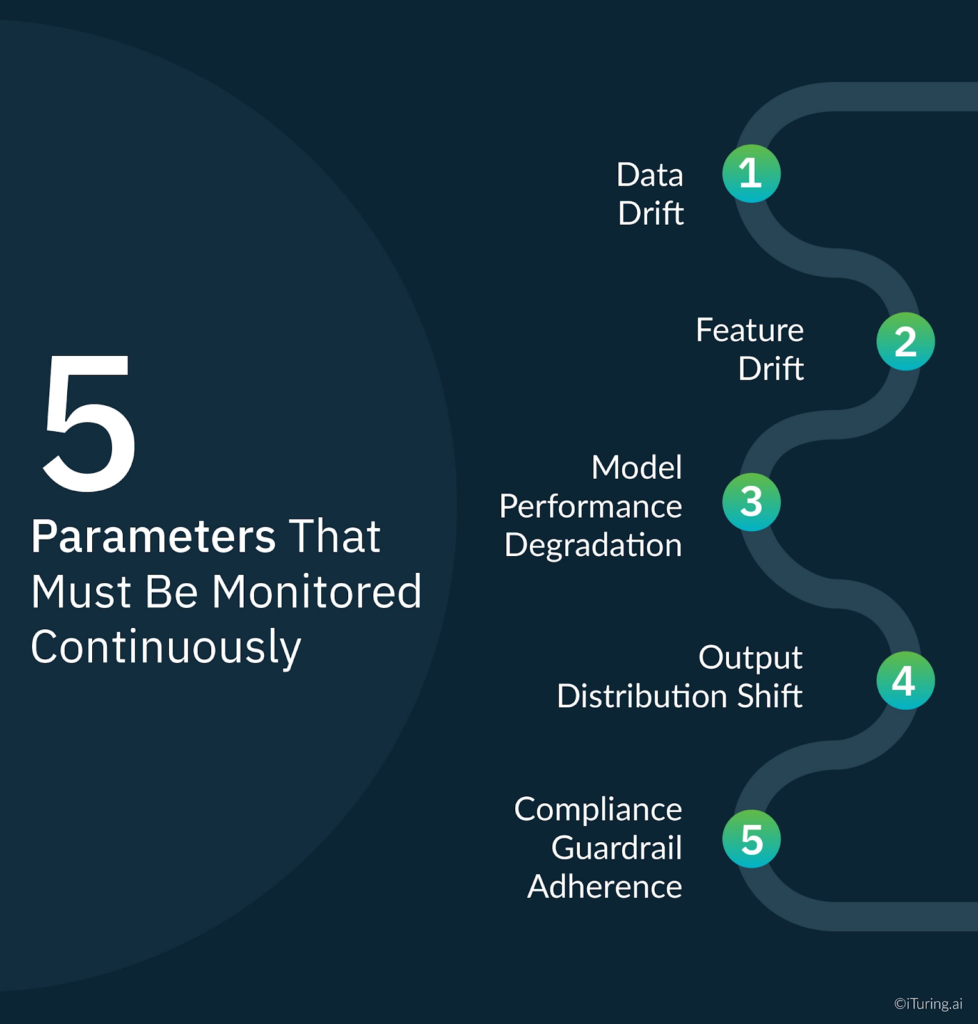
1. Data Drift
Data drift is a change in the statistical distribution of the inputs a model receives in production compared to what it was trained on. If the income distribution, debt-to-income ratios, account vintage profile, or delinquency bucket composition of your collections portfolio shifts materially, the model’s predictions may become unreliable even if the model architecture itself is unchanged. Monitoring for data drift means continuously comparing production input distributions against the training baseline, using statistical distance metrics, and triggering a structured review when divergence crosses a pre-specified threshold. The threshold itself must be documented and approved before deployment, so examiners can see that governance logic was set in advance rather than applied retrospectively.
2. Feature Drift
Feature drift focuses specifically on the predictive features a model relies on to make decisions. A feature that was highly predictive at training time, say the number of inbound customer-initiated contacts in the prior 14 days, may lose predictive power as contact behaviors shift with economic conditions or channel mix changes. Monitoring feature drift means tracking feature importance scores over time using explainability techniques and flagging when previously high-signal features decline in relevance below defined thresholds. Feature drift monitoring also supports the explainability work validators rely on to understand a model’s limitations, which SR 26-2 says effective model use depends on, and it is worth tracking separately from model-level performance.
3. Model Performance Degradation
This is the most direct measure: is the model still predicting accurately? For a collections propensity model, standard performance metrics include the Gini coefficient, the Kolmogorov-Smirnov (KS) statistic, and the lift curve across deciles. When these metrics decline beyond a defined tolerance from their validation-time benchmarks, escalation is required. The critical governance requirement here is pre-specification: thresholds must be set before deployment, documented formally, and the escalation chain must be defined before any breach occurs.
4. Output Distribution Shift
Even when aggregate performance metrics appear stable, the distribution of model outputs can shift in ways that create operational and compliance risk. A propensity model that begins scoring 60 percent of accounts as high-contact-priority when it previously scored 35 percent has changed its effective operating behavior, even if its Gini coefficient has not moved. That shift has downstream consequences for contact volumes, staffing, channel spend, and potentially for fair lending compliance if the shift disproportionately affects protected classes. Output distribution monitoring catches these population-level shifts before they propagate into operational and regulatory problems.
5. Compliance Guardrail Adherence
This is the dimension unique to collections AI, and it is the one that connects model governance directly to consumer harm risk. FDCPA contact hour restrictions, TCPA prior express consent requirements, Regulation F’s seven-day contact frequency cap, and a growing body of state-level restrictions all impose hard operational limits on collections behavior. An AI model that respects all compliance guardrails on day one can drift toward violations if its optimization logic is updated without parallel compliance re-testing. Continuous automated monitoring of guardrail adherence rates, with immediate escalation on any breach, is the mechanism that keeps a model governance failure from becoming a consumer protection finding.
The Governance Monitoring Checklist
A sound AI collections governance monitoring program…”. No standard defines “compliant. Each requires documented ownership, defined thresholds, and a specified review cadence.
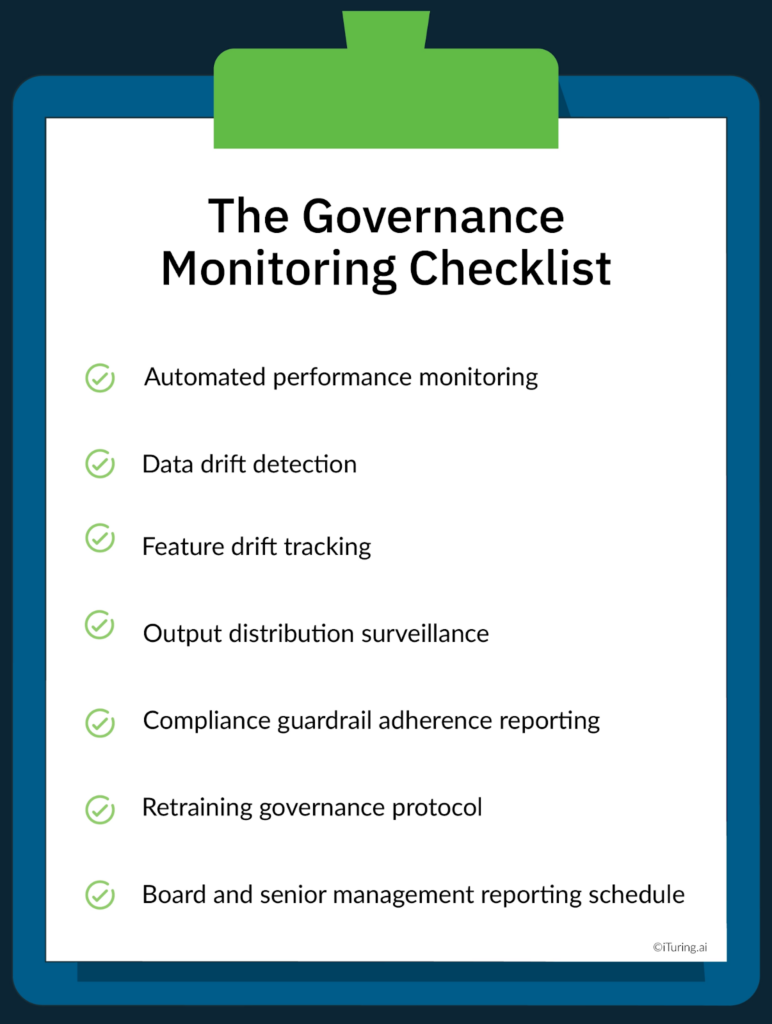
- Automated performance monitoring. Real-time tracking of Gini coefficient, KS statistic, and lift curves, with pre-specified alert thresholds and automated escalation triggers when thresholds are breached.
- Data drift detection. Continuous statistical comparison of production input distributions against training baselines, using population stability index or Jensen-Shannon divergence metrics, with automated flagging on threshold breach.
- Feature drift tracking. Ongoing monitoring of feature importance rankings using SHAP or equivalent explainability methods, flagging when previously high-signal features decline in relevance.
- Output distribution surveillance. Continuous monitoring of model output score distributions to catch population-level shifts that aggregate performance metrics may not surface.
- Compliance guardrail adherence reporting. Daily automated reporting on FDCPA, TCPA, and Regulation F compliance rates across all AI-driven contact decisions. Any guardrail breach triggers immediate escalation.
- Retraining governance protocol. Documented, board-approved criteria distinguishing routine parameter updates from material model changes requiring full re-validation. This must be approved before first production deployment, not defined reactively after a breach occurs.
- Board and senior management reporting schedule. A formal calendar for performance reporting to senior management and the board’s risk committee, including trend data across all five monitoring dimensions.
How iTuring Addresses This
iTuring’s enterprise AI governance platform for collections is built with governance monitoring as a foundational capability, not a post-hoc addition.
The platform monitors across 60 parameters in real time, covering data drift, feature drift, model performance, output distribution, and all applicable compliance guardrails simultaneously. Automated drift detection provides 2 to 4 weeks of early warning before model performance degrades to the point of requiring remediation. That lead time means institutions can respond with governed retraining rather than emergency intervention.
Champion-challenger testing is embedded in the deployment architecture. Every production model runs alongside a challenger by default, providing the continuous independent performance evidence SR 11-7 examinations require without requiring manual intervention to maintain. And one-click regulatory evidence generation produces examination-ready documentation covering monitoring activity, threshold breaches, escalation events, and remediation actions, organized in the format OCC and Federal Reserve examiners expect.
If you are building or reviewing your AI collections governance monitoring program, iTuring’s team can walk through what the operational framework looks like for your specific model architecture, regulatory relationship, and institutional risk appetite.
Why Collections AI Is Different to Validate
Validating a static credit scorecard and validating a self-learning AI collections model are fundamentally different exercises. The model risk principles are the same. The operational demands are not.
The model boundary problem. SR 26-2 defines a model as a complex quantitative method that processes input data into quantitative estimates, and it places generative and agentic AI outside its scope. A modern AI collections platform does not have such clean boundaries. It involves a cluster of interacting agents, each performing a specialised function: a propensity scoring model, a channel selection model, a timing optimisation model, a message personalisation model, and a compliance enforcement layer. These agents exchange information. The output of one becomes the input of another. Defining where one model ends and another begins, for the purposes of model inventory and validation, is a genuinely difficult governance question that most banks have not yet resolved.
Deloitte’s 2026 guidance on managing AI agent risks in banking notes that banks should “expand their AI risk management frameworks to assess agents, not just models,” adding new risk categories like tool misuse, action validity, and outcome monitoring that standard MRM frameworks do not capture. That expansion is worth making for banks running multi-agent collections AI, because SR 26-2 leaves agentic AI to each institution’s own risk management and governance practices.
The self-learning update problem. A traditional scorecard is fixed between validation cycles. You validate it, deploy it, and the next validation happens on the same model. An AI collections model that updates its parameters based on production data is, in a meaningful sense, a different model each week. SR 26-2 says the timing and frequency of validation vary with a model’s purpose, methodology and how often it changes. Determining what constitutes a material change in a continuously updating model requires explicit governance criteria that hould be established before deployment, not developed reactively after a reviewer asks.
The concept drift problem. Consumer payment behaviour changes with economic conditions. A model trained on payment patterns from one economic environment will encounter a different relationship between its input features and payment outcomes when conditions shift. PwC’s guidance on validating multi-agent AI systems notes that “validation must scale to include continuous monitoring and system-level oversight” because the interactions between agents, and between the model and its environment, create ongoing validation demands that a point-in-time examination cannot fully address.
The Model Validation Challenge: Conceptual Soundness for Collections AI
The conceptual soundness requirement is where AI collections model validation diverges most sharply from standard scorecard practice.
For a logistic regression scorecard, conceptual soundness means reviewing the statistical methodology, assessing variable selection, and confirming that the model’s coefficients are directionally consistent with economic intuition. An examiner can review the model documentation, understand the logic, and form a judgment about whether the methodology is sound.
For a gradient boosting or neural network collections model, this process is substantially harder. SR 26-2 describes validation as including an assessment of conceptual soundness, and says effective model use depends on a clear understanding of a model’s limitations. For complex machine learning models, that is harder to do.
Grant Thornton’s guidance on model conceptual soundness identifies the problem precisely: “Artificial intelligence techniques often result in a black box model, in which the underlying logic is a mystery. This presents an inherent challenge: if the methodology is not transparent, how can a reviewer independently assess its soundness?” One widely used answer is SHAP and LIME.
SHAP (SHapley Additive exPlanations) provides system-level model accountability by quantifying the contribution of each feature to every individual prediction, grounded in game theory. For a collections propensity model, SHAP analysis shows, at the individual account level, which features drove a high or low propensity score. This supports both the conceptual soundness assessment and ECOA’s adverse action notice requirements.
LIME (Local Interpretable Model-Agnostic Explanations) generates case-level explanations by building a locally interpretable approximation of the model’s behaviour around a specific prediction. Where SHAP provides the system-level view, LIME provides the individual transaction-level explanation. Together, they give model risk teams the documentation needed to demonstrate that the model’s logic and limitations can be understood by the people who rely on it.
Back-testing for AI collections models should go beyond comparing predicted scores to outcomes. It should evaluate whether the model’s conceptual basis, meaning the relationships between input features and payment behaviour, remains valid as economic conditions change. Benchmarking against the bank’s existing rules-based collections system is a practical way to compare alternative methodologies, which SR 26-2 describes as part of model testing, and gives reviewers a reference pointfor evaluating whether the AI model delivers genuine improvement over the baseline.
Board and Audit Committee Reporting
SR 26-2 describes governance as clear policies, effective controls and well-defined roles and responsibilities, and says internal audit’s role is generally to evaluate whether model risk management practices are rigorous and effective. For AI collections models, that means establishing a formal reporting cadence that keeps both senior management and the board’s audit committee genuinely informed, not just nominally aware.
The CyGeniq analysis of AI risk management in banking identifies board and senior management oversight as a consistent regulatory emphasis across all major jurisdictions: “boards must approve AI policies, oversee model inventories, review validation reports and ensure accountability for model failures.” The OCC’s expectations for US banks align directly with this: board members are expected to receive performance reports that contain enough substantive information to support genuine oversight, not summary assurances.
Three reporting elements constitute a complete board-level AI collections governance report.

Key risk indicator summary. Current status across the four governance components, model inventory management completeness, open validation findings, pending change approvals, monitoring threshold breaches, with trend data showing how each has moved since the previous report. Board members cannot exercise meaningful oversight of AI collections risk from a single-point status indicator. They need trend data.
Material change and exception log. A record of every material model change that occurred in the reporting period, including what changed, who approved it, and whether any expedited or emergency change procedures were invoked. Exceptions to standard governance procedures, even where appropriately authorized, should be visible at the board level.
Forward-looking risk assessment. What validation events, retraining cycles, or model retirement decisions are coming in the next reporting period, and what governance actions are required to prepare for them. This is the element most commonly absent from AI model governance board reports, and it is the element that transforms board oversight from reactive to genuinely anticipatory.
How iTuring Addresses This
iTuring’s collections AI platform includes a model governance module designed specifically for the institutional infrastructure that supports SR 26-2 model risk management principles at US banks.
The platform maintains a centralised model inventory that automatically captures every model component in the collections AI architecture, including self-learning update events, orchestration layer configurations, and third-party vendor model details where integration permits. Every entry includes the governance metadata that supports SR 26-2 model risk management:: owner, purpose, validation status, deployment date, tier classification, and performance history.
Maker-checker approval workflows are built into the platform’s change management architecture. Every material change event generates an approval workflow that routes to the appropriate reviewers based on the model’s tier classification and the nature of the change. Approvals, rejections, and review comments are automatically recorded in the governance audit trail.
Version control and model lineage documentation are maintained automatically across every update cycle. The governance record for each model contains the complete version history, training data provenance at each version event, and the governance decisions associated with each transition.
One-click audit packs generate examination-ready governance documentation covering model inventory, approval records, change management history, and board reporting archives, formatted for OCC and Federal Reserve examination review.
If your institution is building or reviewing its model governance program for AI collections, iTuring’s team can walk through how the platform’s governance architecture maps to SR 26-2 model risk management principles at your institution.
Regulatory Disclaimer
This article is for informational purposes only and does not constitute legal or compliance advice. SR 26-2 is supervisory guidance that does not set enforceable standards and is expected to be most relevant to banks with over $30 billion in total assets. How it applies varies by institution type, regulatory charter and supervisory relationship. The information presented reflects general industry practice and publicly available regulatory guidance as of the publication date. Consult qualified legal and compliance professionals for guidance specific to your institution’s circumstances.
Sources: Federal Reserve SR 26-2 | Equinox Compliance: SR 11-7 and AI | MRM Guidance | OCC Model Risk Management Comptroller’s Handbook | IBM: What Is Model Governance | ValidMind: SR | PiTech: AI Risk Management in Banking | CyGeniq: AI Risk Management in Banking | VLink: AI Model Governance in BFSI | ModelOp: SR 11-7 Model Risk Management | Cimcon: SR 11-7 Guidance | Taktile: Managing AI Model Risk in AML | VerifyWise: Model Inventory | KPMG: Model Risk Management Deloitte: Managing AI Agent Risks in Banking: https://www.deloitte.com/us/en/insights/industry/financial-services/agentic-ai-risks-banking.html
PwC: Validating Multi-Agent AI Systems: https://www.pwc.com/us/en/services/audit-assurance/services/validating-multi-agent-ai-systems.html
Grant Thornton: Conceptual Soundness: https://www.grantthornton.com/insights/articles/banking/2023/how-to-keep-your-models-conceptually-sound