
Two Accounts at the Same DPD Stage Can Have Very Different Provisioning Consequences. Most Collections Models Only See DPD.
TL;DR
- RBI’s Income Recognition, Asset Classification and Provisioning (IRACP) Directions, 2025, effective November 28, 2025, consolidate and replace all earlier NBFC prudential norms into a single framework
- The Directions complete the glide path to a uniform 90-day NPA recognition norm across all NBFC layers by March 31, 2026, Base Layer NBFCs previously had more time, 120 days by March 2025, but now converge with Middle and Upper Layer NBFCs, which have applied the 90-day standard for longer
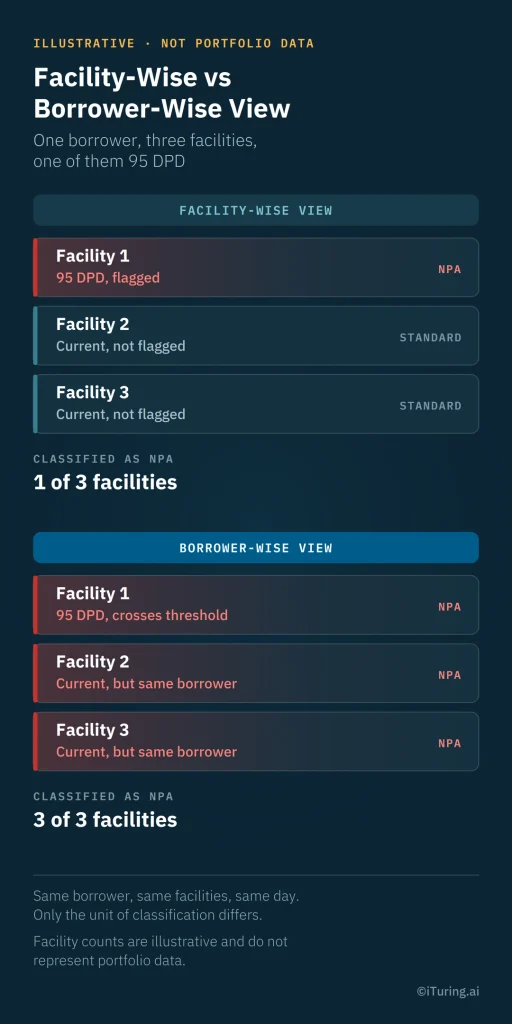
- Classification is explicitly borrower-wise, not facility-wise, meaning all facilities held by a single defaulting borrower move to NPA status together, a structural detail that changes how an account’s true provisioning exposure should be read
- Standard asset provisioning rates are differentiated by layer, 0.25% for Base Layer, 0.40% for Middle Layer including microfinance loans, meaning identical DPD accounts in different layers carry different capital consequences
- Collections prioritisation built purely on DPD misses this provisioning dimension entirely, when the accounts most valuable to prioritise for recovery are often the ones whose resolution delivers the largest provisioning relief, not simply the ones furthest past due
- CFOs and CROs modelling FY2026-27 capital impact need collections output that speaks in provisioning terms directly, not a DPD-based priority list they have to manually translate
Two accounts, both 95 days past due, can represent very different provisioning consequences depending on the borrower’s total exposure across facilities and the layer classification the lending NBFC falls under. A collections model that only scores DPD treats these two accounts identically. The RBI’s consolidated IRACP Directions make clear why that’s the wrong lens for prioritisation.
What the IRACP Directions, 2025 Actually Consolidate
RBI issued the Non-Banking Financial Companies (Income Recognition, Asset Classification and Provisioning) Directions, 2025, effective immediately from November 28, 2025, replacing every earlier prudential norm that had applied to NBFCs on income recognition and asset classification. This is the first time these rules have been consolidated into a single, standalone direction rather than existing across multiple circulars issued over time, and it’s built to align NBFC accounting practices more closely with the standards banks already operate under.
The Directions prescribe uniform rules for classifying assets as standard, sub-standard, doubtful, or loss, set out detailed provisioning requirements across loan types, project finance, securitisation exposures, hire purchase, and leased assets, and formalise the glide path NBFCs have been progressing through toward full alignment with the 90-day NPA recognition standard.
The Completed Glide Path to 90-Day NPA Recognition
Base Layer NBFCs have been moving through a phased timeline: NPA recognition beyond 150 days by March 2024, tightening to 120 days by March 2025, and reaching the full 90-day standard by March 31, 2026. Middle and Upper Layer NBFCs have already operated under the 90-day norm for longer. By the time this piece publishes, that convergence is essentially complete across the sector, meaning Base Layer NBFCs are now recognising stress at the same speed Middle and Upper Layer institutions already do.
This matters directly for collections prioritisation: an institution that’s just completed this transition is now recognising NPAs earlier than it used to, which means the collections function needs to be ready to act on accounts at an earlier stage than its historical playbook assumed.

Borrower-Wise, Not Facility-Wise: Why This Changes the Provisioning Picture
Classification under the Directions is explicitly borrower-wise. If a single borrower holds multiple facilities with an NBFC and one facility crosses into default, all of that borrower’s facilities move to NPA classification together, not just the specific facility that’s actually overdue. This is a structural detail with direct provisioning consequences: an account that looks manageable when viewed facility by facility can represent significantly larger total provisioning exposure once the borrower-wise view is applied.
A collections model scoring individual facilities in isolation misses this entirely. Prioritisation needs to operate at the borrower level, reflecting total exposure across all facilities, not the DPD status of whichever single facility happens to be the immediate trigger.
Standard Asset Provisioning: Layer-Differentiated Rates
Standard asset provisioning rates differ by layer under the Directions, Base Layer NBFCs at 0.25% and Middle Layer NBFCs, including microfinance loans, at 0.40%. This means an identical account profile carries different provisioning impact depending purely on which layer the lending institution sits in, independent of the borrower’s actual behaviour. A collections and provisioning model needs to reflect the institution’s own layer classification directly, rather than applying a generic provisioning assumption that doesn’t match the actual regulatory rate the institution operates under.
Why DPD-Only Prioritisation Misses the Capital Impact
Standard collections prioritisation ranks accounts primarily by how far past due they are. The provisioning framework suggests a different, complementary lens: accounts should also be ranked by how much provisioning relief their resolution would actually deliver, which depends on total borrower-wise exposure across facilities, the applicable layer-specific provisioning rate, and how close the account sits to a classification threshold that would trigger a step up in required provisioning.
Two accounts at the same DPD stage can have very different provisioning-relief potential: one might be a single small facility with limited total exposure, while the other might be one of several facilities held by a borrower whose full exposure is substantial. A DPD-only model treats them the same. A provisioning-aware model correctly prioritises the second.
Building the FY2026-27 Financial Modelling Framework
CFOs and CROs planning for FY2026-27 need a modelling framework that connects collections activity directly to provisioning and capital impact: what provisioning relief does resolving a specific account or borrower relationship actually deliver, given borrower-wise exposure and the institution’s layer-specific provisioning rate, and how does the collections team’s prioritisation plan translate into a capital adequacy forecast the finance function can actually use. This requires collections output structured in provisioning-relevant terms from the start, not a DPD-ranked list that finance has to manually reinterpret.
Connecting Collections AI Output to Capital Adequacy Planning
The practical shift is architectural: collections scoring needs a provisioning-weighted recovery value output alongside, or instead of, a pure propensity or DPD-based rank, and this output needs to reflect the institution’s specific layer classification and borrower-wise exposure structure rather than a generic assumption. Built this way, collections becomes directly legible to capital planning rather than a separate operational function whose connection to provisioning has to be reconstructed after the fact.
Where iTuring Fits
iTuring’s Model Risk and Data Accelerator modules build borrower-wise exposure aggregation and layer-specific provisioning logic directly into collections scoring, producing a provisioning-weighted recovery value alongside standard propensity output, so collections prioritisation and capital planning draw from the same underlying model rather than requiring separate reconciliation.
Sources
- RBI, Non-Banking Financial Companies (Income Recognition, Asset Classification and Provisioning) Directions, 2025, effective November 28, 2025
- RBI Scale Based Regulation Master Direction, October 2023, and subsequent amendments
- RBI NBFC layer classification thresholds (Base, Middle, Upper, Top Layer)
- Verify current standard asset provisioning rates and layer thresholds against the latest RBI circular at time of publication