
TL;DR
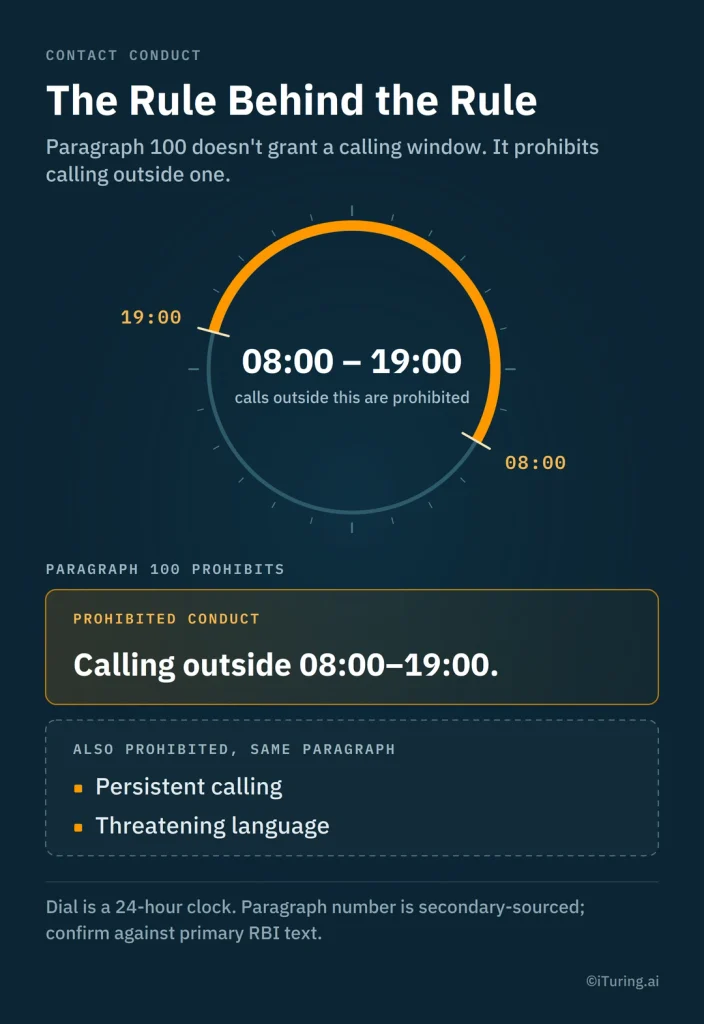
- The 8am to 7pm calling window comes from Paragraph 100 of the RBI (NBFC – Responsible Business Conduct) Directions, 2025, listed there as a prohibited coercive practice. It is not a standalone scheduling permission.
- The rule traces to a 2006 RBI circular requiring agent training on “hours of calling,” with the specific numeric window added later and consolidated in 2025.
- Genuine compliance requires distinguishing inbound, borrower-initiated contact from outbound, agent-initiated contact, and logging both with exception tags.
- A system that blocks outbound dialing but allows SMS or app notifications after 7pm has followed the letter of the voice-call rule while missing its evident intent.
- No source extends the same numeric window to SMS, email, or app push. Treat that as an open operational judgment call rather than an assumed parity.
- iTuring’s autonomous outreach agents enforce timing at the point of execution, with immutable, timestamped, direction-tagged logs built for audit.
Most Compliance Teams Read the Calling-Hours Rule Backward
Ask a collections operations lead what the 8am to 7pm rule means, and most will describe it as a permitted calling window: agents can dial between those hours, full stop. That reading misses where the rule actually sits.
Paragraph 100 of the RBI (NBFC – Responsible Business Conduct) Directions, 2025, lists calling outside 8am to 7pm alongside persistently calling a borrower and using threatening or abusive language, all under the heading of prohibited coercive recovery practices. The calling-hours rule wasn’t written as a scheduling permission that happens to have consequences attached. It was written as a conduct standard, and the time boundary is one expression of that standard.
The distinction matters operationally. A scheduling rule invites a system that simply gates the dialer clock. A conduct rule invites a system that treats timing as one signal among several for detecting harassment, alongside frequency, tone, and channel. Recovery agent calling hours conduct compliance software built around the first reading will pass a narrow audit and fail the actual regulatory intent.
Where the 8am-7pm Figure Actually Comes From
The lineage runs further back than most compliance teams realize. RBI’s 2006 circular (DBOD.No.BP.40/21.04.158/2006-07) on recovery agent conduct required lenders to train agents on “hours of calling” as part of fair-practice obligations. That circular set no numeric window at all, it left the standard to internal policy and general fair-conduct principles.
The specific 8am to 7pm figure entered through later RBI guidance in 2022 and was consolidated into Paragraph 100 of the 2025 Directions. Paragraph 91 of the same 2025 Directions sets a separate, tighter 9am to 6pm window for microfinance loan recovery specifically, which we covered in post six of this series.
One sourcing note worth stating plainly: the Paragraph 100 wording used here is confirmed through a secondary legal-summary source (Taxguru), not independently verified against RBI’s own primary published PDF. Teams building policy or software logic on this citation should verify the paragraph number and exact language against RBI’s primary text before treating it as settled.
Why Compliance Teams Get Conflicting Answers When They Search This
Search the rule and the results are inconsistent in a specific way. Some sources cite 8am to 7pm correctly. Others conflate it with a separate, older BCSBI-era “7am to 7pm” banking convention that governs a different context entirely. Almost none of the top results cite the actual paragraph number, which means most compliance teams are working from paraphrase rather than source.
Most of the content that does rank is written for consumer-rights audiences explaining what borrowers can complain about, not for compliance or operations teams building enforcement logic. That leaves the specific, paragraph-cited, operations-focused version of this rule underserved, and it’s the reason recovery agent calling hours conduct compliance software searches surface so much generic advice.
What the Rule Does and Doesn’t Cover
Paragraph 100 governs the timing of outbound call dispatch. It says nothing about call duration. No source reviewed addresses what happens when a call begins at 6:55pm and runs fifteen minutes past the window. That scenario is genuinely open and unaddressed by current guidance, which makes it a gap for internal policy to close rather than a question with a regulatory answer.
The rule also doesn’t extend, in any source found, to SMS, app push notifications, or email. Paragraph 91’s microfinance provisions address the content of messages, not their timing. Applying the same 8am to 7pm clock to non-voice channels is a defensible operating decision many lenders will reasonably make, but it should be documented as a policy choice. It is not yet a regulatory requirement already in force.
Four Things a Genuinely Compliant System Actually Needs
Recovery agent calling hours conduct compliance software has to do more than gate a dialer. The regulation states an outcome: borrowers shouldn’t be harassed through recovery contact. What follows is inference about what actually prevents violating that outcome. It is not a claim that RBI mandated specific software behavior.
Multi-channel enforcement, not single-channel gating. A system that blocks outbound dialing but allows SMS or app notifications after 7pm has followed the letter of the voice-call rule while missing its evident anti-harassment intent. Timing controls need to apply consistently across every outreach channel an agent or agentic system can use.
Direction-aware logging. Inbound, borrower-initiated contact after 7pm is legally distinct from outbound, agent-initiated contact. A system that logs all contact as one undifferentiated stream will misread legitimate borrower callbacks as violations, or worse, fail to distinguish them during an audit. Every record needs a direction tag.
Third-party and agency-level enforcement. As covered in this series’ earlier posts on agency due diligence and disclosure, responsibility for recovery agent conduct sits with the regulated entity, not just the outsourced agency. Agency-side call timing has to flow into the lender’s own system of record to be defensible in an audit. It should not sit siloed in the agency’s separate systems.
Immutable, timestamped audit logging with exception tags. Legitimate late inbound contact needs to be visible as an exception, timestamped and tagged, rather than either hidden or flagged as a false violation. The log itself needs to be tamper-evident to hold up under RBI’s 2024 MRM-style expectation of explainability on demand.
This is where the underlying execution model matters more than a policy layer bolted on top. iTuring’s platform runs outreach through 23 autonomous agents that predict a borrower’s risk profile, personalize the outreach approach, and execute the contact autonomously, with timing rules enforced at the point of execution itself rather than checked after the fact by a separate compliance module. A rule enforced at dispatch time, across every channel the agent can use, produces a cleaner audit trail than a rule enforced by a downstream monitoring layer trying to catch what already happened.
What This Looks Like in Practice
In a working deployment, a churn or delinquency model flags an account for outreach at 6:40pm. The agentic system checks channel-specific timing rules before dispatch, holds the outbound voice contact until the next permitted window, and logs the hold with a timestamp and reason code. If the borrower calls in at 7:30pm the same evening, that contact is logged separately as inbound and tagged as an exception, not folded into the outbound record. None of this requires a compliance officer to review each contact manually. The constraint is built into how the agent decides when to act, rather than applied as a separate check afterward.
Reviewing How Your Own Outreach Timing Actually Gets Enforced
Most collections teams already have a calling-hours policy written down somewhere. Fewer can produce, on request, a direction-tagged, timestamped log showing that policy held across every channel and every agency touchpoint for a given borrower. If that gap sounds familiar, it’s worth a conversation about how iTuring’s autonomous outreach agents enforce timing at the point of execution rather than as a downstream check. Reach out to see how the logging holds up against your own audit requirements.