





Full NCA Compliance Doesn’t Cover You Here. This Is a Different Act, With a Different Regulator, and Different Rules.
TL;DR
- The Debt Collectors Act 114 of 1998 established the Council for Debt Collectors (CFDC) to regulate anyone who collects debt “for reward” on behalf of another party, a completely separate statutory regime from the National Credit Act
- No person or company may act as a debt collector for reward in South Africa without CFDC registration. Attorneys are specifically exempted, but remain bound by their own professional rules instead
- Money collected on a creditor’s behalf must be held in a trust account, with specific rules governing interest and reimbursement of bank charges incurred in maintaining it
- Collection fees must align with the CFDC’s prescribed tariff. A fee structure outside that tariff, whether higher or simply organised differently, is a compliance red flag regardless of how it’s justified
- The CFDC maintains a monthly-updated public register and holds examination and disciplinary powers, up to and including withdrawing a collector’s registration entirely
- An AI collections system needs to know which regime governs a given piece of activity, because collecting your own book under the NCA and collecting for reward on someone else’s behalf under the Debt Collectors Act carry genuinely different obligations, even when the actual borrower contact looks identical from the outside
A credit provider can run an NCA-compliant collections operation in every respect, proper affordability assessments, correct Section 129 notices, sound debt review handling, and still be operating illegally the moment an account moves to a third-party collector who isn’t registered with the Council for Debt Collectors. That’s not an NCA problem. It’s a completely different Act, with its own regulator, its own registration requirement, and its own set of obligations that most collections compliance programmes were never built to check.
Two Different Acts, Two Different Regulators
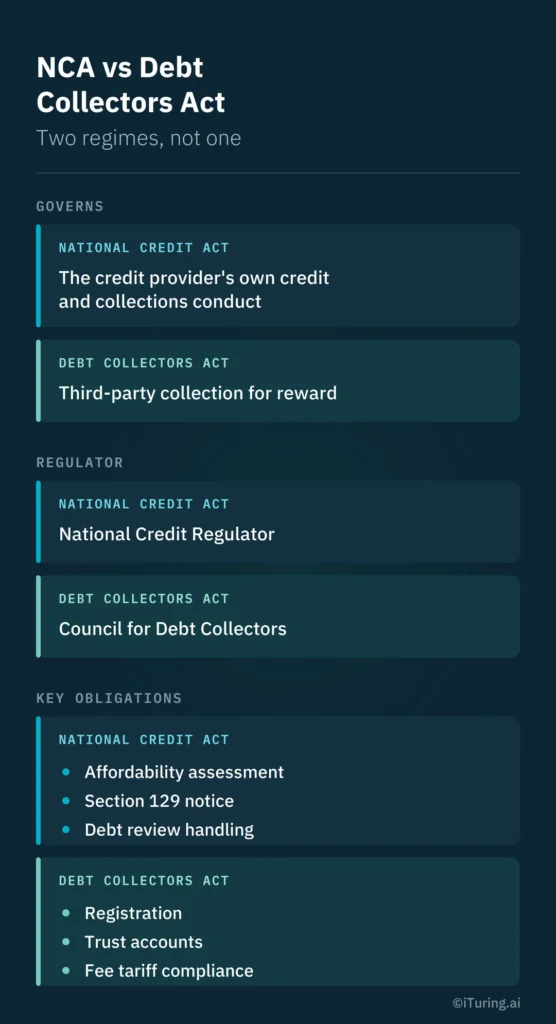
The National Credit Act and the National Credit Regulator govern how a credit provider extends and manages credit, including its own collections conduct on accounts it holds directly. The Debt Collectors Act 114 of 1998 is a separate piece of legislation entirely, administered by a separate statutory body, the Council for Debt Collectors, and it governs something different: the occupation of debt collection itself, specifically where a third party collects on behalf of another for reward.
Treating “collections compliance” as one combined bucket misses this distinction. A credit provider’s own in-house collections activity sits under the NCA. The moment that activity is handed to a third-party collector, or a collections agency operates on behalf of multiple creditors, the Debt Collectors Act applies on top of, not instead of, whatever NCA obligations still exist.
Who Actually Needs CFDC Registration
The trigger is collecting debt “for reward,” meaning as a paid service on behalf of another party, rather than collecting on one’s own book. Attorneys are specifically exempted from CFDC registration, since they operate under their own professional conduct rules and Law Society oversight instead, but this exemption is narrow and specific to attorneys acting in that capacity, not a general carve-out for anyone using legal-sounding language or process.
This matters directly for how an AI collections deployment gets structured. A platform or BPO running collections activity on behalf of a bank or NBFC, rather than the credit provider running collections on its own book internally, needs to establish whether that arrangement itself triggers the CFDC registration requirement, and build the underlying operational and documentation requirements accordingly.
Trust Account Requirements for Money Collected
Money collected on a creditor’s behalf must be held in a dedicated trust account, not commingled with the collector’s own operating funds. The Act sets out specific rules on how interest earned on trust account balances is handled and provides for reimbursement of bank charges incurred in maintaining the account, at a tariff and procedure the Council determines. This isn’t a general best-practice suggestion. It’s a specific statutory obligation with its own accounting discipline, and an AI collections system that triggers payment collection and settlement needs to generate the documentation trail proving trust account handling was followed correctly for every transaction, not just the aggregate figures.
Fee Tariffs and Why Off-Tariff Fees Are a Red Flag
Collection fees charged under the Debt Collectors Act must align with the CFDC’s prescribed tariff structure. A fee that falls outside this tariff, whether it’s simply higher than permitted or structured in an unconventional way that effectively achieves the same result, is a compliance problem regardless of how it’s presented to the debtor or the creditor. An AI collections system calculating fees needs to check the actual calculated amount against the CFDC tariff directly, rather than applying a configured percentage that was set once and assumed to remain compliant indefinitely as tariffs or account circumstances change.
The CFDC Register, Examination Powers, and Discipline
The CFDC maintains a register of all licensed debt collectors, updated monthly, and holds the power to examine a debt collector’s operations to confirm compliance with the Act’s core requirements. Where an examination finds non-compliance, the Council can act, up to and including withdrawing a collector’s registration. For an agency or platform running collections at scale, a registration withdrawal mid-operation is a serious operational disruption, not just a compliance footnote, which is exactly why the underlying trust account, fee tariff, and registration status checks need to be continuously verified rather than confirmed once at onboarding and assumed stable afterward.
Building AI Collections Logic That Knows Which Regime Applies
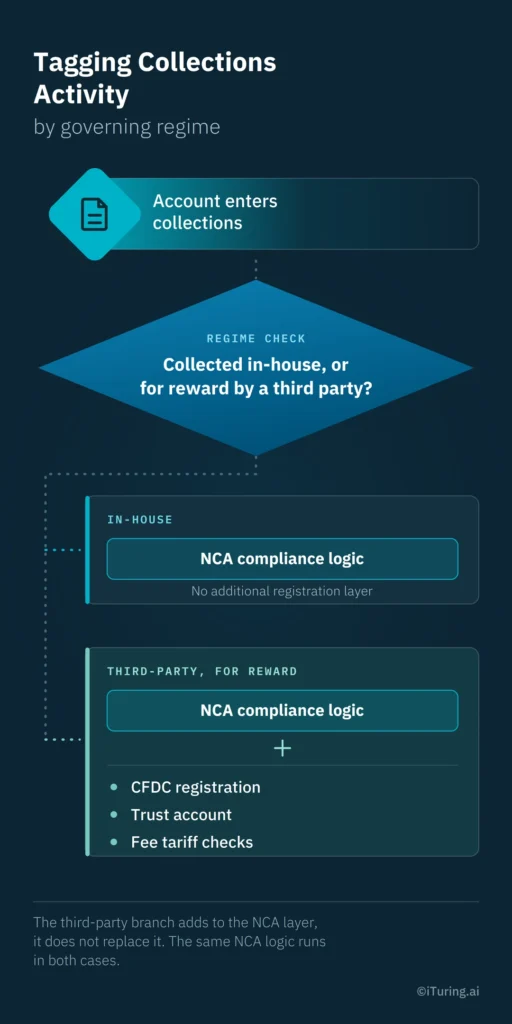
The practical fix is architectural: every account, workflow, or collections relationship needs to be tagged by which regime governs it, an in-house NCA-governed collection versus a for-reward, Debt Collectors Act-governed arrangement, since the documentation, fee calculation, and trust handling requirements diverge meaningfully between the two even when the borrower-facing activity looks the same. A system built without this distinction risks applying NCA-only compliance logic to activity that actually needs the additional Debt Collectors Act layer on top.
Where iTuring Fits
iTuring’s Model Gov module builds regime-aware tagging directly into collections workflow configuration, tracking CFDC registration status, generating trust account documentation for every collected payment, and validating fee calculations against the prescribed tariff automatically, so third-party collection activity carries its own defensible compliance trail alongside standard NCA-governed collections logic.
Sources
- Debt Collectors Act 114 of 1998 (consolidated text via SAFLII)
- Council for Debt Collectors (CFDC), official registration and prescribed tariff guidance
- National Credit Act 34 of 2005, for contrast on the separate NCA/NCR regime
- Verify current CFDC prescribed tariff figures and any recent disciplinary or registration-withdrawal precedents at time of publication