





The Information Regulator Has Already Fined R5 Million and Issued a Public Notice Against WhatsApp. This Isn’t a Hypothetical Risk Anymore.
TL;DR
- POPIA’s statutory maximum administrative fine is R10 million per contravention, with criminal penalties, including up to 10 years imprisonment, available for the most serious offences such as obstructing the Regulator or ignoring an enforcement notice
- The Information Regulator’s first administrative fine, R5 million against the Department of Justice and Constitutional Development, set a real enforcement precedent, and it publicly issued a Section 95 enforcement notice against WhatsApp in April 2025 for applying weaker privacy terms to South African users than European users
- Breach notifications rose roughly 40% year-on-year into the 2024-2025 reporting period, and the Regulator’s 2026-2027 plan, presented to Parliament’s justice committee, shifts explicitly from reactive complaint-handling toward proactive compliance assessments, with financial services specifically named as a priority sector
- Comparing the cost of building POPIA-compliant AI collections governance against realistic penalty exposure in rand terms gives CFOs a defensible basis for the investment decision, rather than treating governance spend as a discretionary cost to defer
- The investment pays back through reduced audit and remediation exposure even in years with no fine levied, since proactive compliance assessments are now a stated Regulator priority, not just a response to complaints
For years, POPIA carried real statutory teeth on paper but limited visible enforcement in practice, which made it easy to treat governance investment as something to defer. That’s no longer a defensible read of the situation. The Information Regulator has issued a real fine, publicly named a major global platform in an enforcement notice, and explicitly stated its shift toward proactive assessment in the sectors, including financial services, where AI collections operates.
What POPIA Actually Allows the Information Regulator to Do
POPIA gives the Information Regulator two distinct enforcement routes. The first is an administrative fine, issued directly by the Regulator without requiring a separate court process, capped at R10 million per contravention. The second is criminal liability for the most serious offences, such as obstructing the Regulator or failing to comply with an enforcement notice, carrying a fine or imprisonment of up to 10 years, or both. Understanding which route applies matters for risk assessment: the administrative fine path is faster and more directly within the Regulator’s own control, making it the more immediately relevant exposure for most compliance failures short of active obstruction.
The Enforcement Record So Far: DoJ&CD, WhatsApp, and What It Signals
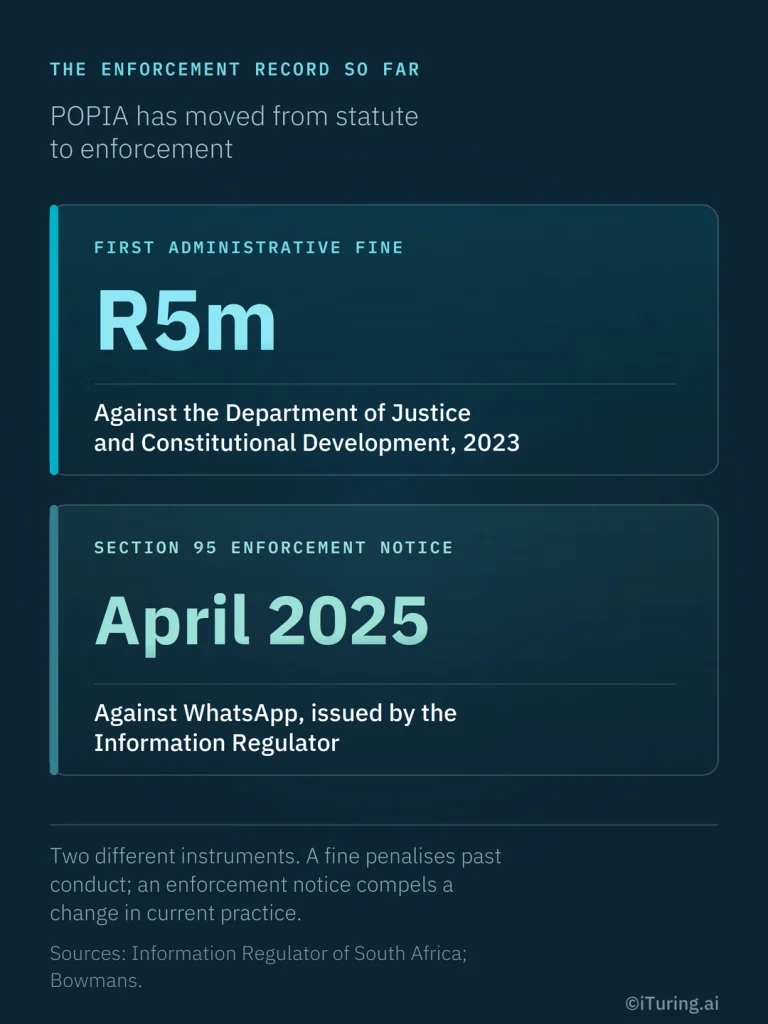
The Information Regulator’s first administrative fine, R5 million, was issued against the Department of Justice and Constitutional Development in 2023 following a security compromise that exposed roughly 1,204 files of personal information, after the department failed to maintain adequate technical security measures including basic steps like renewing its own intrusion detection licence. This wasn’t a nominal or symbolic penalty. It established that the Regulator would use its full administrative fine authority against a real security failure.
More recently, in April 2025, the Regulator issued a Section 95 enforcement notice against WhatsApp, finding that the platform applied different, weaker privacy terms and policies to South African users compared to those it offered European users under GDPR. This matters beyond the specific case: it shows the Regulator willing to take on a major global platform directly, and it signals that inconsistent privacy treatment across markets, exactly the kind of gap that can occur when a global AI collections deployment isn’t specifically configured for POPIA, is squarely within scope for enforcement action.
Why Enforcement Is Shifting from Reactive to Proactive in 2026
Breach notifications rose by roughly 40% year-on-year into the 2024-2025 reporting period, and the Information Regulator’s own plan for 2026 and 2027, presented to Parliament’s Justice Committee in May 2026, describes a deliberate shift toward proactive compliance assessments rather than only responding to complaints as they arrive. The plan specifically names financial services, alongside insurance, health, retail, and telecommunications, as a priority sector for these proactive reviews, precisely the sector where AI collections systems process large volumes of personal information as a matter of course.
This changes the risk calculation meaningfully. A credit provider that has previously avoided scrutiny simply because no complaint triggered a review can no longer assume that pattern continues once the Regulator begins actively selecting institutions for assessment rather than waiting for a complaint to arrive.
Building the Rand-Denominated Cost Comparison
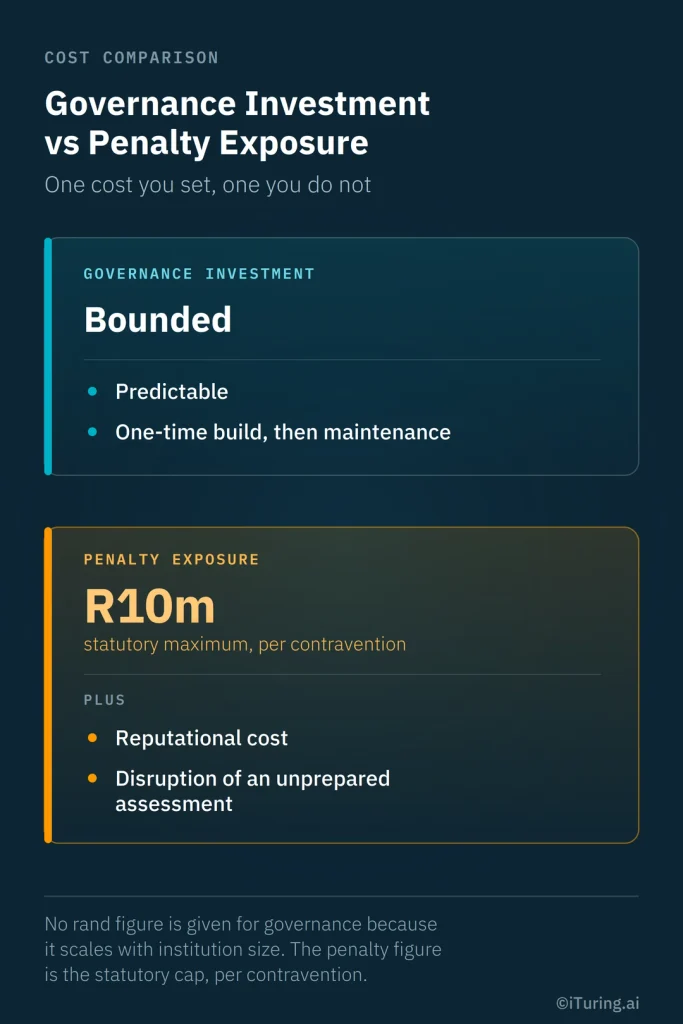
The comparison a CFO actually needs is straightforward to frame once the enforcement picture is clear: the cost of building and maintaining POPIA-compliant AI collections governance, consent architecture, data minimisation controls, breach notification readiness, documented data subject rights processes, set against the realistic exposure of a R10 million maximum administrative fine per contravention, the reputational cost of a public enforcement notice similar to the one issued against WhatsApp, and the operational cost of responding to a proactive Regulator assessment without existing documentation already in place. Governance investment, built once and maintained, is a bounded, predictable cost. Penalty and remediation exposure, especially once proactive assessments become routine rather than exceptional, is not.
Why the Investment Pays Back Regardless of Enforcement
Even setting aside the possibility of an actual fine, proactive compliance investment pays back through the reduced cost and disruption of a Regulator assessment conducted against an institution that already has its documentation, consent records, and data handling practices in order, versus one that has to construct this evidence reactively once an assessment has already begun. Given the Regulator’s own stated shift toward proactive review specifically in financial services, this isn’t a marginal scenario planning exercise. It’s the environment credit providers are now actually operating in.
Where iTuring Fits
iTuring’s Model Gov module builds POPIA-compliant consent architecture, data minimisation controls, and audit-ready documentation directly into AI collections operation, so a proactive Information Regulator assessment finds existing, defensible records rather than a gap that has to be constructed under time pressure once the assessment has already started.
Sources
- Protection of Personal Information Act (POPIA), administrative and criminal penalty provisions
- Bowmans, “Information Regulator issues first fine of ZAR 5 million under POPIA,” 2023
- Information Regulator, Section 95 enforcement notice against WhatsApp, April 16, 2025
- Information Regulator, plan for 2026-2027 presented to Parliament’s Justice Committee, May 2026
- Current breach notification trend data (verify most recent reporting period at time of publication)