




More Contact Isn’t Always Better. Sometimes It’s the Event That Either Resets a Clock You Wanted Left Alone, or Proves You’re Chasing Money You Have No Right to Chase.
TL;DR
- Most South African consumer debt, credit cards, personal loans, retail and store accounts, prescribes after three years under the Prescription Act 68 of 1969, becoming legally unenforceable once that period runs uninterrupted
- Prescription is interrupted by any payment however small, by an express or tacit acknowledgment of liability, which can include a verbal admission during a call, or by properly served summons. A letter of demand on its own does not interrupt it
- A recent High Court ruling (J.H.V v Centlec (SOC) Ltd and Others) confirmed that even an acknowledgment made indirectly, not communicated directly to the creditor, can interrupt prescription, widening what actually counts as an interruption event
- Automated collections contact, designed purely to maximise engagement and response, can inadvertently elicit exactly the kind of acknowledgment that resets a prescription clock the business may not have wanted reset
- The more serious failure runs the other way: continuing standard collections activity on an account that has already prescribed means pursuing debt with no legal right to collect it, a real legal and reputational exposure, not a technicality
- AI collections systems need the prescription clock built in as an active scoring input, driving both prioritisation (surface near-prescription accounts for a deliberate decision before the window closes) and contact script design (avoid unintentionally triggering, or failing to recognise, an interruption event)
Most collections logic runs on a simple assumption: more contact, applied earlier and more consistently, produces better recovery outcomes. Under South African prescription law, that assumption breaks down in two directions at once. Contact itself can be the event that resets a legal clock the business didn’t actually want reset. And separately, failing to track that same clock can mean a system keeps chasing money it no longer has any legal right to collect at all.
The Three-Year Clock, and What It Actually Covers
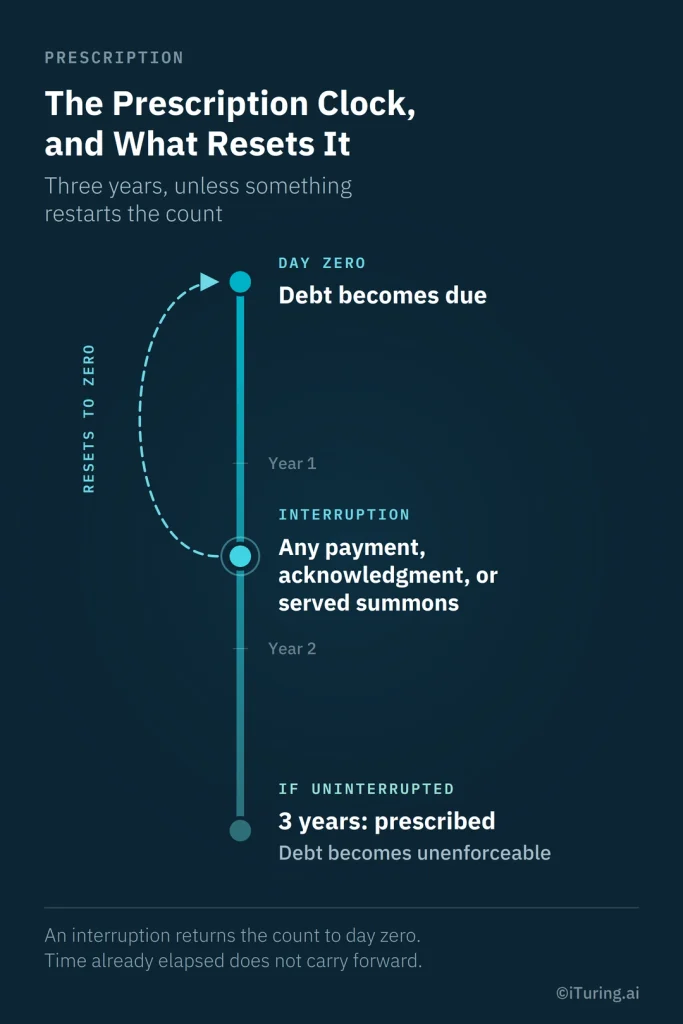
Under the Prescription Act 68 of 1969, most ordinary consumer debt, credit cards, personal loans, retail and store accounts, prescribes after three years from the date the debt becomes due, if no interruption occurs during that window. Once prescription completes and the debtor raises it as a defence, the debt becomes legally unenforceable through court action. Not every debt category follows this three-year default: debt secured by a mortgage bond or reduced to a court judgment carries a much longer 30-year prescription period, debts owed to the state generally run on a 15-year period, and obligations arising from bills of exchange or notarial contracts follow a six-year period. For the great majority of unsecured consumer lending and retail credit that AI collections systems handle day to day, though, the three-year rule is the one that governs.
What Interrupts Prescription, and What Doesn’t
Three things interrupt the running of prescription and reset the clock to zero. Any payment, even a small, partial amount, restarts the full period. An express or tacit acknowledgment of liability, admitting the debt is owed, in any form, verbally on a call, in writing, or through conduct that implies acknowledgment, does the same. Properly served legal process, a summons actually served on the debtor, also interrupts prescription. Critically, a letter of demand on its own does not interrupt prescription. Sending correspondence asserting a debt is owed, without an acknowledgment from the debtor or actual service of a summons, does nothing to stop the clock.
This distinction matters enormously for automated collections messaging. A system generating dunning letters or automated calls asserting the debt and requesting payment isn’t, by itself, interrupting anything. But if that same contact successfully elicits an acknowledgment from the debtor, even an informal one, prescription resets, whether or not that outcome was actually what the collections strategy intended.
The Centlec Ruling: Indirect Acknowledgment Still Counts
A recent High Court ruling, J.H.V v Centlec (SOC) Ltd and Others, addressed exactly this kind of acknowledgment question and confirmed that an acknowledgment of liability interrupts prescription even where it wasn’t communicated directly to the creditor itself. This widens what actually counts as an interruption event beyond a clean, direct admission made in a formal collections conversation, and it means an AI collections system’s contact logs and transcripts, not just its explicit “acknowledgment captured” flags, need to be reviewed for language that could constitute an interruption event under this broader reading.
The Two Failure Modes AI Collections Systems Create
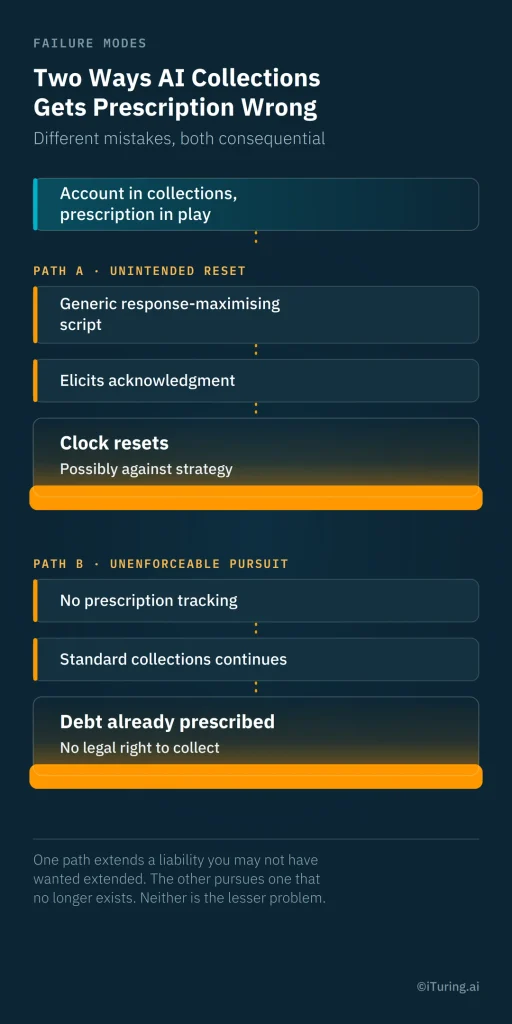
Two distinct failure modes emerge from getting this wrong, and they pull in opposite directions. The first: a contact script optimised purely to maximise engagement and elicit some kind of response can inadvertently produce exactly the acknowledgment that resets a prescription clock, which may work against the business’s own interests if the account was actually approaching prescription and the collections strategy for that specific account was to let it lapse rather than pursue it through summons. The second, more serious failure: a collections system that doesn’t track prescription status at all will continue standard collections activity, contact, demand, negotiation, on an account that has already prescribed, meaning the business has no legal right to collect on it through court action at all. This second failure mode carries genuine legal and reputational exposure, not just an inefficiency.
Building Prescription-Aware Prioritisation
The fix starts with treating the prescription clock as a live scoring input for every account, not a fact someone checks manually if a dispute happens to arise. Accounts approaching the three-year mark with no interruption event should surface for a deliberate decision well before the window closes: pursue through properly served summons if the account and amount justify it, negotiate a settlement while the debt is still enforceable, or make a conscious decision to let the debt lapse, rather than defaulting into inaction simply because nobody was tracking the date.
Designing Contact Scripts That Don’t Accidentally Interrupt (or Fail to Recognise) Prescription
Automated contact logic needs two capabilities working together: awareness of what language or response patterns constitute an acknowledgment under the broader Centlec-informed reading, so the system can recognise when an interruption event has actually occurred and log it accurately, and, separately, the ability to adjust script design for near-prescription accounts where the deliberate strategy is not to elicit an acknowledgment, rather than running the same generic, response-maximising script regardless of where an account sits on its prescription timeline.
Where iTuring Fits
iTuring’s Collections & Recovery module tracks the prescription clock as a standing account attribute, surfaces near-prescription accounts for deliberate review well ahead of the three-year mark, and flags contact interactions containing language that could constitute an acknowledgment under current case law, so the business makes an informed choice about every near-prescription account rather than discovering the status only after the fact.
Sources
- Prescription Act 68 of 1969, Sections 11 and 14
- J.H.V v Centlec (SOC) Ltd and Others (confirm full case citation, court, and date at time of publication)
- Legal commentary on acknowledgment and interruption of prescription in South African debt collection practice
- Verify current case law developments on acknowledgment and interruption at time of publication, as this remains an actively litigated area