






Courts Have Already Struck Down the Shortcuts. What’s Left Is a Process That Has to Be Followed Precisely.
TL;DR
- Emolument attachment orders (EAOs), commonly known as garnishee orders, are governed by Section 65J of the Magistrates’ Courts Act 32 of 1944, and a series of court rulings has progressively tightened what a lawful EAO requires
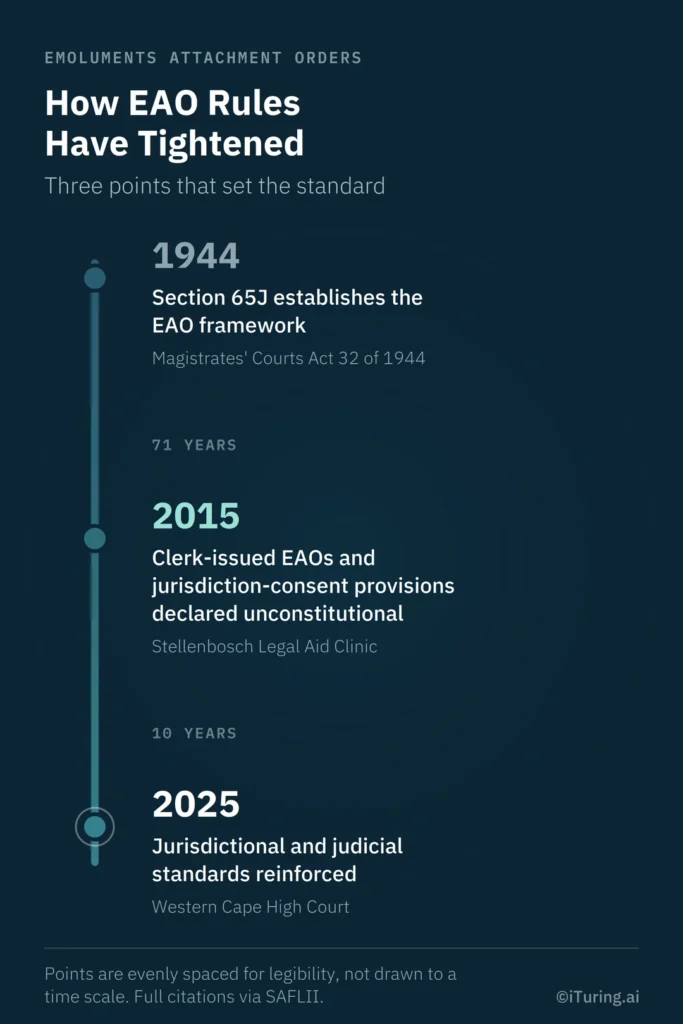
- The 2015 Western Cape High Court ruling in Stellenbosch Legal Aid Clinic v Certain Organs of State declared clerk-issued EAOs, and consent to jurisdiction outside a debtor’s home or employment district, unconstitutional. EAOs must now be issued by a Magistrate in open court, with a proportionality assessment of the debtor’s actual financial situation
- A 2025 Western Cape High Court ruling reinforced strict jurisdictional and judicial standards, citing continued concern from the NCR and South African Human Rights Commission about EAO abuse
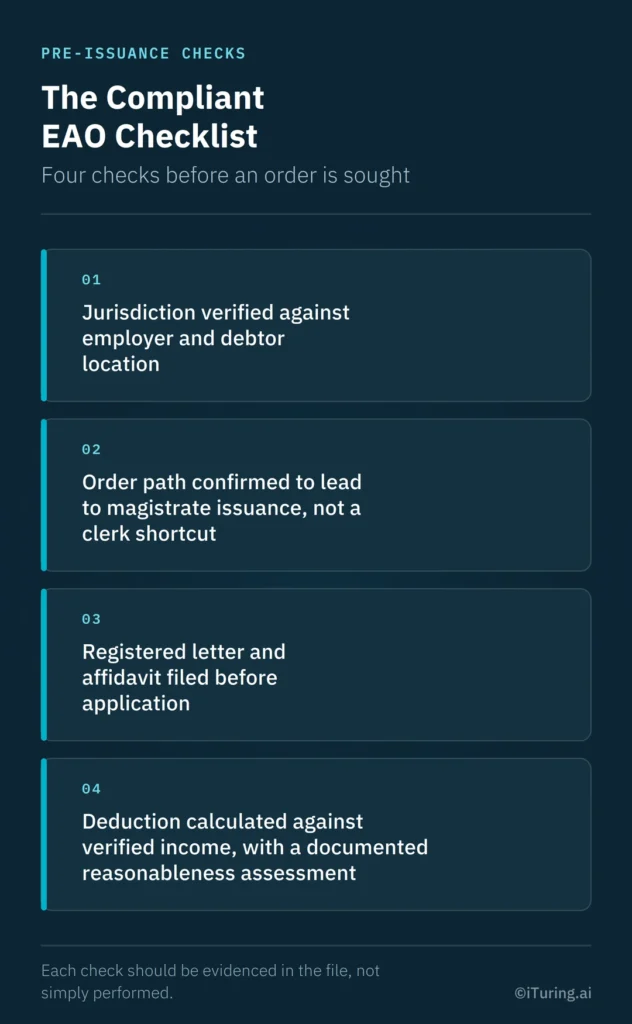
- Before an EAO can be issued, the judgment creditor must send a registered letter to the debtor and file that letter with an affidavit at the Clerk of the Court, and jurisdiction must sit with the court where the employer or the debtor is actually located
- Deduction amounts must be reasonable, generally accepted as up to around 25% of net salary, though the Act requires a genuine, case-specific assessment of what’s just and equitable rather than a fixed formula
- Once granted, the employer is obliged to deduct on an ongoing basis or risk being held in contempt of court, which makes accurate, verifiable process on the creditor’s side essential, not optional, since the employer’s compliance depends entirely on the order being lawful in the first place
Emolument attachment orders have a difficult history in South Africa, and the legal framework governing them today exists specifically because of that history. Courts have repeatedly intervened to close shortcuts that allowed EAOs to be issued without real scrutiny, clerk-issued orders bypassing a magistrate’s proportionality review, jurisdiction shopping that put debtors before courts far from where they lived or worked, deduction amounts that left little to nothing for basic living expenses. Understanding what a genuinely lawful EAO process requires now means understanding exactly what those rulings were responding to.
What the Magistrates’ Courts Act Requires, and What the Courts Have Since Added
Section 65J of the Magistrates’ Courts Act 32 of 1944 is the statutory basis for EAOs, requiring, among other things, that the judgment debtor either consent in writing or that a court authorise the order, and that the judgment creditor first send a registered letter to the debtor’s last known address warning that an EAO will follow if the debt isn’t paid, with that letter and a supporting affidavit filed with the Clerk of the Court.
The statute alone wasn’t enough to prevent abuse. In 2015, the Western Cape High Court, in Stellenbosch Legal Aid Clinic and 16 Others v Certain Organs of State, declared key provisions of Section 65J, and a related provision, Section 45, unconstitutional. The ruling stopped Clerks of the Court from issuing EAOs at all: only a Magistrate, in open court, can grant one now, specifically so a proportionality assessment of the debtor’s actual financial circumstances happens before an order is made. The same ruling ended the practice of debtors consenting to jurisdiction in a court other than the one where they reside or are employed, closing a route that had been used to move cases to more creditor-friendly jurisdictions.
A 2025 Western Cape High Court ruling reinforced these standards further, addressing continued jurisdictional and procedural abuse and referencing ongoing concern from both the National Credit Regulator and the South African Human Rights Commission about how EAOs were still being misused despite the 2015 precedent.
Employer Notification: Where Manual Processes Go Wrong
The employer, referred to as the garnishee in this process, is obliged to deduct the ordered amount on an ongoing basis once a lawful EAO is served, and failure to comply risks the employer being held in contempt of court. This puts real weight on the creditor side getting the process right: an employer acting on an order that turns out to be improperly issued, wrong jurisdiction, clerk-issued rather than magistrate-issued, missing the required prior registered letter, creates legal exposure that a manual, inconsistently checked process is poorly positioned to avoid catching before service.
Income Verification and Lawful Attachment Calculations
The Act doesn’t set a single fixed percentage for what can be deducted. It requires the amount to be reasonable, taking into account the debtor’s financial needs and dependants, with roughly 25% of net salary generally treated as an accepted ceiling in practice, though courts assess what’s genuinely just and equitable case by case rather than applying that figure mechanically. Calculating a defensible deduction amount requires actual, verified income information, not an assumed salary figure, and this verification needs to happen before an application proceeds, not be discovered as a problem only if the order is later challenged.
Compliance Checks AI Should Enforce Before and During Attachment
Given the specific abuse patterns courts have targeted, a compliant EAO workflow should verify jurisdiction against where the employer or debtor is actually located before an application proceeds, confirm the order will be sought from and granted by a Magistrate in open court rather than processed as a clerk-issued shortcut, generate and file the required registered letter and supporting affidavit before any application is lodged, and calculate the deduction amount against verified income data with a documented reasonableness assessment rather than a default percentage applied uniformly regardless of the debtor’s actual circumstances.
Where iTuring Fits
iTuring’s Model Gov and Collections & Recovery modules build jurisdiction verification, magistrate-issuance confirmation, registered letter and affidavit generation, and income-verified deduction calculation directly into the EAO workflow, so the exact abuse patterns that produced the 2015 and 2025 court rulings are checked and documented automatically, rather than depending on manual diligence at each step of a legally sensitive process.
Sources
- Magistrates’ Courts Act 32 of 1944, Section 65J
- Stellenbosch Legal Aid Clinic and 16 Others v Certain Organs of State, 2015 Western Cape High Court ruling
- Western Cape High Court ruling on EAO jurisdiction and judicial standards, 2025 (SAFLII reference ZAWCHC 244/2025, verify citation at time of publication)
- National Credit Regulator and South African Human Rights Commission guidance on EAO abuse concerns
- Regulation 23A, National Credit Regulations, on deduction limit references