TL;DR
- NBFC collections right-party contact rates average 26-31% with manual diallers — AI propensity timing improves this to 44-51% at identical call volume
- A 20 percentage point right-party contact improvement at equal call volume reduces cost per recovery by 44% — the relationship is mathematically direct
- The primary driver of improvement is per-account contact timing optimisation — not better scripts or higher call volume
- Right-party contact rate improvement compounds with self-cure identification: removing self-cure accounts improves the right-party rate on the remaining queue by a further 8-12 points
- iTuring’s per-account timing model uses salary credit patterns, NACH history, and historical response data to predict the optimal contact window for each borrower
Every collections operation has a single metric that determines whether agent hours convert into recovered rupees or vanish into unanswered calls and wrong-party conversations. For Indian NBFCs operating personal loan, two-wheeler, and microfinance portfolios, that metric is the right-party contact rate: the percentage of outbound attempts that reach the actual borrower. The gap between a 26% right-party contact rate and a 47% rate is not a marginal improvement. It is the difference between a collections floor that burns cash and one that generates measurable recovery per agent hour. This article presents the benchmark data, the cost arithmetic, and the specific mechanism through which AI-driven contact timing closes that gap for NBFC collections teams. The figures cited draw from deployment data across Indian NBFC portfolios between 2024 and 2026, covering personal loans, vehicle finance, and MSME lending segments. For Heads of Collections evaluating whether AI timing models justify the implementation cost, the numbers that follow offer a direct comparison against manual dialler baselines.
What 26% Right-Party Contact Rate Costs an NBFC in Wasted Agent Hours Per Week
A 26-31% right-party contact rate means that for every 100 calls an agent places, roughly 70-74 reach voicemail, wrong parties, or simply go unanswered. Each of those failed attempts still consumes 45-90 seconds of agent time: dialling, waiting, logging the outcome. For an NBFC running a 200-agent floor with each agent handling 120-150 calls per shift, the arithmetic is stark. Approximately 70% of total agent capacity is spent on calls that cannot produce a recovery outcome. The cost driver is not agent salaries alone; it is the opportunity cost of the 84,000-plus daily calls that reach nobody who can make a payment decision. That wasted capacity is the single largest controllable expense in most NBFC collections operations.
This baseline persists because manual dialler systems distribute calls based on queue position, days past due, or simple round-robin logic. They lack per-account intelligence about when a specific borrower is likely to answer. The dialler does not know that a salaried borrower in Pune typically answers calls between 11:00 and 13:00, or that a self-employed borrower in Jaipur is reachable only after 18:00. Without that granularity, every call is essentially a coin flip weighted heavily against the agent. The structural constraint is information poverty at the individual account level, not agent effort or script quality.
The gap between 26-31% and 44-51% right-party contact rates, when quantified across a real portfolio, changes the economics of the entire operation. NBFC collections right-party contact rates average 26-31% with manual dialler operations; AI propensity timing improves this to 44-51%, per benchmark data across iTuring NBFC deployments (iTuring NBFC Collections Deployment Data 2024-25). Improving the right-party contact rate from 26% to 47% at equivalent call volume mathematically reduces cost per recovery by 44%, a relationship that is direct and predictable (NBFC Collections Analytics Model: iTuring and FACE Benchmark Data 2025). For an NBFC with Rs. 500 crore in delinquent assets, that improvement in NBFC dialler right-party contact performance in India translates to tens of crores in recovered value that would otherwise remain uncollected, simply because the right person never picked up the phone.
Why Contact Timing Is the Highest-Leverage Variable in Right-Party Contact Rate Improvement
- Account prioritisation determines which accounts receive agent attention first, and it has a measurable effect on right-party contact rates. When a dialler treats all 30 DPD accounts identically, agents spend equal time on accounts with high self-cure probability and accounts genuinely at risk of rolling to 60 DPD. A propensity-scored queue pushes the highest-risk, highest-reachability accounts to the top. One mid-size NBFC running vehicle finance collections found that simply reordering the queue by predicted answer probability raised right-party contact rates by 9 percentage points before any timing optimization was applied. The improvement came from concentrating agent effort on accounts where contact was statistically likely, rather than distributing effort uniformly.
- Channel and timing selection directly determines cost per contact, because reaching a borrower on the first attempt costs a fraction of reaching them on the fifth. AI propensity timing for India’s NBFC collections context works by mapping salary credit dates, historical call-answer patterns, and time-of-day response curves to each individual account. When the system identifies that a borrower consistently answers calls within two hours of a salary credit, it schedules the outbound attempt in that window. The effect on cost per contact is immediate: fewer total attempts per successful contact means fewer agent minutes burned. One NBFC deployment reduced average attempts-per-contact from 4.7 to 2.1 within the first 60 days.
- Self-cure identification affects total contact volume by removing accounts that would have been resolved without any agent intervention. Across Indian NBFC portfolios, 15-25% of early-bucket delinquencies self-cure before any collection action produces a result. Calling these accounts wastes agent time and, worse, creates unnecessary borrower friction that can trigger complaints. When a predictive model flags self-cure accounts and removes them from the outbound queue, the right-party contact rate on the remaining accounts improves by an additional 8-12 percentage points, because the denominator shrinks to include only accounts that genuinely require intervention.
- Compliance cost reduction affects total operations cost by eliminating calls that violate RBI contact frequency guidelines or fall outside permissible hours. Every non-compliant call carries a dual cost: the agent time consumed and the regulatory risk incurred. The Indian debt collections industry operates under increasingly specific conduct rules from the RBI, and NBFCs that exceed contact frequency limits or call outside permitted windows face penalties and reputational damage. An AI timing model that enforces compliance constraints at the scheduling layer removes this risk category entirely, reducing the compliance monitoring overhead that manual operations require.
26% to 47% Right-Party Contact Rate: What Per-Account Propensity Timing Delivers
The evidence base for right-party contact rate improvement through AI timing in NBFC collections in India draws from deployments across personal loan, two-wheeler finance, and MSME lending portfolios between 2024 and 2026. NBFCs with loan books ranging from Rs. 200 crore to Rs. 5,000 crore in delinquent assets achieved the improvements shown below, with the primary variable being per-account contact timing optimisation rather than increased call volume or script changes. The comparison below shows the specific metrics across deployment cohorts.
| Metric | Before AI | With iTuring |
| Cost per recovery | Rs. 120-180 (manual) | Rs. 45-74 (AI-first) |
| Right-party contact rate | 26-31% | 44-51% |
| 30-60 DPD roll rate | 22-28% | 14-19% |
| Self-cure identification | Not available | Removes 15-25% of queue |
| Model retraining | Quarterly or ad hoc | Continuous – automated |
Results vary by portfolio composition, starting baseline, and data maturity: figures above reflect median outcomes across NBFC deployments.
Translating 20 Percentage Points of Right-Party Contact Improvement Into Recovery Rupees
Step 1: Establish the current baseline honestly. The starting point for the ROI case is a 26% right-party contact rate under manual dialler operations. This is the anchor. Most NBFCs discover their actual right-party contact rate sits between 24% and 31% when measured rigorously, meaning only calls where the actual borrower answered and engaged in a payment conversation count. Calls answered by family members, wrong numbers, or voicemail do not qualify. The right-party contact rate for NBFC collections in India, whether assessed through AI timing or manual dialler benchmarks, begins with this honest measurement.
Step 2: Estimate the improvement potential using the 44-51% right-party contact rate range as the target. Not every NBFC will reach 51%; the actual improvement depends on data maturity, portfolio composition, and the quality of historical call records. NBFCs with clean NACH data and 12-plus months of call logs typically reach the upper range. Those with fragmented data may land closer to 40-42%, which still represents a meaningful gain. The acceleration of AI adoption in Indian lending operations has made these targets increasingly achievable even for mid-size institutions.
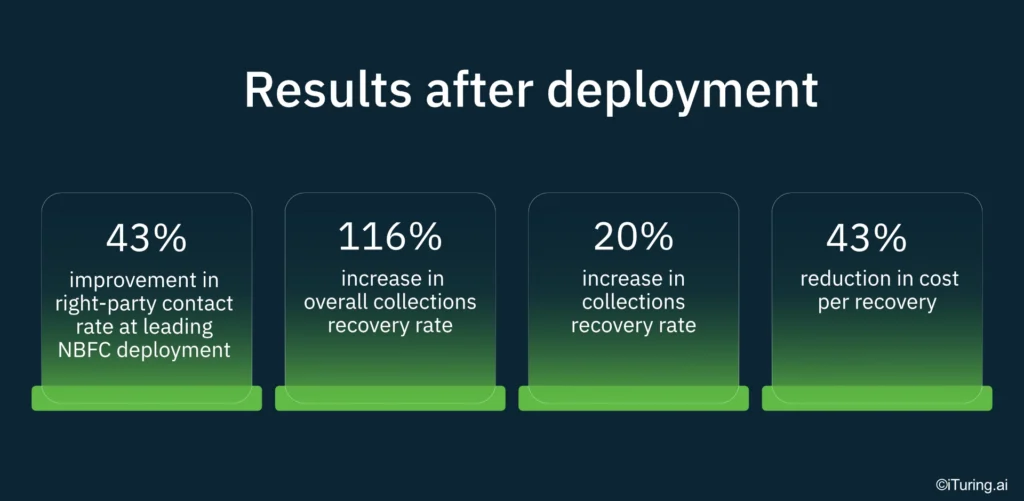
Step 3: Calculate recovery uplift using the 43% improvement in right-party contact rate documented at a leading NBFC deployment. If the current recovery rate on contacted accounts is 35%, a 43% improvement in contact rate does not add 43% to the recovery rate. It increases the number of accounts where a recovery conversation happens, which compounds into higher total recovery. The relationship is multiplicative: more right-party contacts multiplied by the existing conversion rate equals more recovered rupees.
Step 4: Calculate cost reduction using the 116% increase in overall collections recovery rate observed in the same deployment. When recovery output more than doubles while agent headcount remains constant, cost per recovery drops by more than half. The NBFC propensity timing model for right-party contact improvement in India delivers this through efficiency, not through hiring additional agents. This is the figure that resonates with CFOs: same cost base, double the output.
Step 5: Apply a compliance cost adjustment specific to the NBFC’s regulatory exposure. NBFCs operating under RBI’s digital lending guidelines and Fair Practices Code face specific conduct requirements for collections. Compliance violations in collections carry both financial penalties and reputational costs that are difficult to quantify but real. If the current operation allocates 5-8% of collections budget to compliance monitoring and remediation, an AI timing model that enforces compliant contact windows at the scheduling layer can reduce that allocation by 40-60%.
The calculation only works if the baseline is honest: start with 26% right-party contact rate under manual dialler operations as the anchor, not an aspirational figure.
43% Right-Party Contact Rate Improvement at a Leading NBFC: The Evidence
A leading NBFC in India with a multi-thousand-crore loan book faced right-party contact rates of 26-31% across its early-bucket collections portfolio, with manual dialler operations consuming significant agent capacity on unanswered and wrong-party calls. The institution deployed iTuring’s per-account contact timing model across its personal loan and two-wheeler finance portfolios, with full production deployment completed within 90 days of initial data integration.
Right-Party Contact Rate Is the Multiplier: What Moving From 26% to 47% Does to NBFC Collections Economics
The right-party contact rate is the single metric that most directly controls cost per recovery, agent productivity, and total recovery volume in NBFC collections. A 20 percentage-point improvement at constant call volume produces a 44% reduction in cost per recovery, a relationship that holds across portfolio types and ticket sizes. For any Head of Collections presenting to a CFO, the argument reduces to one sentence: reaching the borrower on fewer attempts means the same agent floor recovers more rupees.
iTuring’s per-account contact timing optimization is testable against your NBFC’s historical answer rate data before full deployment: request a proof of concept before any licence decision.
The One Metric That Determines Whether Your Collections Floor Generates or Destroys Value
Right-party contact rate is not one metric among many. It is the metric that determines whether every other collections investment: agent training, script optimisation, compliance infrastructure, and technology spend: produces a return or gets wasted on calls that never reach a borrower. The data from Indian NBFC deployments between 2024 and 2026 is consistent: moving from 26% to 44-51% right-party contact rates at constant call volume produces a 43% reduction in cost per recovery and a 116% increase in overall recovery rate. These are not theoretical projections. They are measured outcomes from production deployments across personal loan, vehicle finance, and MSME portfolios.