
Card NPAs Jumped 28% in a Year, Concentrated Almost Entirely in the Segment Instalment Models Handle Worst
TL;DR
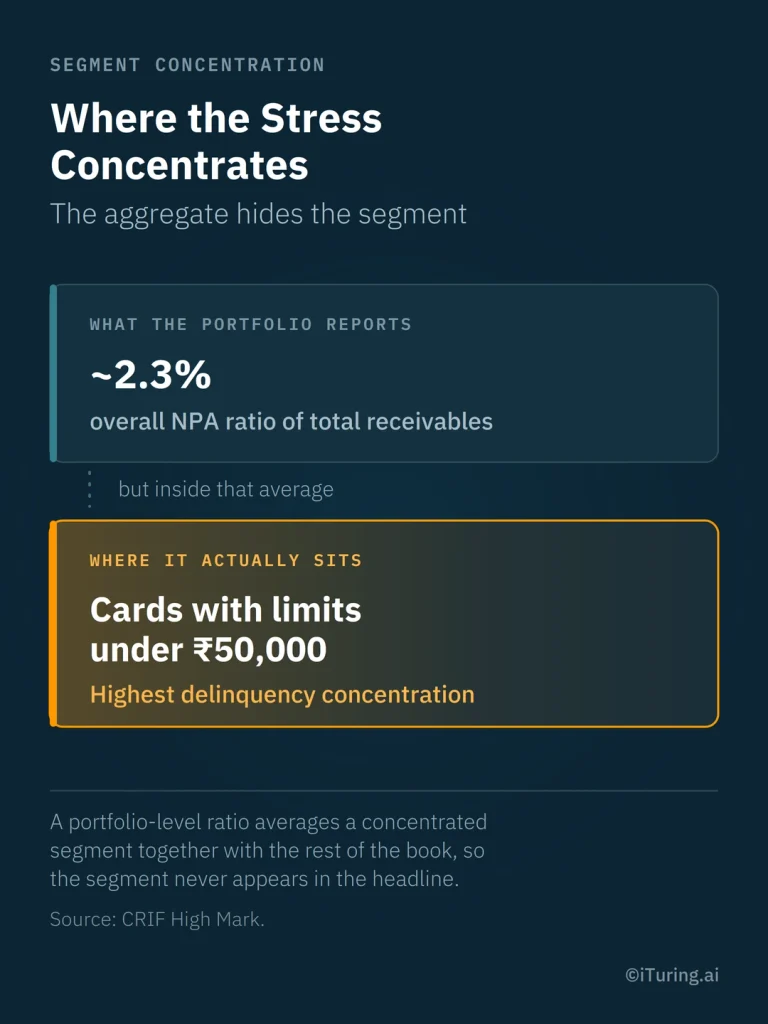
- Credit card NPAs in India rose 28.42% year-on-year to Rs 6,742 crore by December 2024, up from Rs 5,250 crore a year earlier, per RBI data, even as the NPA ratio stays modest at around 2.3% of the Rs 2.92 lakh crore in total outstanding receivables
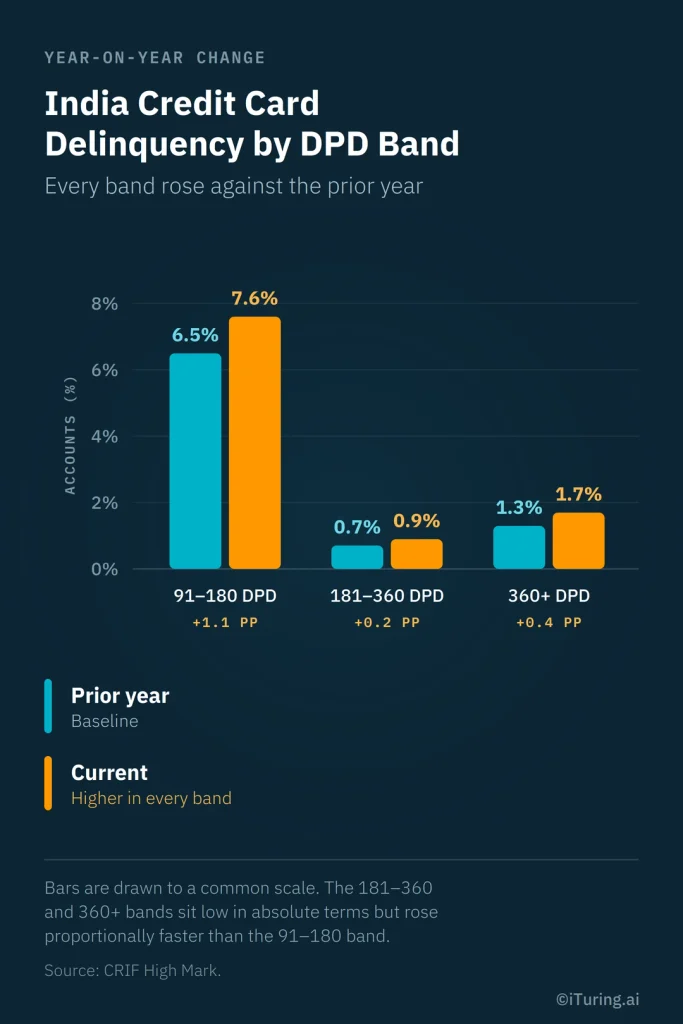
- CRIF Highmark data shows delinquency rising across every days-past-due band: the 91-180 DPD bucket climbed to 7.6% by mid-2024 from 6.5% a year prior, and 360-plus-day delinquency rose from 1.3% to 1.7%
- The highest concentration of delinquency sits specifically in cards with credit limits under Rs 50,000, a segment with materially different utilisation and payment behaviour than higher-limit cards
- Card issuers have responded by slowing new card growth sharply, from 19% year-on-year issuance growth in March 2024 to under 8% by March 2026, shifting toward cross-selling existing, already-known customers rather than acquiring new ones
- An instalment-loan-tuned collections model has no concept of utilisation trajectory or minimum-payment-pattern history, the exact signal families that matter most for the small-limit, high-delinquency segment now driving India’s card NPA growth
- Product-specific AI, not a retrained personal-loan model, is what actually addresses the segment where the stress is concentrated
India’s credit card NPA numbers moved sharply in a short window: a 28.42% year-on-year jump to Rs 6,742 crore by December 2024. The aggregate NPA ratio still looks manageable at roughly 2.3% of total receivables, but that aggregate number, like the MSME aggregate discussed elsewhere on this site, hides exactly where the stress concentrates. CRIF Highmark’s data points to a specific pocket: cards with limits under Rs 50,000, precisely the segment where instalment-style collections logic performs worst.
The Current India Credit Card Delinquency Picture
RBI data shows credit card NPAs climbing from Rs 5,250 crore in December 2023 to Rs 6,742 crore by December 2024, a 28.42% rise in absolute terms. CRIF Highmark’s tracking across delinquency bands shows the same direction: the 91-180 days-past-due bucket rose to 7.6% by mid-2024 from 6.5% a year earlier, the 181-360 DPD band rose from 0.7% to 0.9%, and 360-plus-day delinquency climbed from 1.3% to 1.7%. Card issuance itself slowed meaningfully in response, year-on-year growth in cards in circulation dropped from around 19% in March 2024 to under 8% by March 2026, as issuers pulled back from aggressive new-customer acquisition toward cross-selling cards to existing, already-underwritten customers.
The specific detail that matters most for collections strategy: CRIF Highmark’s reporting identifies the highest delinquency concentration in cards with credit limits under Rs 50,000. This is a materially different customer profile and utilisation pattern than higher-limit cards, and it’s exactly the segment where generic, instalment-adjacent collections logic is least equipped to help.
Why Instalment Models Break Down on This Specific Segment
An instalment loan model scores distance from a fixed repayment schedule, a concept that doesn’t map onto revolving credit at all, and it maps even less well onto the small-limit card segment specifically, where utilisation swings are proportionally larger relative to the credit line and minimum-payment cycling is a more common pattern than on higher-limit cards held by more affluent, lower-risk customers. A model built for personal loans or vehicle loans, then pointed at this segment, has no feature vocabulary for what’s actually happening in the account.
Utilisation Trajectory and Minimum Payment Behaviour, India-Specific
Utilisation trajectory, the rate of change in balance-to-limit ratio over a rolling window, matters more on small-limit cards precisely because the absolute rupee swings needed to move utilisation meaningfully are smaller, meaning trajectory shifts happen faster and more frequently than on a high-limit card held by a more stable-income customer. Consecutive minimum-payment cycles are a similarly important signal here: a customer on a Rs 30,000-limit card making only minimum payments for three consecutive cycles is showing a materially different risk pattern than a single missed payment, and this is the segment where that distinction determines whether early intervention can still help.
Balance Transfers and Cash Advances in the Indian Card Market
Balance transfer and cash advance behaviour carry the same distress signal value in the Indian market that they do elsewhere, a cash advance drawn against a small-limit card often reflects an already-exhausted set of other options, and this signal has no instalment-loan equivalent for a model to fall back on.
Segmenting Revolvers from Transactors
Given where India’s card NPA growth is concentrated, segmenting the small-limit, high-utilisation-volatility population from higher-limit, more stable-transactor customers isn’t an optional refinement, it’s the difference between a model that can see the specific segment driving NPA growth and one that averages it away into a portfolio-wide blend dominated by the larger, more stable customer base.
India Card Delinquency Trends and Recovery Benchmarks
Building recovery benchmarks specific to the small-limit segment, rather than applying portfolio-wide averages, reflects the reality that this segment behaves differently on every dimension: utilisation pattern, payment cycling, and response to early intervention. As issuers shift strategy toward existing-customer cross-selling rather than new acquisition, understanding this specific segment’s collections economics becomes more important, not less, since it’s now a larger share of where issuers are choosing to grow exposure.
Where iTuring Fits
iTuring’s AutoML+ builds revolving-specific feature families, utilisation trajectory, minimum payment pattern history, balance transfer and cash advance signals, calibrated specifically to segments like India’s small-limit card population where CRIF Highmark data shows delinquency concentrating, rather than a single model averaged across a full card portfolio dominated by lower-risk, higher-limit customers.
Sources
- Reserve Bank of India, credit card NPA data through December 2024
- CRIF High Mark, credit card delinquency trend reporting by DPD band, 2024
- RBI credit card issuance and card-in-circulation data through March 2026
- Verify most current quarter delinquency and NPA figures at time of publication, this segment moves quickly