TL;DR
- Global platforms claiming India-readiness mostly are not ready for India
- Four requirements separate genuine India-fit from adapted global tools
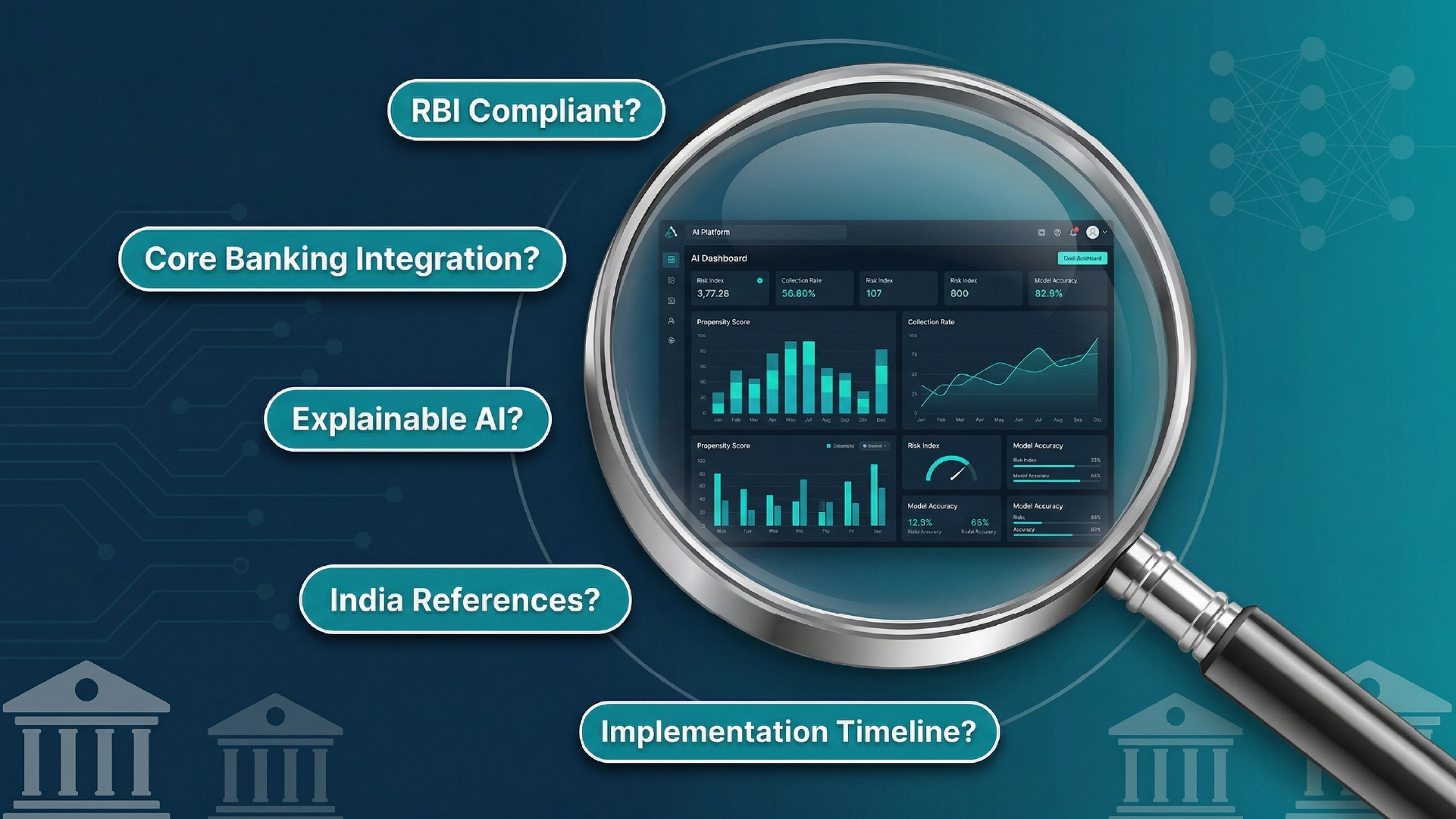
- Eight specific questions should drive every vendor evaluation conversation
- Build is rarely the right answer for Indian banks and NBFCs in 2026
- Total cost of ownership over 36 months is the correct comparison metric, not license fee
Every major global banking AI platform vendor now has an India page on their website. It mentions RBI. It shows the word “vernacular.” It references NBFC. Some have a case study featuring a bank you have never heard of.
This is the problem.
The Indian banking AI platform market attracted significant global attention after India’s digital lending surge crossed Rs. 47 lakh crore in 2025. Where attention flows, vendor claims follow. And when every vendor claims India-readiness, the claim becomes functionally meaningless. The technology head at an upper-layer NBFC or a mid-size scheduled commercial bank cannot select a collections AI platform based on a landing page. They need a structured evaluation framework that separates genuine India-fit from a platform adapted at the margins.
This article is that framework. It applies equally to specialist debt collection software and to broader banking AI platforms with a collections module.It applies equally to specialist debt collection software and to broader banking AI platforms with a collections module. It covers what India-readiness actually means in regulatory and operational terms, the eight questions every vendor needs to answer before a shortlist decision, the build-versus-buy analysis relevant for 2026, the total cost of ownership calculation that most procurement processes get wrong, and the red flags that should end a vendor conversation before it wastes further time.
The India-Specific Requirements Most Global Platforms Fail
India’s collections regulatory environment is genuinely distinct. The RBI issued 147 regulatory circulars on digital lending and collections practices between 2022 and 2025. Aggregate penalties levied on NBFCs for collection-related violations in FY 2024-25 totalled Rs. 48 crore. The RBI’s Fintech AI (FREE-AI) Committee, constituted in December 2024, is developing an explicit regulatory framework for AI use in Indian financial services that will add further compliance requirements to all AI-driven collections operations in 2026 and beyond.
A platform built for US FDCPA compliance or European GDPR requirements is not the same as a platform built for this environment. Four requirements define genuine India-fit.
RBI Digital Lending Guidelines compliance, not just awareness. The RBI Digital Lending Master Direction, progressively tightened since its 2022 issuance, requires that every AI-driven collection interaction clearly identify the regulated entity making the communication, disclose the grievance redressal mechanism to the borrower, obtain and verify channel consent before initiating digital outreach, and store all borrower data in India-region data centres. A platform that is “aware” of these requirements is not the same as one that has hardcoded them into its contact flow architecture. The distinction is the difference between a human agent following a checklist and a system that cannot deviate from the compliance requirements regardless of what the agent or the AI model might prefer to do.
The RBI also mandates 100 percent call recording for all collection communications, with recordings stored in a format that is searchable, retrievable, and submissible to RBI examiners on request. Any platform that cannot demonstrate this capability natively, without a third-party bolt-on, does not meet the baseline audit trail requirement.
SARFAESI workflow integration, not just acknowledgment. Most global platforms acknowledge SARFAESI exists. A platform genuinely integrated with SARFAESI manages the Section 13(2) notice issuance timeline, tracks the 60-day response period, flags accounts where the window is closing, sequences pre-enforcement contact interventions based on payment propensity, and connects the collections outcome to the SARFAESI decision logic. This is a workflow integration, not a documentation feature. A platform that cannot demonstrate this in a live demo is not SARFAESI-integrated regardless of what the brochure says.
Vernacular support across at least six languages, with dynamic selection. Hindi and English together cover roughly 60 percent of India’s population. A national bank or upper-layer NBFC with geographic distribution across South India, the North-East, and coastal West India is operating in a language environment that requires at minimum Tamil, Telugu, Kannada, Marathi, Bengali, and Gujarati in addition to Hindi. The requirement is not just multilingual audio for IVR, it extends to WhatsApp message templates, AI voice agent scripting, and SMS content, all dynamically selected based on the borrower’s registered language preference without agent intervention.
DPDP Act 2023 compliance architecture. India’s Digital Personal Data Protection Act 2023 introduced data principal rights that directly affect how borrower data is used in AI collections workflows. Consent records for data processing must be maintained. Borrowers have the right to access, correct, and withdraw consent from data processing. Any collections platform that processes borrower data for AI model training or contact optimisation must have a compliance architecture that satisfies DPDP requirements, including data localisation, consent management, and data erasure capabilities.

The Evaluation Framework: Eight Questions to Ask Any Banking AI or Predictive Analytics Platform Vendor
Whether a platform is positioned as a specialist collections AI tool or a broader predictive analytics software suite with a collections module, the same eight questions determine genuine India-readiness. They are sequenced from compliance gatekeepers to commercial differentiators. A vendor who fails questions one through three should not progress to questions four through eight.

Question 1: Show me the RBI compliance audit trail in a live environment.
Not a demo environment. Not a prepared walkthrough. Ask to see the full audit trail for a recent AI-generated collection interaction in a production environment, including timestamp, caller ID registration, grievance disclosure, consent verification, and call recording link. If the vendor cannot produce this in a live session, the compliance capability does not exist at production scale.
Question 2: Walk me through a SARFAESI-triggered account in your system.
Ask the vendor to demonstrate an account moving through the pre-SARFAESI contact intervention sequence, the 13(2) notice issuance, the 60-day countdown tracking, and the enforcement flag trigger. The workflow should be entirely within the platform, not a separate legal case management tool with a manual data handover.
Question 3: Demonstrate vernacular AI voice in Tamil and Kannada.
If the vendor’s vernacular capability extends only to Hindi and English in live demos, their regional language capability is not production-ready for a national portfolio. Ask for a live AI voice call demonstration in at least two South Indian languages with dynamic language switching mid-call if the borrower responds in a different language.
Question 4: What is your implementation timeline, and what is specifically included?
A genuine four-to-six week implementation for an Indian bank or NBFC includes data integration with the core banking system, model training on the institution’s own historical collections data, compliance testing across all contact channels, regulatory documentation of the AI model for RBI examination purposes, and team onboarding. Any vendor quoting four weeks who then separately scopes the integration project is not quoting a real timeline.
Question 5: Which Indian core banking systems do you integrate with natively?
Finacle is deployed at most PSBs and many large private sector banks. Temenos T24 and Nucleus FinnOne are common in the mid-size bank and NBFC segment. Flexcube is widely used in cooperative and regional banks. A platform that requires a custom API development project for your specific core banking system is carrying hidden implementation cost and timeline risk that the headline fee does not reflect. Ask specifically for a list of certified, production-ready integrations, not planned integrations.
Question 6: How are your propensity models retrained, and who governs the retraining process?
For RBI examination purposes, the governance of model retraining is as important as the initial model validation. The vendor must be able to describe who approves retraining, how material changes to model behaviour are defined and detected through continuous model monitoring, and how the retraining governance documentation is maintained in a form reviewable by RBI examiners. Retraining governance is also what determines whether the platform can support real-time credit risk decisioning reliably across changing economic conditions, a model retrained reactively rather than on a governed cadence will drift against live portfolio behaviour before the breach is detected. A vendor who cannot answer this question is not ready for the regulatory environment Indian banks operate in.
Question 7: What are your explainability capabilities at the account level?
RBI’s FREE-AI Committee has signalled that explainability will be a formal requirement for AI systems in Indian financial services. A platform that produces propensity scores without account-level explanations for how the score was generated will face a compliance gap when these requirements take formal effect. Ask specifically for a SHAP waterfall chart or equivalent explanation for a sample high-risk account.
Question 8: Who are your India reference clients, and can I speak with them?
Reference clients must be comparable in portfolio composition, asset size, and institutional type. A reference client who is a large PSB is not relevant validation for an upper-layer NBFC with a personal loan book. Ask for two or three reference clients who match your profile and arrange direct conversations without vendor involvement.
Build vs. Buy vs. Partner: The 2026 Indian Market Reality
Four years ago, building an internal collections AI capability was a defensible choice for Indian banks with strong data science teams. The model validation could be managed internally, the regulatory requirements were less prescriptive, and the competitive advantage from proprietary models was meaningful.
That calculation has changed substantially in 2026 for three reasons.
Data science talent costs have risen sharply. A senior ML engineer with credit risk experience in India’s financial services sector commands Rs. 40 to 70 lakh per annum. A minimal viable internal collections AI team like model development, MLOps, data engineering, compliance governance, requires five to seven people. The annual people cost alone exceeds Rs. 2 to 4 crore, before infrastructure, data costs, and model maintenance overhead.
RBI governance requirements have made internal model maintenance significantly more expensive. An internally built collections AI model must meet the same RBI audit trail, explainability, and governance documentation standards as a vendor platform. Without a dedicated model governance function, internal AI teams typically cannot produce examination-ready documentation at the standard RBI examiners now expect. The cost of building that governance capability internally is now comparable to the total cost of a vendor platform.
Vendor platforms have compressing implementation timelines. In 2022, a credible vendor implementation took twelve to sixteen weeks. In 2026, well-engineered platforms with pre-built Indian core banking integrations implement in four to six weeks, with model training on institution-specific data included. The time-to-value gap between build and buy has narrowed to the point where build only makes sense for institutions with unusual data assets or strategic reasons to develop proprietary AI capability.
The “partner” option, where a bank licenses a vendor platform but retains internal control of model governance and retraining, is the correct choice for upper-layer NBFCs and large private sector banks where regulatory scrutiny of AI governance is most intense. As ai for banks continues to mature across India’s financial sector, institutions that adopt the partner model gain the implementation speed and compliance architecture of a proven vendor platform without surrendering the governance accountability that high-tier regulatory oversight requires. It combines the pre-built compliance architecture of a vendor platform with the governance oversight that high-tier institutions need to maintain internally.
The Total Cost of Ownership Question

Most procurement processes for banking AI platforms compare license fees. This produces the wrong answer almost every time.
The correct comparison unit is total cost of ownership over 36 months, because that is the realistic period over which a collections AI platform needs to deliver ROI against the selection decision. Over 36 months, five cost categories determine the real comparison.
Licensing and platform fees. The headline cost. Typically charged per account under management or as a percentage of recovered value. This is the only number most procurement conversations focus on, and it is the smallest source of variance between credible vendors.
Implementation and integration costs. Core banking integration, data migration, compliance testing, and initial model training. For platforms without native Finacle or Temenos integration, this cost can run Rs. 50 to 80 lakh in professional services fees for a mid-size bank. For platforms with certified integrations, it is typically included in the implementation fee.
Ongoing model governance overhead. RBI compliance documentation, model retraining governance, audit trail maintenance, and examination preparation. Model monitoring cadence is the primary driver of this overhead: a platform that requires manual monitoring review generates significantly higher internal governance cost than one with automated threshold breach detection and escalation logging. For a vendor platform with built-in governance tooling, this overhead is managed by the vendor. For an internal build or a platform with thin governance capabilities, this cost falls to the institution’s internal teams.
Attrition replacement costs. Collections operations running on manual agent workflows in India face 40 to 60 percent annual agent attrition in BPO environments. Each agent replacement carries recruitment, training, and productivity ramp costs. An AI-driven platform that reduces agent headcount by 40 to 60 percent reduces this attrition-driven cost proportionally.
Compliance penalty risk. A single RBI show-cause notice for collection-related violations can result in penalties that dwarf the 36-month license cost of a compliant platform. The penalty risk of a non-compliant or partially compliant platform is a cost that belongs in the TCO calculation even though most procurement processes treat it as unquantifiable.
Red Flags to End a Vendor Conversation
Some signals in a vendor demo are informative. These five are disqualifying.
No live RBI compliance demonstration. If the vendor cannot show the full audit trail for a production interaction on request, the compliance capability does not exist at production scale. A slide deck explaining how compliance works is not a compliance demonstration.
No India reference clients in a comparable segment. A vendor with five years in India and no reference clients you can speak with who match your institution type has not achieved production-grade deployment in your segment. The reference client list tells you more than any demo.
Vernacular capability limited to Hindi and English. As established above, this is not adequate for a national institution. If the vendor cannot demonstrate Tamil or Kannada in a live voice interaction, their vernacular claims are aspirational.
No account-level explainability for propensity scores. A black-box model that cannot produce an explanation for why a specific account received a specific propensity score is a regulatory liability that will become more acute as the FREE-AI Committee finalises its framework.
Implementation timeline beyond eight weeks for a standard deployment. Genuine platforms with pre-built Indian core banking integrations implement in four to six weeks. A quote of twelve or more weeks for a standard bank or NBFC deployment signals either immature integration capability or an underresourced implementation team.
How iTuring Addresses This
iTuring’s collections AI platform was built for the Indian regulatory environment, not adapted from a global product for the Indian market.
Every RBI Digital Lending Guidelines requirement is hardcoded into the platform’s contact flow architecture: entity identification, grievance disclosure, consent verification, and call recording are mandatory and non-bypassable in every AI-generated interaction. The audit trail is complete, retrievable, and formatted for RBI examination on request.
SARFAESI workflow management is integrated into the collections decisioning engine. Pre-SARFAESI contact interventions are sequenced automatically based on payment propensity, and the 13(2) and 13(4) timeline tracking runs within the same platform as the AI contact strategy.
Vernacular AI voice and messaging are supported across ten Indian languages, including Tamil, Telugu, Kannada, Marathi, Bengali, and Gujarati, with dynamic language selection based on the borrower’s registered preference. Core banking integrations with Finacle, Temenos T24, Nucleus FinnOne, and Flexcube are certified and production-ready, with standard implementations completing in four to six weeks.
For upper-layer NBFCs and private sector banks requiring internal governance oversight, iTuring’s partner deployment model provides full platform capability with institution-controlled model governance and examination documentation.
Regulatory Disclaimer
This article is for informational purposes only and does not constitute legal or compliance advice. RBI guidelines, SARFAESI eligibility criteria, Digital Lending Master Direction requirements, and DPDP Act obligations are subject to change. Information presented reflects publicly available RBI guidance and industry data as of the publication date. Consult qualified legal and compliance professionals for guidance specific to your institution.
Sources: CarmaOne: RBI Compliant AI Collections Guide India 2026 | CarmaOne: Agentic AI in Debt Collection India 2026 | Vinod Kothari: AI in Lending Transactions Regulatory Review | Mondaq: FREE-AI Committee Report RBI | Subodh Bajpai: SARFAESI Act Explained | Edesy: AI Debt Collection India 2026 | LinkedIn: Indian Banks Core Banking Finacle TCS | Credility: Digital vs Manual Debt Collection NBFCs | LinkedIn: Build vs Buy Digital Lending | Inspirisys: Comparing Temenos and Finacle