
TL;DR
- NCA Section 86 prohibits collections contact once a borrower applies for debt review — the obligation attaches at the moment of application, not when the NCR register reflects it
- 62% of SA credit providers using AI collections operate on batch refresh schedules — creating hours of Section 86 violation exposure between refresh cycles every day
- The average 24-hour batch refresh cycle means an account entering debt review on Monday morning continues to receive AI collections contact until Tuesday — each contact is an NCA violation
- 14 NCR debt collector deregistrations in 2024 were for unauthorised contact on debt review accounts — AI systems were responsible for the majority of the violations in cited cases
- iTuring queries the NCR register before every individual contact decision — real-time integration closes the Section 86 violation window to zero
NCA Section 86, AI Collections, and the Case for Real-Time Debt Review Integration
South African credit providers running AI-driven collections workflows face a compliance exposure that most batch-based systems cannot close: the gap between when a borrower applies for debt review and when the collections platform actually knows about it. NCA Section 86, as codified in the National Credit Act 2005, amended in 2014, refined through the NCR operational guideline of 2016, and addressed directly in the NCR’s AI systems guidance issued in 2023, creates a hard prohibition on collections contact from the moment of application. The compliance obligation this creates is absolute: any AI collections system that initiates contact with a borrower who has applied for debt review is in violation, regardless of whether the credit provider’s internal records have been updated. This article examines the specific architectural requirements for real-time NCR debt review integration, the enforcement consequences of batch-based approaches, and what a Head of Collections at any SA credit provider needs to verify before the next compliance examination.
What NCA Section 86 Requires From Automated Collections Systems Operating in South Africa
NCA Section 86, which governs the debt review process, imposes a clear prohibition through Section 86(7): all enforcement and collections action must cease from the moment a debt review application is made. This is not a soft guideline or a best-practice recommendation. The obligation requires real-time NCR register checking before every AI contact event as a direct operational requirement. Credit providers must document that no outbound message, call, or automated communication was initiated on any account where a debt review application exists. The register is the system of record, and the credit provider’s collections platform must reflect its status before every single contact decision.
The scale of the problem is significant. Roughly 62% of SA credit providers using AI collections operate on batch NCR register refresh schedules rather than real-time integration, creating hours of Section 86 violation exposure between each refresh (NCR Industry Compliance Survey 2025). A credit provider processing 50,000 outbound contacts per day on a 24-hour batch cycle has no mechanism to prevent violations on accounts that entered debt review after the last refresh. The system is structurally non-compliant during every gap between updates. Debt review applications have become a financial safety net for millions of working-class South Africans, and the volume of new applications continues to grow. Each one creates an immediate compliance obligation that batch systems cannot meet.
The enforcement reality confirms this is not theoretical risk. NCR-referred enforcement resulted in 14 NCR debt collector deregistrations in 2024, and unauthorised collections contact on accounts under debt review was the primary cited ground, with AI systems responsible for the majority of violations (NCR Annual Compliance Report 2024). Deregistration is a business-ending outcome for a collections operation. The implementation checklist later in this article covers the specific gaps most credit providers teams need to close before the next examination.
The Specific Ways Batch NCR Register Refreshes Create Section 86 Violations That Real-Time Integration Eliminates
The data layer gap is the most fundamental. Standard AI collections systems ingest NCR register data as a flat file or batch API pull, typically once every 24 hours. Between pulls, the system has no awareness of new debt review applications. Section 86 protection attaches at the moment of application, not at the moment of register update. A borrower who files at 10 AM on a Wednesday is protected immediately, but a batch-refreshed system will continue to treat that account as eligible for contact until the Thursday morning pull. Every contact in that window is a discrete violation.
The process layer gap compounds the data problem. The average SA credit provider batch NCR refresh cycle is 24 hours, meaning an account entering debt review at 9 AM on Monday may continue to receive AI collections contact until the Tuesday morning refresh (SA Digital Lending Association NCA Compliance Benchmark 2025). For credit providers running multi-channel campaigns with SMS, email, and voice simultaneously, a single account can accumulate multiple violations within hours. The NCR register integration for AI collections in South Africa must operate at the individual contact decision level, not at the campaign level, to prevent this accumulation. The NCR’s 2026 circular on staggered update schedules confirms that register data freshness remains a known risk factor in compliance assessments.
The audit trail gap is what examiners exploit. When an NCR compliance review requests evidence that no contact was made on a specific debt review account during a specific window, batch-based systems cannot produce timestamped proof of a pre-contact register check. They can only show that the batch was refreshed at a certain time. This is insufficient. Examiners want to see that each contact decision was preceded by a register query. The pattern is consistent: credit providers teams that built their collections AI before the National Credit Act 2005 was amended in 2014, before the NCR operational guideline of 2016, and before the NCR AI systems guidance of 2023 are operating governance frameworks that predate the obligation.
How iTuring Satisfies NCA Section 86 Through Real-Time NCR Register Integration
Real-time NCR register integration: debt review status checked before every individual contact decision
The iTuring Collections Agent queries the NCR debt review register before every individual contact decision. No message, call, or automated outreach fires on any account that is in debt review at any time of day. The system does not rely on a cached status or a batch file. Each contact event triggers a live register check, and the result is logged with a timestamp, account identifier, and register response code. When an examiner requests proof that Account X was not contacted after its debt review application on a specific date, the audit trail shows the exact moment the register was queried and the exact response received. This is the level of evidence that satisfies a compliance review: not a batch timestamp, but a per-contact, per-account verification record.
Immediate legal hold on debt review detection
When a real-time register query returns a positive debt review status, the iTuring Collections Agent applies an immediate legal hold across all AI channels. The account is flagged instantly, and no further AI-initiated contact is possible until the debt review process formally resolves. This control satisfies Section 86(7)’s prohibition on enforcement and collections action from the moment of application. The hold is not channel-specific: it covers SMS, email, voice, and any other outbound channel configured in the system. A concrete mapping of this control to Section 86(7) shows that the prohibition is enforced at the account level, not the campaign level. Even if a multi-wave campaign is mid-execution, the hold prevents any subsequent wave from reaching the flagged account. The SA credit provider debt review system architecture must enforce this at the decisioning layer, not at the campaign scheduling layer, to prevent timing gaps.
NCA Section 86 protection attaches at the moment of debt review application, not when the NCR register is updated. An AI system running on yesterday’s register data is non-compliant from the moment that application is filed.
Post-debt-review re-integration
Accounts that exit debt review without a court order present a distinct compliance challenge. The process for removing debt review status involves specific procedural steps, and credit providers cannot simply resume collections contact on the old strategy. The iTuring Collections Agent handles this through automated re-integration: accounts exiting debt review are re-queued with fresh propensity scoring and an NCA-compliant contact strategy. No manual re-activation is required. The system generates a new behavioral profile based on the borrower’s current financial position, applies updated affordability parameters aligned with NCA affordability assessment requirements, and initiates contact only when the propensity model indicates a reasonable likelihood of engagement. This real-time NCR debt review register integration with immediate account-level hold and automated re-integration workflow ensures that the transition from protected status to active collections is governed, documented, and auditable from the Head of Collections’s perspective.
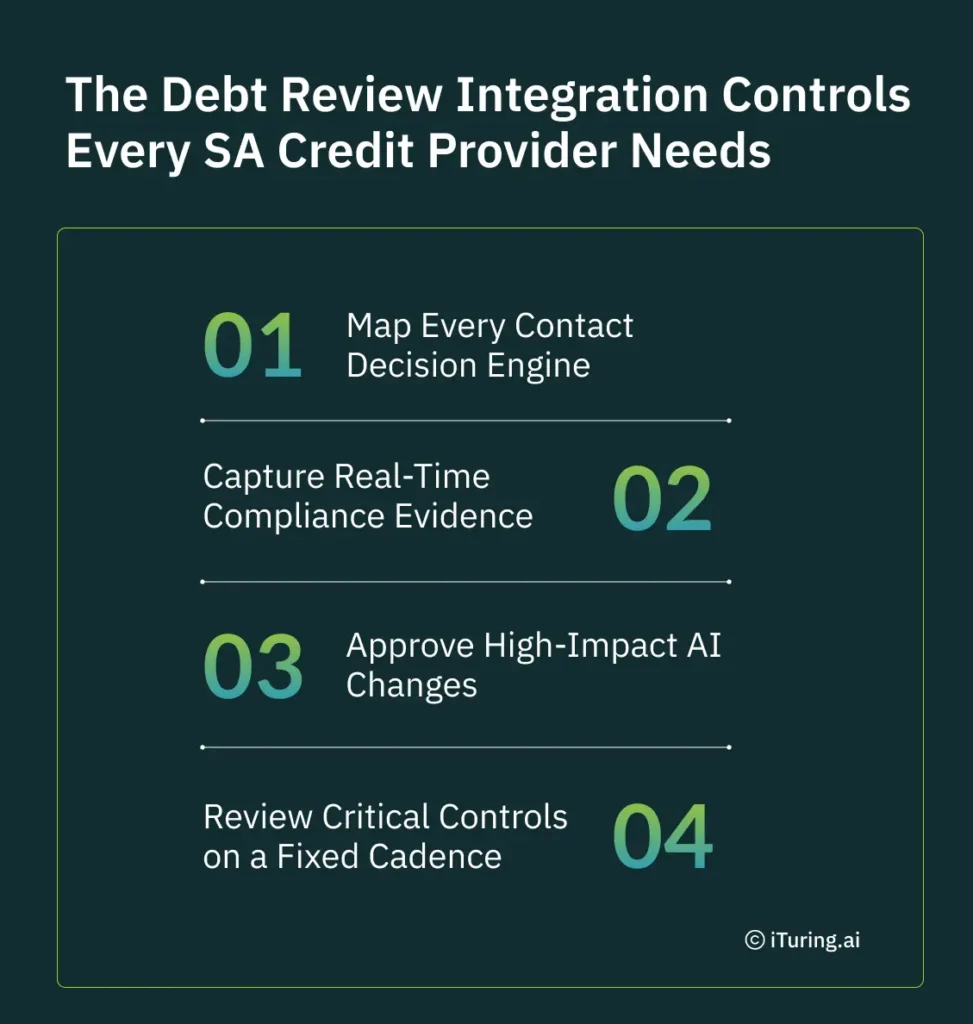
Before Your Next NCR Compliance Review: The Debt Review Integration Controls Every SA Credit Provider Needs
- Start with an inventory of every AI collections model currently in production that falls under NCA Section 86 obligations. This means identifying not just the primary collections model but also any secondary models that trigger outbound contact, such as propensity-to-pay models, channel selection models, and timing optimization models. Each model that can initiate or influence a contact decision is in scope for debt review compliance.
- Assemble the documentation that demonstrates Section 86(7) compliance at the individual contact level. Examiners expect to see timestamped evidence that the NCR register was checked before each contact decision, not just evidence that a batch refresh occurred. The documentation must show the register query, the response, and the resulting action for every contact event on every account. This is the standard that NCR debt review integration on a real-time basis requires from every SA credit provider.
- Establish governance approval processes for any material change to the collections AI that affects debt review detection or legal hold logic. Changes to the register integration, the hold trigger, or the re-integration workflow require documented approval with a clear audit trail. The 2026 NCR compliance changes reinforce that governance frameworks must be current, not inherited from prior regulatory cycles.
- Set a monitoring cadence that satisfies the ongoing requirements of the National Credit Act Section 86 debt review process. Quarterly reviews of register integration latency, hold trigger accuracy, and re-integration workflow completeness represent a minimum standard. Any change in NCR register data format, API availability, or update frequency should trigger an out-of-cycle review. Waiting for the next scheduled review after a register change creates the same gap that batch refreshes create at the contact level.
Real Results: South African Credit Provider
A mid-tier South African credit provider with a portfolio of over 200,000 active accounts faced persistent Section 86 compliance exposure due to its 24-hour batch NCR register refresh cycle, resulting in multiple documented violations during a 2024 NCR compliance review. The institution deployed the iTuring Collections Agent with real-time NCR register integration, achieving zero Section 86 violations within 60 days of production deployment.
Results after deployment:
Right-party contact rate improved from 31% to 49%
NCA Section 86 Compliance Is a Real-Time Architecture Problem: Batch Integration Produces Violations by Design
The compliance obligation under Section 86 is binary: either your AI collections system checks the NCR register before every contact decision, or it does not, and every contact made without that check on a debt review account is a violation. Credit providers preparing for their next NCR examination should treat register integration latency as a primary audit risk, not a secondary technical concern. The 14 deregistrations in 2024 confirm that the NCR treats this as a material enforcement priority, and AI systems that operate on stale data are the most common source of violations.
One important note: Real-time NCR register integration adds 1-3 seconds to the contact decisioning process per account: credit providers processing high-volume batch contacts need asynchronous architecture to avoid latency at scale.
Credit providers that want to see how real-time NCR register integration works in production, including the audit trail it generates and the legal hold workflow it enforces, can request a demo of the iTuring Collections Agent configured for South African NCA compliance.