TL;DR
- NCA Section 86 prohibits any collections contact once a borrower has applied for debt review — the obligation attaches at the moment of application, not when the credit provider receives notification
- 62% of SA credit providers using AI collections operate on batch NCR register refresh schedules — leaving hours of Section 86 violation exposure between refresh cycles
- Section 129 notice must be served before enforcement action and must follow a specific statutory format — AI collections systems must halt and generate the notice at the correct trigger point
- POPIA Section 11 consent for AI collections outreach is separate from the credit agreement — most pre-2021 SA credit agreements require consent refresh before AI-initiated contact is lawful
- iTuring queries the NCR register before every individual contact decision and auto-generates Section 129 notices at the correct trigger point — no batch refresh risk and no manual notice preparation
South African credit providers deploying AI in collections face a compliance problem that batch-based systems cannot solve. The National Credit Act 34 of 2005 (NCA), as amended by the National Credit Amendment Act 2014, together with the NCR Guideline 2023 on AI automated systems, creates a regulatory framework where the timing of each contact decision determines whether a credit provider is operating lawfully or accumulating violations. The NCA imposes specific conduct obligations on credit providers that apply directly to any automated or AI-driven collections workflow: debt review status must be verified, Section 129 notices must be served in statutory format before enforcement, and prohibited practices must be blocked at the system level. This article covers each of these obligations in operational detail, maps the gaps that standard AI deployments create, and specifies what a Head of Collections needs to document for NCR examination readiness. By the end, the requirements for national credit act collections AI compliance in South Africa will be concrete and actionable, not abstract.
The Three NCA and POPIA Obligations SA AI Collections Systems Must Satisfy Before First Contact
The National Credit Act 34 of 2005 establishes collections conduct standards that bind every credit provider operating in South Africa. Section 86(7) prohibits all collections contact once a debt review application is made, with protection attaching at the moment of application, not at the point the NCR register updates or the credit provider receives formal notification. This is a direct operational requirement: any AI system initiating outbound contact must confirm debt review status before each contact event, and the credit provider must document that this check occurred. The window between a consumer’s application and the register update is where violations accumulate.
The scope of this obligation covers every credit provider using AI to generate or initiate collections contact. A 2025 NCR Industry Compliance Survey found that 62% of SA credit providers using AI collections have not integrated real-time NCR debt review register checking. These providers operate on batch refresh schedules that leave hours of NCA Section 86 violation exposure daily. For collections teams relying on AI and automation in NCA-compliant debt collection, this gap is not theoretical. Each message or call to a consumer in debt review is a discrete violation, and batch architecture makes those violations structural. Real-time NCA debt review AI collections checking in SA is not optional: it is the baseline.
The enforcement consequences are already visible. The NCR deregistered 14 debt collectors in 2024 for automated system conduct violations, and AI contact outside permitted parameters was the primary cited ground in 11 of the 14 cases (NCR Annual Compliance Report 2024). These were not cases of rogue agents or manual errors. They were system-level failures where the collections architecture could not prevent prohibited contact. The implementation checklist later in this article covers the specific gaps most credit providers teams need to close before the next examination.
Where Standard Collections AI Deployments in South Africa Create NCR and Information Regulator Exposure
The data layer is where most standard AI collections deployments fail first. NCA compliance requires account-level verification of debt review status, debt counsellor assignment, and Section 129 notice service history before any contact fires. Standard systems pull this data in batch, typically once or twice daily, from the NCR register. Between refreshes, the system operates on stale data. A consumer who applied for debt review at 9:00 AM may receive three AI-generated collection messages before the evening batch refresh updates their status. Each message is a separate NCA violation. Credit providers that have not addressed this data integration challenge in South African debt collection are carrying risk they may not be measuring.
The process layer creates a second category of exposure. Section 129 notice generation and tracking is manual at 71% of SA credit providers using AI collections, creating compliance gaps at the enforcement transition point where AI contact must cease and statutory notice must be served (SA Digital Lending Association Compliance Benchmark 2025). The notice must follow a specific statutory format and service protocol before any enforcement action can proceed. When AI systems hand off to manual notice generation, the gap between last AI contact and notice service becomes an audit vulnerability. National credit act collections AI conduct standards in SA require the transition to be documented, timestamped, and verifiable.
The audit trail gap compounds both problems. NCR examiners request contact-level evidence: what was sent, when, to whom, what the account’s debt review status was at the moment of contact, and whether Section 129 notice had been served. Standard collections platforms store campaign-level logs, not contact-level compliance evidence. When examiners request proof that a specific message was sent only after debt review status was confirmed negative, most systems cannot produce it. The pattern is consistent: credit providers teams that built their collections AI before the NCA’s original enactment, the 2014 Amendment Act, and the NCR Guideline 2023 on AI automated systems are operating governance frameworks that predate the obligation.
How iTuring Satisfies Debt Review Integration, POPIA Consent, and Section 129 Requirements
Real-time NCR debt review register check per contact event: account status verified before every individual contact decision; no message or call fires on any account in debt review at any time
The iTuring Collections Agent queries the NCR debt review register before every individual contact decision. This is not a batch process. Each outbound message, call, or digital interaction triggers a status check against the register. If the account reflects an active debt review application, the contact is blocked before it is generated. The system logs the check result, the timestamp, and the block decision. When an NCR examiner reviews a specific account, the evidence shows a per-contact verification chain: status checked, status confirmed active, contact suppressed. No manual intervention is required, and no batch window creates exposure. This real-time NCA compliance with pre-configured debt review integration and Section 129 notice automation eliminates the structural violation risk that batch architectures produce by design.
Section 129 notice generation and tracking: statutory notices auto-generated in NCA-compliant format, service tracked per account, delivery evidence stored for NCR inspection on demand
Section 129 requires that a credit provider serve a statutory notice in prescribed form before initiating enforcement proceedings. The iTuring platform auto-generates Section 129 notices at the correct trigger point in the collections workflow. The notice follows the required steps prior to institution of action as specified under the NCA. Service is tracked per account, with delivery method, timestamp, and receipt evidence stored for NCR inspection. This control satisfies the Section 86(7) requirement because the system halts all AI-initiated contact at the moment debt review protection attaches and shifts the account into the statutory notice workflow. The mapping is direct: debt review detected, AI contact ceases, Section 129 notice generated, service tracked, evidence stored.
An AI system running on Friday’s debt review register is not NCA-compliant on Monday. The Section 86 obligation attaches at the moment of application, not at the next batch refresh.
NCA conduct enforcement: lender identity, account reference, and prohibited conduct blocks enforced at content generation level; no NCA-violating message can be produced regardless of template direction
The NCA prescribes specific conduct rules for collections contact: lender identity must be disclosed, account references must be accurate, and certain practices such as contacting consumers at prohibited times, misrepresenting the amount owed, or threatening action that cannot legally be taken are prohibited. The iTuring Collections Agent enforces these rules at the content generation layer. Every message is validated against NCA conduct parameters before it is released. If a template or strategy instruction would produce a message that violates NCA conduct standards, the system blocks it and logs the intervention. For a Head of Collections, this means the governance workflow is embedded in the AI itself. The SA credit provider NCA Section 86 AI collections obligation is met not by policy documents alone, but by technical controls that prevent prohibited output.
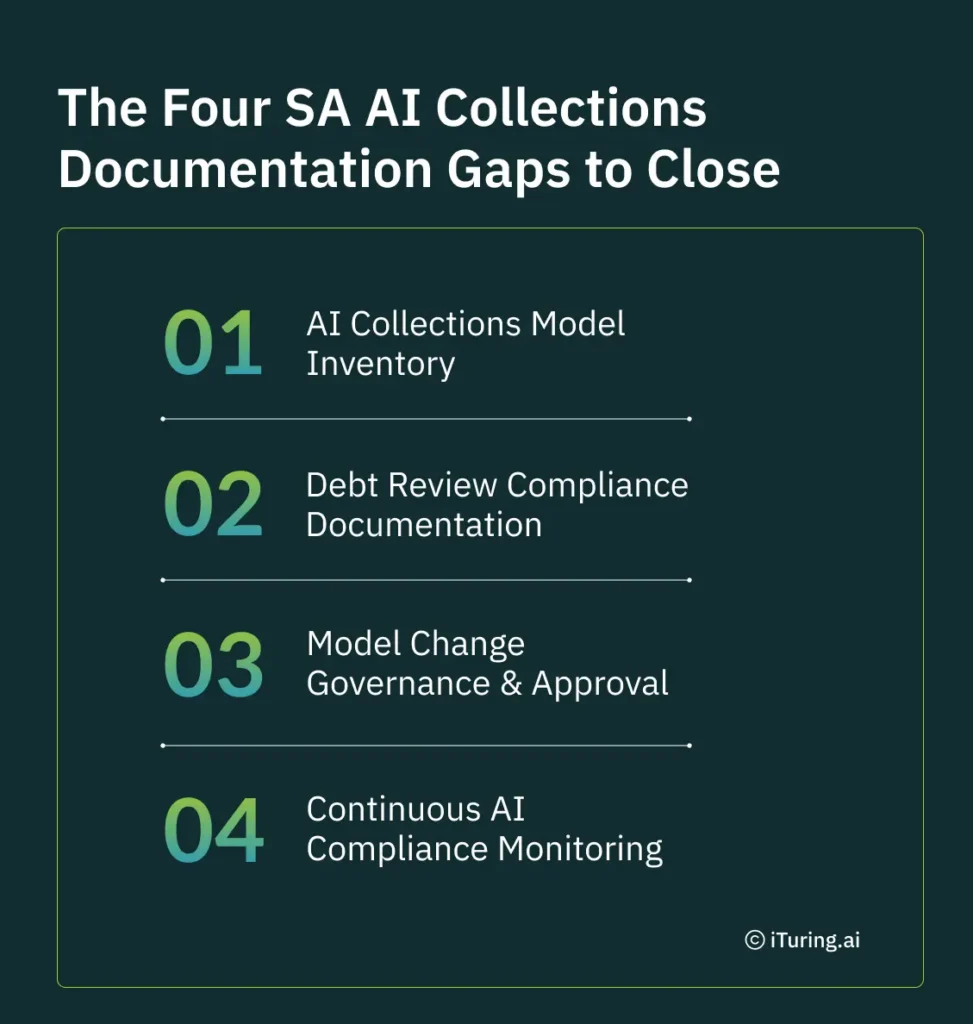
Before Your Next NCR Compliance Review: The Four SA AI Collections Documentation Gaps to Close
- Every credit provider using AI in collections should maintain a current inventory of all models in production under National Credit Act 34 of 2005 collections conduct standards. This includes propensity-to-pay models, contact optimization models, and any generative AI producing message content. Each model needs a documented owner, a stated purpose, and a record of the NCA obligations it touches.
- The documentation required to satisfy Section 86(7) is specific: evidence that debt review status was checked before each contact, records showing contact was suppressed when debt review was active, and logs demonstrating the check occurred at the moment of application, not at the next batch refresh. Credit providers should assemble sample evidence packets now, before the examination request arrives.
- Governance processes must include maker-checker approval for material changes to collections AI models or strategies. Any change to contact frequency, channel selection, message content, or suppression logic should pass through a documented approval workflow. The NCR expects to see who approved the change, when, and what compliance review occurred. National credit act collections AI South Africa compliance depends on governance that is auditable, not just present.
- Monitoring cadence should align with the risk profile of the AI system. Daily monitoring of debt review suppression accuracy, weekly review of Section 129 notice generation rates, and monthly audit of NCA conduct compliance across all channels represent a defensible baseline. Any material change to the AI model, a shift in contact volume, or an NCR inquiry should trigger an out-of-cycle review. The regulatory expectations around algorithm compliance are becoming more granular each year.
Real Results: South African Credit Provider
A South African credit provider faced persistent NCA compliance exposure from its legacy collections architecture, which relied on twice-daily batch refreshes of NCR debt review data and manual Section 129 notice preparation. The provider deployed the iTuring Collections Agent with real-time NCR register integration and automated Section 129 notice generation, achieving full NCA compliance within 21 days of deployment.
Results after deployment:
Right-party contact rate improved from 31% to 49%
NCA Compliance in AI Collections Is a Real-Time Problem – Batch Architecture Produces Violations by Design
The single most consequential decision a collections team makes about NCA compliance is whether the system checks debt review status per contact or per batch. Batch architecture does not fail occasionally: it fails predictably, every day, during the hours between refreshes. Credit providers preparing for NCR examination should audit their suppression logs for the gap between debt review application timestamps and the first suppressed contact, because that gap is the violation window the examiner will measure.
One important note: NCA compliance for AI collections requires real-time NCR debt review status checking – a technical integration that takes 2-4 weeks depending on your core banking system architecture and NCR API access setup.
If your collections team needs to close these gaps before the next NCR review, request a demo to see how iTuring’s Collections Agent handles debt review integration, Section 129 automation, and NCA conduct enforcement in a single governed platform.