
TL;DR
- Upper Layer NBFC designation creates enhanced board oversight obligations for all AI risk systems – a collections AI platform deployed without MRM policy coverage is a governance gap from day one
- Only 34% of the 16 Upper Layer NBFCs have implemented all required board oversight mechanisms for AI collections, per RBI’s Q3 2025 assessment
- 44% of AI and ML models across Upper Layer NBFC portfolios are not in the board-approved MRM inventory – collections propensity models are the most common unregistered category
- RBI’s 2025 supervisory guidance requires Upper Layer NBFCs to demonstrate board-level visibility into AI collections model performance and governance status on a quarterly basis
- iTuring’s governance layer produces board-ready AI risk dashboards, maker-checker approval records, and MRM policy alignment documentation without manual compilation
RBI Scale Based Regulation and AI Collections Governance for Upper Layer NBFCs
The intersection of RBI scale based regulation for Upper Layer NBFCs and AI collections governance has become the most scrutinized compliance domain for India’s largest non-bank lenders. RBI’s Scale Based Regulation for NBFCs, issued in October 2021, operationalized through the Upper Layer circular in July 2023, and reinforced by Q1 2025 supervisory guidance on AI governance gaps, established a tiered regulatory architecture that assigns the most stringent obligations to the 16 entities classified as Upper Layer. These obligations require Upper Layer NBFCs to maintain board-level oversight of every AI system that influences credit and collections decisions, placing AI-driven collections workflows squarely within the governance perimeter. After reading this article, a Chief Risk Officer will understand the specific board documentation, model risk management (MRM) inventory, and quarterly reporting standards that RBI Upper Layer NBFC governance for AI collections demands, including what examiners have flagged in 2024 and 2025 supervisory cycles.
What Upper Layer NBFC Designation Actually Requires in Terms of AI Risk Governance
The RBI Scale Based Regulation framework assigns Upper Layer (UL) NBFCs a governance standard that mirrors scheduled commercial banks in several critical areas. Enhanced board oversight of all AI risk systems is mandatory for Upper Layer NBFCs, including collections AI, under the 2023 Upper Layer circular. This means every AI model that scores borrowers for collections prioritization, determines contact timing, or generates communication content must be documented in a board-approved model inventory. Any AI system deployed without that documentation is operating outside the governance perimeter from its first day in production.
Upper Layer NBFCs are required to submit annual AI risk governance reports to RBI. Only 34% of the 16 entities currently designated as Upper Layer have implemented all required board oversight mechanisms for AI collections (RBI Scale Based Regulation Supervisory Assessment Q3 2025). The gap is not theoretical. Supervisors are actively reviewing whether boards receive quarterly updates on model performance, drift metrics, and governance status for every collections AI model. RBI’s proposed changes would define Upper Layer status by an absolute asset size threshold of ₹1 lakh crore, making designation criteria more predictable and expanding the number of entities that must meet these standards.
Three Upper Layer NBFCs received formal regulatory action in H2 2024 for inadequate board oversight of AI risk systems, and each was required to submit a remediation plan with specific AI governance milestones (RBI Supervisory Action Register H2 2024). The remediation timelines ranged from 90 to 180 days, with interim progress reports required monthly. The implementation checklist later in this article covers the specific gaps most Upper Layer NBFC teams need to close before the next examination.
Where Mid-Tier NBFCs Create Upper Layer Compliance Gaps in Their AI Collections Governance After Designation
The data layer is where most compliance gaps begin. Standard collections platforms capture call outcomes and payment data, but RBI’s governance framework requires complete data lineage for every AI model input. That means tracing each variable in a collections propensity model back to its source system, transformation logic, and validation status. Most NBFCs that built their collections infrastructure before 2023 lack this lineage at the feature level, and retrofitting it is not a configuration change. RBI’s 2026 draft directions on NBFC loan recovery further raise the bar on documentation standards for recovery agent oversight, which intersects directly with AI collections model governance.
The process layer gap is equally consequential. The average Upper Layer NBFC has 7 to 12 AI or ML models in production across credit, collections, and fraud functions. 44% of these models are not in the board-approved MRM inventory, per RBI supervisory findings (RBI Supervisory Findings Summary FY2024-25). Collections propensity models are the most common unregistered category, often because they were deployed by operations teams without routing through the model risk function. The absence of these models from the NBFC scale based regulation AI collections MRM framework means they operate without governance thresholds, performance monitoring, or change control protocols.
The audit trail gap surfaces during examinations. When supervisors request evidence of model approval, retraining decisions, and threshold changes for a specific collections AI model, standard operations cannot produce that documentation on demand. Examiners expect timestamped approval records, not email threads or meeting minutes reconstructed after the fact. The pattern is consistent: Upper Layer NBFC teams that built their collections AI before October 2021 (Scale Based Regulation), July 2023 (Upper Layer circular operationalization), and Q1 2025 supervisory guidance on AI governance gaps are operating governance frameworks that predate the obligation.
How iTuring Satisfies Scale Based Regulation Board Oversight Requirements for AI Collections
Board-level AI risk dashboard: committee-ready risk assessment with model performance, governance status, and MRM policy compliance indicators updated per reporting cycle without manual compilation
The board-level AI risk dashboard within iTuring produces a single view of every collections AI model’s performance against governance thresholds. Model accuracy, drift indicators, population stability index, and governance status are updated per the institution’s reporting cycle and formatted for board committee consumption. When an examiner requests evidence that the board has visibility into AI collections model performance, the dashboard produces a timestamped report showing exactly what the board reviewed, when they reviewed it, and which models triggered threshold alerts. This eliminates the manual compilation process that typically consumes two to three weeks of analyst time before each board meeting.
Maker-checker approval workflow: every AI model change, threshold adjustment, and retraining event requires documented approval from the designated risk governance committee before deployment
Every model change within iTuring’s platform, whether a feature modification, threshold adjustment, or retraining event, passes through a maker-checker approval workflow with platform-native model governance, immutable audit trail, and maker-checker approval. The maker proposes the change with documented rationale. The checker, typically a member of the designated risk governance committee, reviews and approves or rejects with recorded reasoning. This control directly satisfies the enhanced board oversight requirement under the 2023 Upper Layer circular because it produces an unbroken chain of evidence from change initiation to production deployment. RBI’s move toward ethical and responsible AI in financial services reinforces that governance controls must be embedded in the model lifecycle, not applied retrospectively.
Upper Layer designation is not a classification. It is an obligation. An NBFC that deploys AI collections without a board-approved MRM policy covering that system is not meeting the governance standard that Upper Layer designation requires.
MRM policy alignment documentation: governance framework aligned to board-approved MRM policy thresholds; policy threshold updates propagate automatically to all model governance parameters
From the Chief Risk Officer’s perspective, the critical requirement is that MRM policy thresholds propagate consistently to every model in production. iTuring’s governance framework maps each collections AI model to the institution’s board-approved MRM policy. When the board updates a materiality threshold or changes a performance tolerance, those updates propagate automatically to all model governance parameters. This satisfies the RBI Scale Based Regulation requirement for Upper Layer NBFC board oversight of AI collections by ensuring no gap exists between policy and operational enforcement. The governance documentation is generated continuously, not assembled before examinations, which means the institution maintains exam-readiness as a default state rather than a periodic exercise. India’s banking sector is accelerating institutional AI adoption in 2026, and the institutions that build governance into their AI architecture from day one will avoid the costly remediation cycles that have affected early movers.
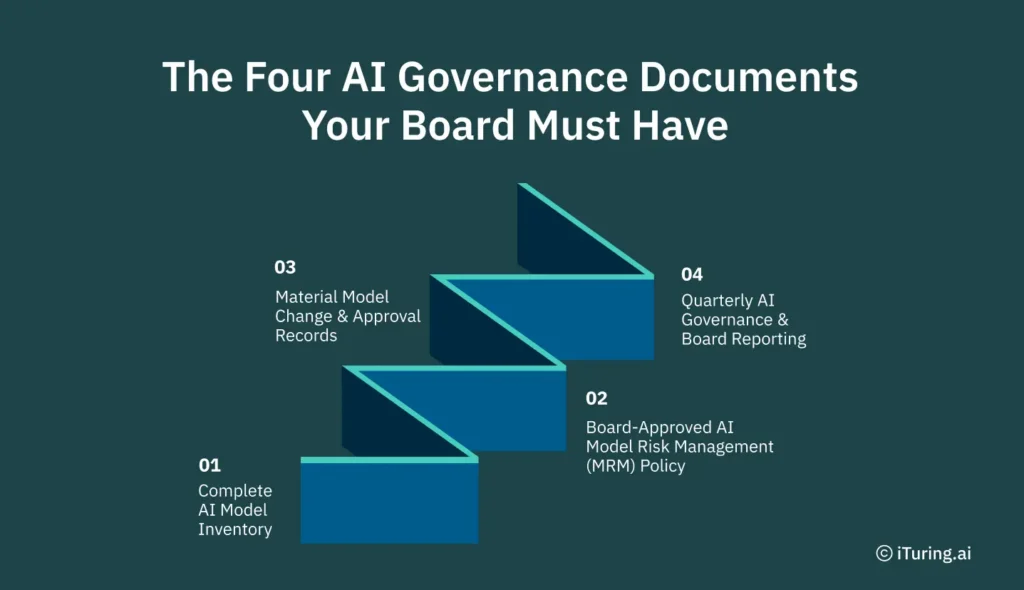
Before Your Next RBI Upper Layer Review: The Four AI Governance Documents Your Board Must Have
- The first document is a complete inventory of every AI collections model in production. Under the RBI Scale Based Regulation Upper Layer governance framework, this inventory must include model purpose, owner, deployment date, data sources, and current performance metrics. Collections propensity models, contact optimization models, and any generative AI used for borrower communication must all appear. An incomplete inventory is the single most common finding in RBI examinations of Upper Layer NBFCs.
- The second document is the board-approved MRM policy with explicit coverage of AI collections models. This policy must define performance thresholds, materiality criteria, and escalation procedures for every model type in the inventory. Enhanced board oversight of all AI risk systems is mandatory for Upper Layer NBFCs, including collections AI under the 2023 Upper Layer circular. If the MRM policy was written before collections AI was deployed, it almost certainly does not cover the specific risk characteristics of these models.
- The third document is a record of every material model change, including the approval chain, rationale, and post-deployment validation. RBI examiners expect to see that no collections AI model was modified in production without documented governance committee approval. This includes retraining events, feature additions, threshold adjustments, and any change to the model’s operational scope. The RBI master direction on information technology governance provides the broader IT risk management framework within which these model change records must be maintained.
- The fourth document is the quarterly board reporting package that demonstrates ongoing monitoring. This must satisfy the RBI Scale Based Regulation requirement for periodic board-level review of AI model performance and governance status. The reporting cadence is quarterly at minimum, with out-of-cycle reviews triggered by material model drift, significant changes in portfolio composition, or regulatory findings. RBI Upper Layer NBFC governance for AI collections in 2024 and 2025 has shown that boards receiving only annual AI risk updates do not meet the supervisory standard.
Real Results: Leading NBFC, India
A leading Upper Layer NBFC in India faced a governance gap after its collections AI models, deployed before the 2023 Upper Layer circular, were found outside the board-approved MRM inventory during a supervisory review. The institution deployed iTuring’s Collections Agent with its integrated governance layer, establishing board-level visibility, maker-checker controls, and MRM policy alignment across all collections AI models within 60 days. The governance requirements for NBFC AI collections under scale based regulation were fully addressed through this deployment.
Results after deployment:
- 116% increase in collections recovery rate
Upper Layer Governance Is a Board Obligation – Not a Compliance Team Activity to Be Delegated
Chief Risk Officers preparing for their next RBI examination should verify three things immediately: that every collections AI model appears in the board-approved MRM inventory, that the maker-checker approval trail for each model change is complete and timestamped, and that quarterly board reporting packages include model performance metrics alongside governance status indicators. The institutions that treat these as operational defaults rather than examination preparation exercises are the ones that pass supervisory reviews without remediation orders. RBI’s 2026 roadmap for institutional AI signals that AI governance expectations for Upper Layer NBFCs will only intensify from here.
One important note: RBI’s Upper Layer designation criteria are reviewed annually – NBFCs approaching the threshold should monitor their classification status, as designation triggers the enhanced AI governance obligations from the date of confirmation.
If your institution needs to close governance gaps before the next supervisory cycle, request a demo to see how iTuring’s governance layer produces exam-ready documentation for every collections AI model in your portfolio.