
TL;DR
- Three layers, one label: debt collections software usually bundles outreach automation, decisioning, and compliance infrastructure into a single search term.
- Automation plateaus on its own: a rule-based dialer gets more calls made, not necessarily more recovered.
- Decisioning is what moves the outcome: software that scores repayment likelihood and times contact accordingly changes recovery rates, not just call volume.
- Compliance now lives inside the software: calling hours, agent disclosure and call recording increasingly sit in the system itself, not only in the policy document.
- Honest caveat: the decisioning claim below draws on iTuring’s own published case study. Treat any vendor’s recovery-rate claim, including this one, as a number to verify against your own portfolio before buying.
Most NBFCs searching for debt collections software are really asking three separate questions at once, and most vendor pages answer only the first one.
Head of Collections teams tend to start this search after outreach volume stops moving the recovery number. The instinct is to buy something that makes more calls, sends more reminders, or works more accounts per day. That solves the wrong bottleneck when the real problem is which accounts get contacted, in what order, and whether the system running those calls can survive an audit.
This piece breaks the category into the three layers worth evaluating separately before signing anything.
Debt collections software usually means three different things at once
Debt collections software typically bundles three distinct capabilities under one label: outreach automation (calls, SMS, reminders at scale), decisioning (who to contact, when, and how hard), and compliance infrastructure (calling-hour enforcement, agent disclosure, call recording). Most evaluations compare vendors on the first layer alone, because it’s the easiest to demo.
That’s a problem because the three layers solve different problems and fail in different ways. Outreach automation fails by wasting effort on accounts unlikely to pay regardless of contact frequency. Decisioning fails by misjudging who’s actually at risk. Compliance infrastructure fails quietly, until an examiner or a customer complaint surfaces the gap.
A vendor demo built around call volume and channel coverage looks impressive regardless of which layer it’s actually strong in. The question worth asking early is which of the three layers a given platform was built around, and which two got added on afterward.
Why outreach automation alone plateaus
A rule-based dialer, one that works a fixed call list on a fixed schedule, does exactly what it’s built to do. It makes more contact attempts. What it can’t do is tell you whether attempt number four on a low-risk account is worth more than attempt number one on a high-risk one.
That’s why recovery rates plateau even as call volume keeps climbing. More outreach against the same undifferentiated list produces diminishing returns. It also produces complaints, since repeatedly contacting a borrower with no read on their actual risk or circumstances is exactly the pattern conduct rules exist to catch.
What changes when decisioning drives the contact strategy
Decisioning-led software scores each account’s repayment likelihood and recommends contact timing and intensity based on that score, rather than a fixed schedule. iTuring’s own deployment with a leading NBFC in India produced a 116% improvement in collections recovery rate and 86% predictive accuracy, live in two weeks, by acting on that score rather than a static bucket.
The mechanism is straightforward. Instead of working every overdue account the same way, the system ranks accounts by how likely they are to pay with the right nudge. In that deployment, focusing effort on the highest-risk 30% of the portfolio captured 72% of likely defaulters, a very different allocation of effort than a dialer working the full list in order.
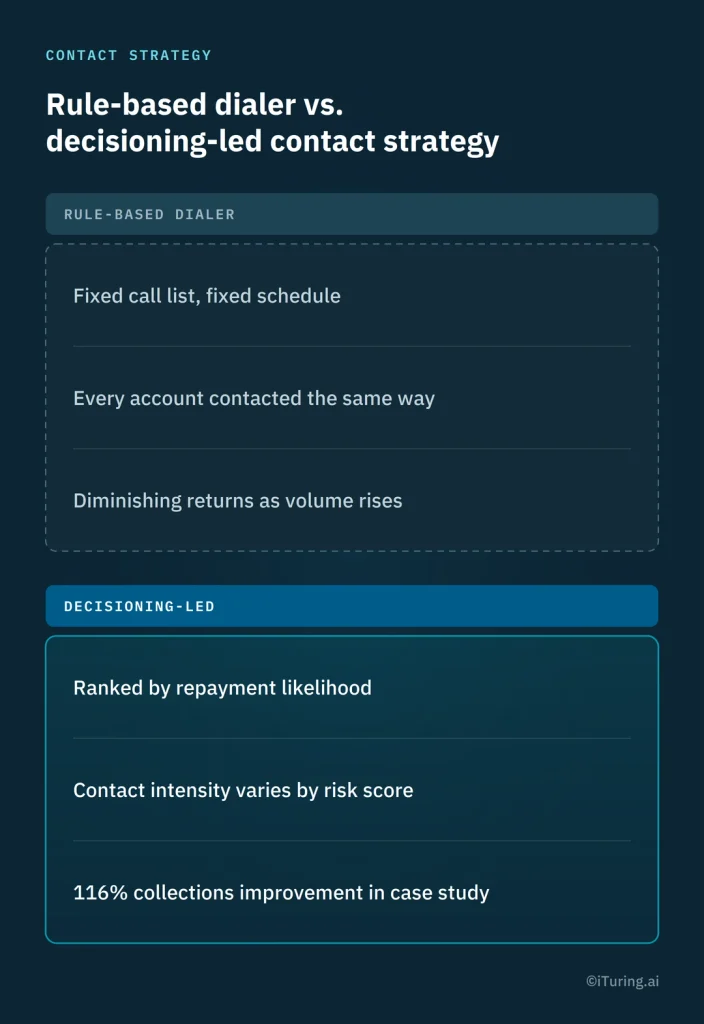
That reordering is where the recovery-rate difference actually comes from. It isn’t more calls. It’s better-targeted ones.
The compliance layer that’s no longer optional to check for
RBI’s Fair Practices Code sets calling-hour limits, no contact before 08:00 or after 19:00, requires recovery agents to carry identification and disclose the lending institution, and expects NBFCs to maintain a current, published agent list. Buyers increasingly need software that enforces these rules automatically, rather than relying on agent discipline alone.
These aren’t new obligations. What’s newer is the expectation that software enforces them rather than a training manual. A system that can’t block a call outside permitted hours, or can’t produce a recorded interaction on demand, pushes that risk straight back onto the collections team.
This piece won’t re-explain the full Fair Practices Code or the newer device-locking and agency-disclosure rules layered on top of it. “What the RBI Fair Practices Code Requires From NBFC Collections” and “RBI’s New Device-Locking Rules” cover those in depth. The point here is narrower: check whether compliance is a feature of the software, or a hope about the people using it.
A first-pass way to sort any vendor into these three layers
Before a full procurement process, a short filter question for each layer works as a quick sort.
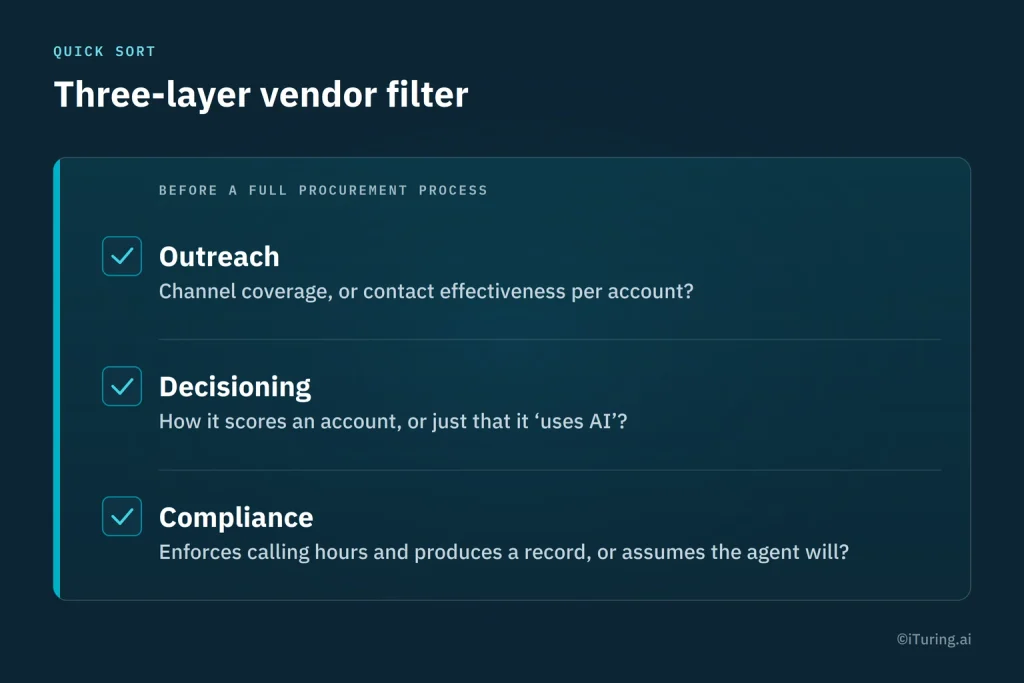
- Outreach: does the vendor show channel coverage and contact volume, or contact effectiveness per account?
- Decisioning: does the vendor explain how it scores an account, or just that it “uses AI”?
- Compliance: does the software enforce calling hours and produce a recorded, auditable interaction, or does it assume the agent will?
A platform strong on the first question and thin on the other two is an outreach tool wearing a broader label. That’s worth knowing early, before a demo spends an hour on the wrong layer.
The fastest way to shorten a vendor evaluation is deciding which of these three layers matters most for the gap in front of you today, then testing every demo against that layer specifically rather than the full feature list.
Book your 15-minute discovery with iTuring’s team to see where a decisioning-led approach would change your own portfolio’s recovery numbers.
Sources
- iTuring.ai, “Improve Collections and Optimize Efforts” case study (case-study page, confirmed by direct fetch). https://ituring.ai/case-study/improve-collections-and-optimize-efforts/
- taxguru.in, “RBI (Non-Banking Financial Companies – Responsible Business Conduct) Directions, 2025,” dated 28 November 2025. https://taxguru.in/rbi/rbi-non-banking-financial-companies-responsible-business-conduct-directions-2025.html