
TL;DR
- The umbrella rule: every customer-facing NBFC must adopt a Board-approved Fair Practices Code, and it governs everything downstream in collections.
- Five obligations sit under it: Board approval and adoption, public disclosure, a ban on harassment and persistent calling, recovery agent standards, and fixed calling hours.
- The specific rules get their own citations: device locking, call recording retention, and agency disclosure timelines all trace back to this Code, but each has its own paragraph and its own deadline.
- Most compliance gaps start here, not downstream: an NBFC that has not formalized its Fair Practices Code as a Board-approved document is exposed on every collections call it makes, regardless of how good its call scripts are.
- Honest caveat: the Fair Practices Code obligations below are drawn from the stable, already-in-force RBI (NBFC – Responsible Business Conduct) Directions, 2025. The newer 2026 amendments covering device locking, call recording and agency disclosure are separate instruments layered on top, and this piece signposts them rather than repeating their detail.
Every NBFC collections conversation eventually runs into a version of the same question. Is this specific practice allowed. The answer almost always traces back to one document: the Fair Practices Code every customer-facing NBFC is required to adopt.
Most compliance teams know the Code exists. Fewer treat it as the single source that everything else in their collections policy has to trace back to. That gap is where audit findings come from.
This piece lays out what the Code actually requires, in plain terms, and where the newer, more specific 2026 rules sit relative to it.
What the Fair Practices Code actually requires from an NBFC collections team
The Fair Practices Code is not a single collections rule. It is a Board-approved governance document that every customer-facing NBFC must adopt, and it sets five specific obligations that a collections function has to operate inside: mandatory adoption, public disclosure, a harassment ban, recovery agent standards, and fixed calling hours.
The five obligations, in order:
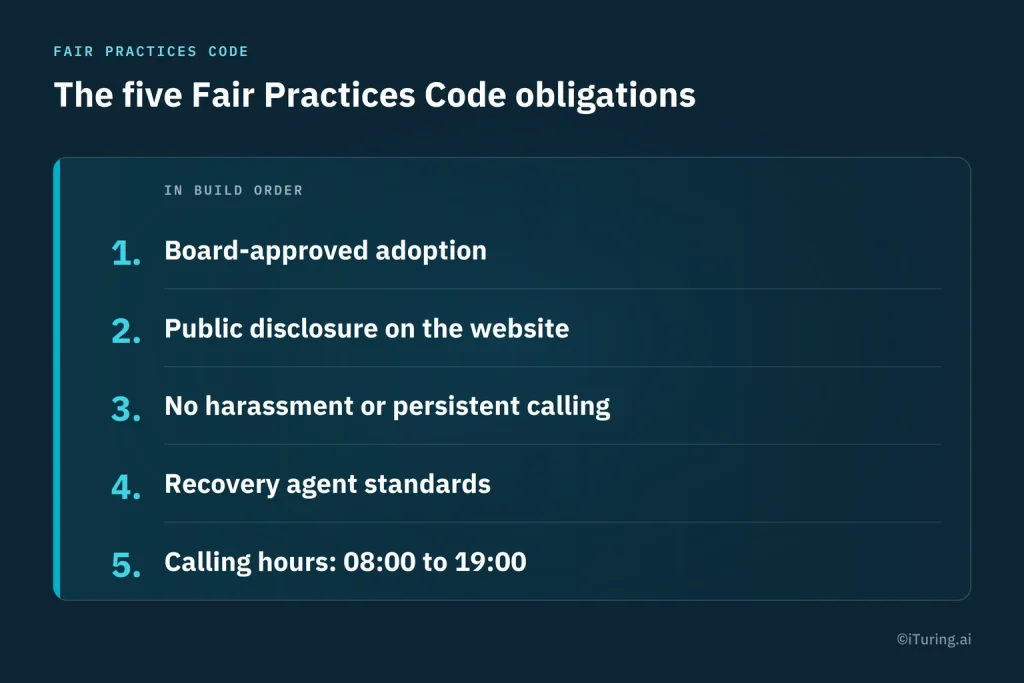
- Board-approved adoption. Every customer-facing NBFC must adopt a Fair Practices Code approved by its own Board, not a generic template borrowed from elsewhere.
- Public disclosure. The Code, along with related collections information, has to be disclosed on the NBFC’s website.
- No harassment. Persistently contacting a borrower at odd hours is named directly as a harsh practice, not left to interpretation.
- Recovery agent standards. Every agent needs an authorization letter, a police-verified background, and a spot on a current, published agent list.
- Fixed calling hours. Contact is restricted to between 08:00 and 19:00.
An NBFC that treats these as five separate checklist items misses the point. They are one governance structure. A collections team that gets the calling hours right but has never formalized Board approval of its Code is still exposed, because the auditor’s first question is whether the Code exists as a Board-approved document at all.
Why “no undue harassment” isn’t the vague standard it sounds like
Persistently contacting a borrower at odd hours is named directly in the Fair Practices Code as an example of undue harassment, not left as a subjective judgment call for the collections team to interpret. This gives compliance officers a specific, citable standard rather than a general good-conduct principle.
The wording matters because it removes the defense that a team member “used their judgment” on when and how often to call. Persistence itself, not just tone or language, is treated as the harm. A team that calls a borrower six times in one day has a problem even if every individual call was polite.
This changes how a collections desk should measure its own conduct. Call frequency per borrower per day becomes a metric worth tracking on its own, not just call outcomes or contact rates. A propensity-scoring system that spaces out contact attempts based on predicted response likelihood, rather than calling on a fixed daily schedule, directly reduces this exposure as a side effect of better targeting.
Staff training is also named specifically. NBFCs are required to ensure staff are trained to deal with customers appropriately, which means a documented training record is part of the evidence an examiner expects to see, not just the calling policy itself.
The recovery agent paperwork most NBFCs get wrong
Every recovery agent an NBFC deploys needs three things in place before that agent makes a single call: a signed authorization letter naming the NBFC, a completed police verification, and a current spot on the NBFC’s published agent list.
Break each requirement down and the paperwork gaps become obvious:
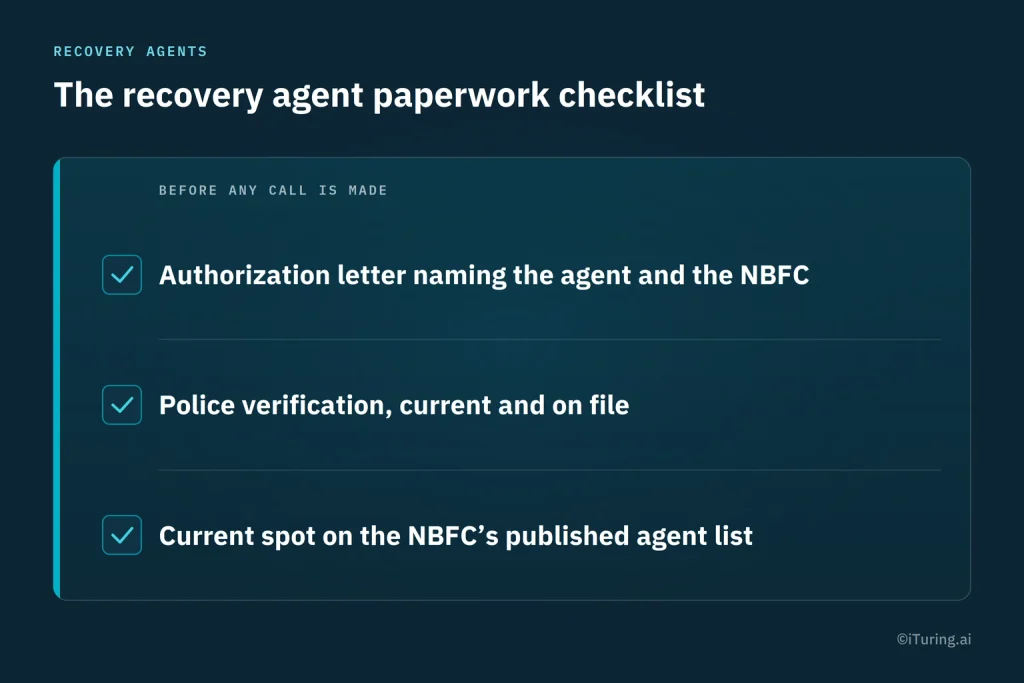
- Authorization letter. Every agent must carry a letter identifying them by name and confirming the NBFC’s contact details, so a borrower can independently verify who is calling them.
- Police verification. NBFCs must conduct a police verification check on every recovery agent before deployment, not just at initial hiring for the recovery function generally.
- Published agent list. The list of active recovery agents has to be current and disclosed publicly, which means it needs an update process, not a one-time publication.
The most common failure point is the gap between hiring and updating. An NBFC that ran police verification on an agent eighteen months ago, before that agent moved teams or the NBFC changed its agency partner, has a stale record that will not survive an audit even though verification technically happened once. The published list requirement has the same failure mode: a list that was accurate at launch and never refreshed is functionally the same as no list at all from a compliance standpoint.
The calling-hours rule and where it sits in this compliance cluster
Contact with a borrower is restricted to the hours between 08:00 and 19:00 under the Fair Practices Code, and this single rule sits at the center of a wider set of 2026 amendments that add specific enforcement mechanisms around it, including call recording retention and device-based restrictions tied to repayment status.
The Code itself sets the calling-hours boundary. What changed in 2026 is not the boundary but the evidence trail around it. Every collections call now has to be recorded and the recording retained, which means a calling-hours violation is no longer a matter of a borrower’s word against the NBFC’s. We cover the recording and retention requirement in full in our piece on the next RBI compliance flashpoint for recovery calls.
Device-based restriction mechanisms, which allow an NBFC to restrict certain functions on a device that financed the loan under strict eligibility conditions, are a separate and much more specific addition layered on top of the same underlying conduct obligations. That mechanism carries its own detailed rules on eligibility, timing and compensation, which we cover separately in our device-locking compliance guide rather than repeating here.
What changes when the newer amendments take effect
The short version: the Fair Practices Code stays the constitutional layer, and the 2026 amendments add specific, dated enforcement mechanisms on top of it rather than replacing anything. An NBFC collections team should treat the Code as the policy foundation and the newer rules as the operational detail that foundation now has to produce evidence for.
That means a compliance program built only around the Code’s five obligations above will not be sufficient once the newer rules take effect on 1 January 2027. Call recording retention, device-based restriction eligibility, and agency-list update timelines all need their own operational build, on top of, not instead of, the Code’s foundational requirements.
An NBFC that built its collections recovery on iTuring’s platform saw a 116% increase in its collections recovery rate using delinquency bucket movement modeling, the kind of measurable outcome that a properly governed collections program can produce once the foundational compliance layer is in place. Book a working session to see how a governed collections platform handles this compliance layer alongside the scoring and outreach work.
Sources
- Reserve Bank of India, Guidelines on Fair Practices Code for NBFCs. https://www.rbi.org.in/commonman/english/Scripts/Notification.aspx?Id=1572
- Tax Guru, coverage of RBI (Non-Banking Financial Companies – Responsible Business Conduct) Directions, 2025 (RBI/DOR/2025-26/362), 28 November 2025. https://www.taxguru.in
- iTuring.ai case study, “Improve Collections and Optimize Efforts.” https://ituring.ai/case-study/improve-collections-and-optimize-efforts/