
TL;DR
- New rule: RBI’s Fourth Amendment Directions, 2026 require lenders to record every collections call and retain it for six months.
- Two rulebooks, same obligation: Banks get this under RBI/2026-27/223, para 454P. NBFCs get it under RBI/2026-27/230, para 100P. Same date, same requirement, different paragraph number.
- Effective date: 1 January 2027.
- What changes operationally: call recording, storage, retrieval and borrower notification all need to work together, not sit as separate systems.
- Sub judice extension: recordings tied to a dispute must be retained until the matter is resolved, not just for six months.
- Honest caveat: the paragraph numbers here come from secondary reporting on the RBI circulars, not a direct fetch of rbi.org.in text. Verify against the primary circular before this goes to print.
Every NBFC collections desk is about to inherit a new recordkeeping obligation, and most compliance teams have not mapped what it actually touches yet. RBI’s Fourth Amendment Directions, 2026 (RBI/2026-27/223, for commercial banks) and the parallel Third Amendment Directions, 2026 (RBI/2026-27/230, for NBFCs) both landed on 6 August 2026, effective 1 January 2027. Buried inside them is a requirement that changes how every recovery call gets handled from the first ring.
This is not a documentation update. It is a systems requirement. Recording, storage, retrieval on demand, and a retention clock that can extend indefinitely for disputed accounts. Teams that treat this as a call center software tickbox will miss the retention and retrieval half of the obligation.
What the recording rule actually requires
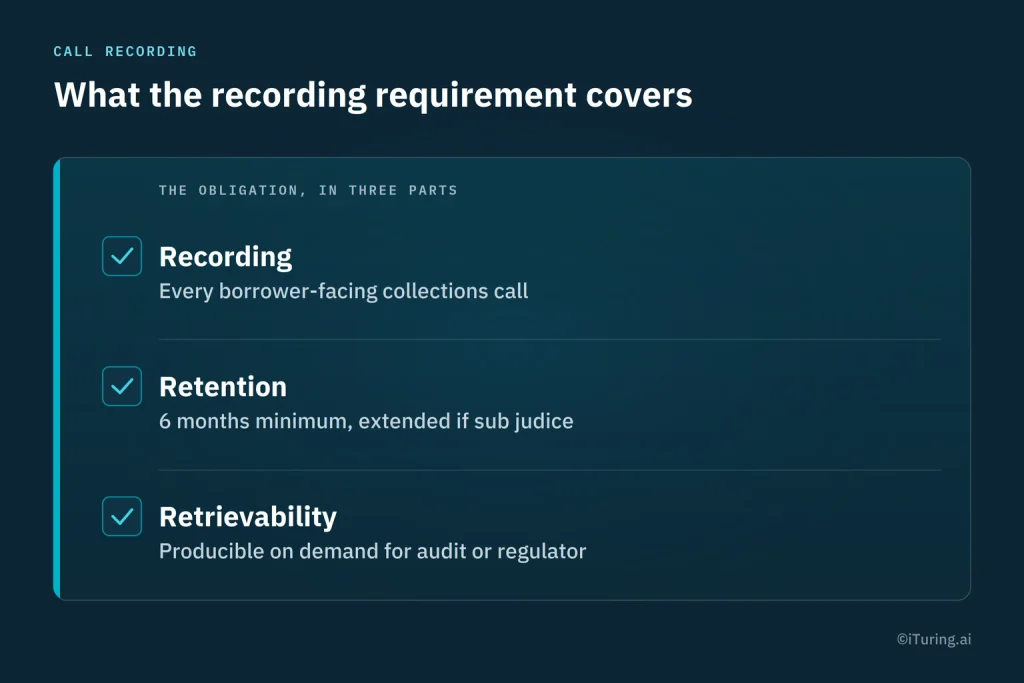
Every collections call to a borrower must be recorded, and the recording must be retained for a minimum of six months from the date of the call. For any call connected to a dispute, that retention period extends until the dispute is resolved, however long that takes.
This applies across the recovery journey, not just the first contact or a final demand call. The obligation has three parts that have to work together:
- Recording: every borrower-facing collections call captured, not a sample or a subset.
- Retention: six months minimum, extended indefinitely if the call is tied to a sub judice matter.
- Retrievability: the recording has to be producible on demand, whether that demand comes from an internal audit, a grievance process, or the regulator.
Most NBFCs already record calls for quality assurance. The gap is retention architecture built for the sub judice extension, and retrieval built for regulatory speed rather than internal QA convenience. A system that auto-deletes at 90 days because that is what the call center vendor’s default plan includes is now a compliance gap, not a cost saving.
Same rule, two paragraph numbers
RBI split its conduct overhaul into two parallel documents on the same date. Commercial banks got the Fourth Amendment Directions, 2026, with the call recording obligation at paragraph 454P. NBFCs got the Third Amendment Directions, 2026, with the identical obligation at paragraph 100P.
This is the same citation pattern we cover in full in our piece on the new device-locking rules. RBI runs Master Directions for commercial banks and NBFCs as separate documents with separate paragraph schemes, even when the underlying obligation is word for word the same. A paragraph number copied from a document written for the other entity type is wrong, even though the underlying rule is identical.
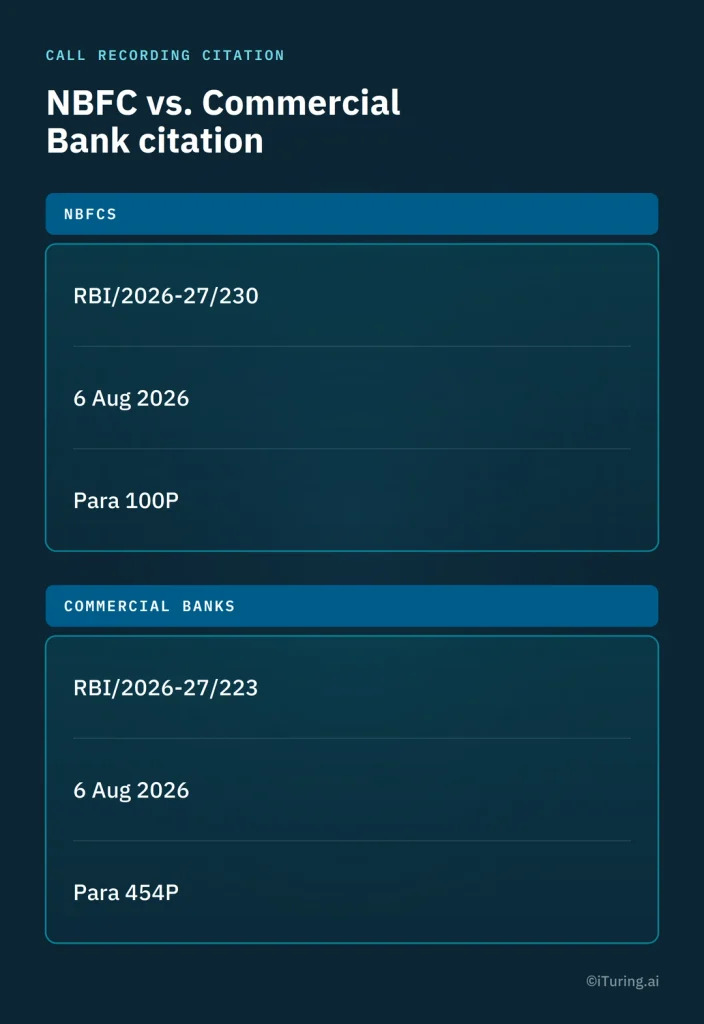
For an NBFC compliance officer, this matters practically when a regulator or an auditor asks for the citation and gets handed the bank-side paragraph number by a vendor or a consultant who didn’t check which entity type they were writing for.
What breaks if the retention architecture is an afterthought
Six months is a long time to hold audio at scale for a mid-size NBFC running thousands of collections calls a month. Three failure points show up before most teams expect them:
- Storage cost creep. Six months of retained audio, multiplied across every active loan in collections, is a materially different storage bill than a 30-day QA retention window.
- The sub judice extension has no natural end date. A system built around a fixed six-month deletion schedule needs a flag and an override, not a manual process someone has to remember to run.
- Retrieval speed under regulatory pressure. An audit request is not the same as a QA manager pulling a file for coaching. It needs to be fast, indexed, and traceable to the loan account and the call date.
Autonomous outreach systems that already log every borrower interaction have a natural head start here, because the recording obligation is really an extension of the same audit trail discipline RBI has been building into digital lending oversight since the 2022 Master Direction.
Building this into a collections workflow instead of bolting it on
The short answer: treat call recording, retention and retrieval as one system tied to the loan account, not three separate vendor relationships. A platform that already logs every outreach action for audit purposes extends naturally to cover recorded calls under the same trail.
Recovery platforms built for RBI-regulated collections already carry the propensity scoring and outreach timing pieces. Adding recording retention and retrieval to that same governed record, instead of a bolt-on call center archive, keeps the audit trail continuous across channels. That continuity is what an auditor or a regulator actually wants to see: one traceable record per account, not a QA recording system and a compliance system that do not talk to each other.
Sources
- Corporate Professionals, analysis of RBI/2026-27/223 (Fourth Amendment Directions, 2026) and RBI/2026-27/230 (Third Amendment Directions, 2026), 6 August 2026. https://www.corporateprofessionals.com
- Tax Update, coverage confirming RBI/2026-27/230 circular number and date, 2026. https://www.taxupdate.in
- RBI Master Direction on Digital Lending, 2022 (2025 operative update), for existing audit trail baseline. https://www.rbi.org.in