TL;DR
- The rule: From 1 January 2027, a lender may restrict a borrower’s device only if that device financed the loan itself, and only under an explicit clause agreed at origination.
- The timeline: Partial restriction is permitted from 30 days past due. Full restriction is permitted only after 60 days past due.
- The protections: Incoming calls, SMS and emergency access must keep working throughout, and a wrongful or delayed unlock costs the lender 250 rupees an hour, capped at the loan amount.
- The trap: Banks and NBFCs got the identical rule on the same date, under two different sets of paragraph numbers. A citation copied from one document is wrong for the other.
- The caveat: RBI has not yet published the final NBFC circular text in a form we can cite directly. The paragraph numbers below are reported consistently across multiple legal and industry sources, not read from the notification itself. Treat them as well corroborated, not primary confirmed.
Most compliance teams are asking the wrong first question about India’s new device-locking rule. The question isn’t whether a lender can restrict a borrower’s phone. It’s whether the loan qualifies at all, because the rule only ever applies to the exact device that loan financed.
RBI issued the amendment on 6 August 2026. It takes effect 1 January 2027. It reached NBFCs and Commercial Banks on the same day, through two separate circulars that impose the same substantive obligations under different paragraph numbers. A recovery team that builds against the wrong document’s citation, or copies a paragraph number from a vendor’s blog post written for banks when the reader is an NBFC, will fail an examination on a technicality that has nothing to do with whether the underlying conduct was compliant.
This piece covers what the rule permits, the timeline it runs on, what a compliant system has to produce, and the citation split itself, since getting that part wrong is the single most avoidable mistake in this rollout.
What the rule actually permits
RBI’s device-locking rule lets a lender restrict a borrower’s phone only when the loan itself financed that specific device, and only when the loan agreement states this in explicit, unambiguous language agreed at origination. It does not authorize locking any other device the borrower owns, and it does not authorize collecting data from the device beyond what confirms payment status.
Three conditions have to hold before a lender can activate any restriction:
- Device-loan match. The device being restricted is the one the loan was disbursed to purchase. A personal loan, a business loan or any facility that did not finance the device cannot trigger this mechanism at all.
- Express agreement. The loan agreement names device restriction as a recovery mechanism in specific, standalone language. General terms-and-conditions consent does not qualify.
- Certified mechanism. The locking technology itself has to meet an operating-system and device-manufacturer certification standard, so the restriction happens through an approved channel rather than a third-party tool bolted onto the device afterward.
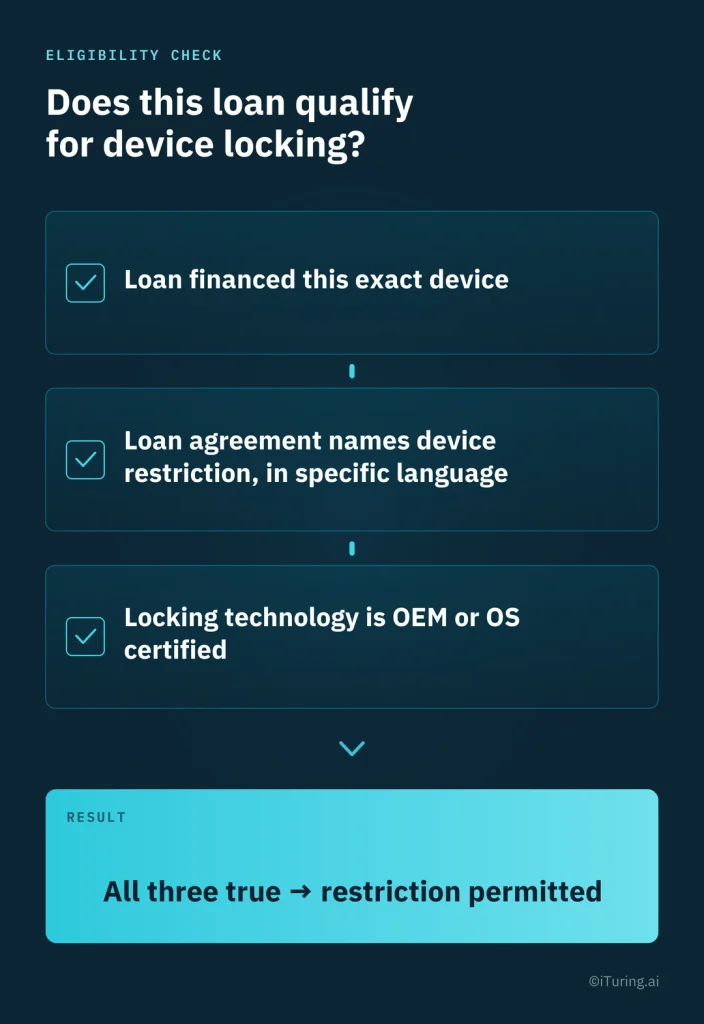
Outside these three conditions, no device-based recovery mechanism is permitted under this instrument, whatever the collections team’s existing practice has been.
The 30-day and 60-day timeline
The rule allows a lighter restriction starting at 30 days past due and a full restriction only once an account reaches 60 days past due. Nothing beyond notice and a partial restriction is permitted before that 60-day mark, and even after it, several device functions have to keep working no matter how far the restriction goes.
The stages run like this:
- Before 30 days past due. No restriction of any kind is permitted.
- 30 to 60 days past due. A lighter, partial restriction is permitted once required notice has gone to the borrower. Outgoing calls remain protected through this whole window.
- 60 days past due and beyond. Full restriction becomes permitted, applied gradually rather than as a single, complete lockout.
Regardless of stage, essential functions have to remain available at all times. Incoming calls, SMS and emergency access, including SOS features, cannot be disabled under any circumstance. The lender also cannot access the borrower’s contacts, photos or call logs at any point in this process, whatever the device’s technical permissions would otherwise allow.
What happens when the borrower pays
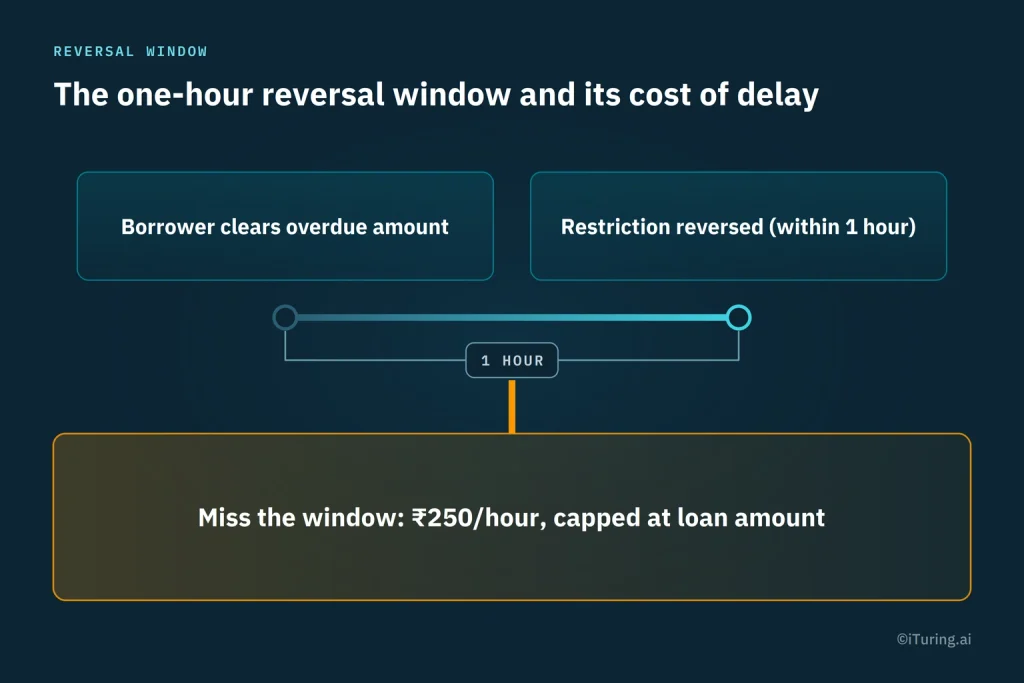
The moment a borrower clears the overdue amount, the lender has one hour to reverse any device restriction. Missing that window, or having locked a device wrongfully in the first place, carries a fixed cost: 250 rupees for every hour of wrongful or delayed restriction, capped at the total disbursed loan amount.
This is not a discretionary service-level target. It is a compensation obligation with a number attached, which means a lender’s system has to detect payment and trigger reversal automatically rather than routing it through a manual queue that might sit for a day before anyone notices.
Same rule, two paragraph numbers: the citation trap for banks and NBFCs
RBI issued the identical device-locking obligation to NBFCs and Commercial Banks on the same date, through two separate circulars with two separate numbering schemes. Citing one circular’s paragraph number for the other entity type is a factual error, even though the underlying rule is the same.
For NBFCs, the instrument is the Reserve Bank of India (Non-Banking Financial Companies, Responsible Business Conduct) Third Amendment Directions, 2026, notification RBI/2026-27/230, dated 6 August 2026. Device locking sits at paragraph 100S, which sets out the eligibility conditions described above, and paragraph 100T, which carries the borrower protections and the compensation mechanism.
For Commercial Banks, the instrument is the Reserve Bank of India (Commercial Banks, Responsible Business Conduct) Fourth Amendment Directions, 2026, notification RBI/2026-27/223, also dated 6 August 2026. The equivalent provisions sit at paragraphs 454S through 454U, covering the same three conditions and the same timeline.
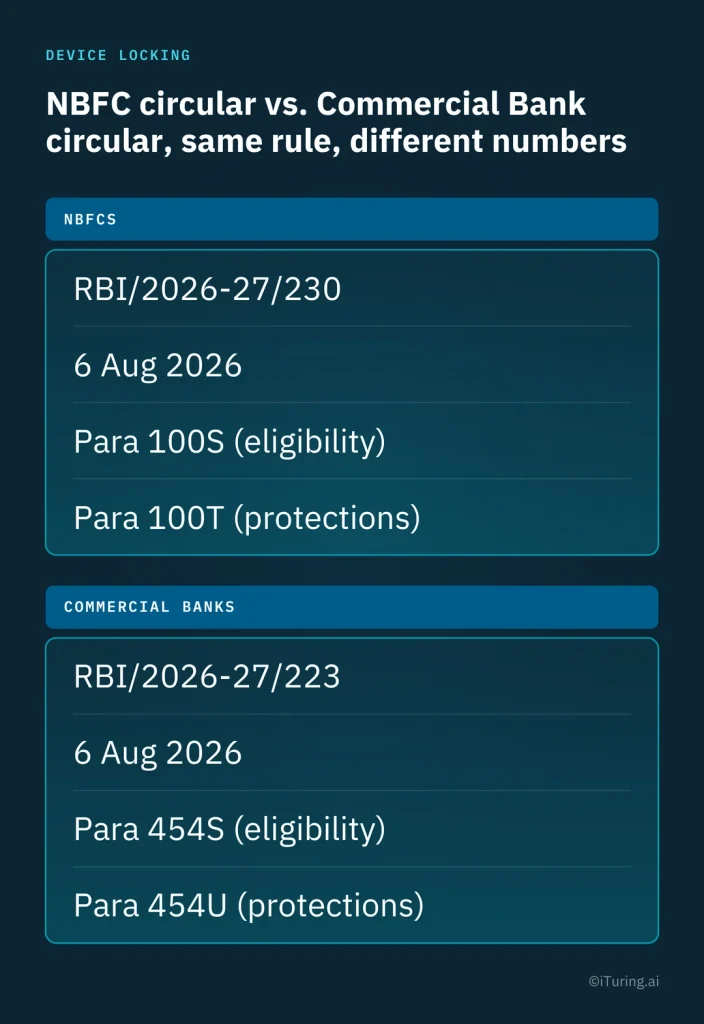
The letter suffixes line up exactly across both documents, S for the eligibility conditions, the next letter for the protections, which is strong evidence these were drafted as parallel insertions into each entity’s own base conduct directions rather than as two independently written rules. That consistency is also what makes the wrong citation so easy to make. A recovery agency serving both NBFC and bank clients, or a compliance team that reads one client alert written from the bank side, can walk away citing 454S for an NBFC loan file and be wrong on the page.
RBI has not published a version of either final circular that we could fetch and quote directly. The paragraph numbers above are reported consistently, independently, across multiple legal and industry sources covering this notification, including Corporate Professionals’ analysis of the NBFC amendment. Treat this as well-corroborated secondary reporting rather than a primary citation, and confirm against the notification text directly once it is available in a citable form.
What a compliant system has to produce on demand
An examiner asking about a specific device restriction will want three things: a timestamped log of every stage the restriction went through, the specific consent clause tied to that device and that loan, and proof the locking mechanism itself carries the required OEM or operating-system certification.
A timestamped, stage-by-stage log. Every transition, the 30-day notice, the partial restriction, the 60-day full restriction, the payment event, the one-hour reversal, needs its own timestamp. A single “device locked” entry with no stage history will not satisfy this requirement.
Consent language specific to the device. General loan-agreement boilerplate does not meet the bar. The clause has to identify the financed device and state the restriction mechanism in terms a borrower actually read and agreed to, separately from the rest of the loan terms.
Certification of the locking mechanism. The technology performing the restriction has to operate through an approved OEM or operating-system channel, not a workaround. This is its own compliance question with its own set of open details, and it deserves separate treatment beyond what fits here.
Producing all three on request, rather than reconstructing them after the fact, is the difference between a system built for this rule and a system retrofitted to survive an audit.
Building this before 1 January 2027
A compliant device-locking workflow needs six pieces in place before the effective date:
- Confirm which loans in the book actually financed the device being considered for restriction. Every other loan type is out of scope entirely.
- Add a standalone, device-specific consent clause to the loan agreement for new originations, and review whether existing agreements need an amendment.
- Confirm the locking technology itself carries the required certification before deploying it to a single account.
- Build automatic stage transitions at 30 and 60 days past due, rather than a manual trigger a collections agent has to remember to apply.
- Build automatic payment detection and a one-hour reversal trigger, since the 250-rupee-per-hour compensation clock starts the moment the default is cured.
- Confirm the system logs every stage with a timestamp that would satisfy an examiner asking for the full history of one account.
Most of this is a workflow and audit-trail problem rather than a legal one. iTuring’s platform runs this kind of stage-gated recovery action through Agentic AI, which executes each restriction and reversal step at the moment the trigger condition is met rather than waiting on a manual queue, with the full sequence recorded through Model Gov for exactly the on-demand evidence an examiner will ask for. On a related workflow, a leading NBFC in India using this approach saw a 116 percent improvement in collections recovery with 86 percent predictive accuracy, deployed in two weeks.
If your recovery workflow cannot yet produce a timestamped log, a device-specific consent record and a certified locking mechanism on demand, book a working session and we will walk through where the gaps sit against your own loan book.
Sources
- “When the Recovery Call Comes: RBI Rewrites the Rules of Engagement for NBFCs,” Corporate Professionals, 2026. https://www.corporateprofessionals.com/articles/when-the-recovery-call-comes-rbi-rewrites-the-rules-of-engagement-for-nbfcs/
- “Draft RBI (NBFC-Responsible Business Conduct) Directions, 2026 – Key Amendments,” Corporate Professionals, 2026. https://www.corporateprofessionals.com/articles/draft-rbi-nbfc-responsible-business-conduct-directions-2026-key-amendments/
- “RBI’s New Loan Recovery Rules From January 1, 2027: What the August 6, 2026 Directions Mean for Every Borrower,” Tax Update India, 2026. https://taxupdate.in/finance/843/rbi-loan-recovery-rules-2027-responsible-business-conduct-amendment-directions-6-august-2026-recovery-agents/
- “Improve Collections and Optimize Efforts,” case study, iTuring.ai. https://ituring.ai/case-study/improve-collections-and-optimize-efforts/