TL;DR
- What it is: MLOps consulting services cover getting models into production and keeping them there. Most scopes of work only price the first half.
- The core problem: A scope that covers platform build but skips governance, audit trail and validation looks cheaper today and gets renegotiated, or re-scoped from scratch, the first time an examiner or an auditor asks for evidence.
- What changes: The line items worth naming explicitly in a scope of work, and the three genuinely different risk profiles behind build, buy and consult, rather than treating them as three price points for the same thing.
- What doesn’t change: A consulting engagement is still often the right call for a bank that doesn’t want to hire a full internal platform team. The question is what that engagement has to include, not whether to have one.
- Honest caveat: RBI’s draft guidance referenced below is still under review and not yet in force, so treat its requirements as the direction a scope of work should already be built toward, not a finalized checklist.
A CFO signing off on an MLOps consulting engagement usually sees a proposal built around getting models into production: a deployment pipeline, a monitoring dashboard, a handover deck. That is real work and it is worth paying for. It is also, on its own, half the job.
The other half is proving the model can be trusted once it is live: who validated it, who approved it, what happens when it changes, and what a bank can show an examiner without reconstructing the story from memory. A scope of work that never names these things does not include them by default.
This page covers what belongs in an MLOps consulting scope beyond the platform build, what a narrow scope costs later, and the three different risk profiles behind building it yourself, buying a governed platform, or bringing in a consulting engagement to close the gap.
What “MLOps consulting services” actually has to cover for a regulated lender
MLOps consulting spans two jobs that are often priced as one: building the technical pipeline that gets a model into production, and building the governance evidence that proves it belongs there. A scope of work that covers only the first job looks complete until someone asks for the second.
The technical half is familiar to any engineering team: deployment automation, monitoring, retraining pipelines, infrastructure decisions. The governance half is less familiar to a platform vendor and easy to leave out of a proposal entirely, since it does not show up as a visible deliverable the way a working pipeline does.
A scope that only covers deployment can still produce a working model in production. What it cannot produce, without separate work nobody budgeted for, is the record of who validated that model, who approved its release, and what happens when it changes.
What a narrow scope actually costs you later
A scope missing its governance half does not fail during the engagement. It fails months later, when a regulator, an auditor or a new compliance hire asks for evidence the engagement was never asked to produce, and the bank pays twice: once for the original build, once to retrofit what should have been included.
Re-scoping after the fact costs more than scoping it correctly up front, because a vendor now has to document a system that already exists rather than build the documentation alongside it. The team that built the pipeline has often moved to the next engagement by the time the gap surfaces, so the retrofit falls to whoever is available, not whoever has the context.
The cheapest proposal in the room is often the one that priced only the visible half of the job. A low quote is worth checking closely: see what it explicitly lists, then compare that against a pricier one that lists more.
Where consulting scope typically breaks: platform work without the governance line items
A scope of work protects a bank only when it names governance requirements explicitly. A vendor delivers what is written down, not what a client assumed was implied, so RBI’s draft guidance on model risk management and data governance both matter to how that scope gets worded, not just what gets built.
RBI’s draft model risk management guidance requires validation by a function independent of the model’s developers, a documented approval structure, and a defined threshold that reopens validation when a change is material. Its draft data governance guidance separately requires named accountability for a domain of data and metadata that survives every transformation.
A consulting scope should name each of these as its own line item: who performs independent validation and how that independence is structured, what the approval record looks like and where it lives, what counts as a material change under this specific engagement, and who owns the data flowing through the pipeline once the engagement ends. None of these are difficult to deliver. They are just easy to omit from a proposal that nobody asked to include them.
A vendor that already builds to this bar does not need a second, later, more expensive engagement to add governance evidence on top of a working pipeline. iTuring’s platform ships with maker-checker approval and an immutable audit trail as part of the deployment itself, which is the difference between governance as a scope line item and governance as an assumption.
Build, buy, or bring in consulting: three different risk profiles, not three prices
Building in-house, buying a governed platform, and hiring a consulting engagement are three different risk profiles, not three price points for the same outcome. This is a different decision than the build-versus-buy-versus-partner question for a specific AI use case like collections. Here the decision is about who builds and maintains the MLOps layer itself.
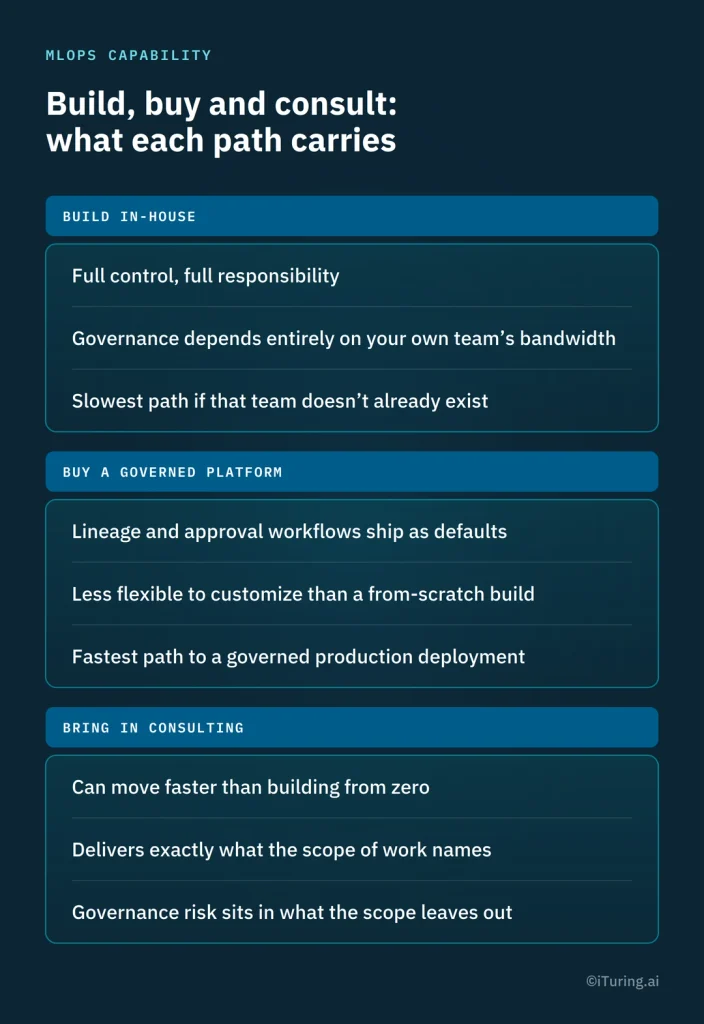
Building in-house keeps full control and puts every governance decision on the bank’s own team, which is fine if that team already exists and has the bandwidth, and a real gap if it doesn’t. Buying an integrated, governed platform trades some flexibility for governance that ships by default rather than being assembled. Bringing in a consulting engagement sits between the two: it can move faster than building from zero, but only delivers what its scope of work explicitly names, which is why the scope itself carries most of the risk in this path specifically.
Neither big integrated platforms nor small specialist vendors are automatically the safer choice. A big platform can be slow to customize; a small vendor can be fast to engage but thin on the governance record a regulated deployment needs. The question that actually predicts the outcome is whether the scope of work, whichever path a bank picks, names the governance line items directly.
What a right-sized engagement actually delivers
A properly scoped engagement can move fast without skipping the governance work, because the two get built together rather than sequenced. iTuring took a live collections model from build to production in two weeks for a leading NBFC in India, with maker-checker approval and audit trail running as part of that same timeline.
That engagement delivered a 116% improvement in collections and 86% predictive accuracy, proof that speed and governance evidence can ship together rather than being added on afterward. The speed did not come from cutting the governance half of the scope. It came from a platform that ships lineage, approval workflows and monitoring as defaults, so the engagement’s time went into configuring the model for the bank’s specific data rather than building governance infrastructure from a blank page.
If your current MLOps scope reads like a pipeline build with governance mentioned once, book a working session with our team to compare it against what a scope actually needs to cover.
Questions to put in the scope of work before signing
Before signing an MLOps consulting scope of work, ask who performs independent validation and whether that function is genuinely separate from whoever builds the model. Ask what the approval record looks like, what counts as a material change under this engagement, and whether audit trail and lineage ship as part of the deployment or as a separate, later line item.
A vendor who answers these questions with a specific mechanism, not a general assurance, is scoping the job correctly. A vendor who treats governance as something to add once the platform is live is the one whose proposal needs a second look before anyone signs it.
Sources
- Reserve Bank of India, Draft Guidance on Regulatory Principles for Model Risk Management (guidance document), paragraphs 29-35, 38-42. https://www.rbi.org.in/Scripts/bs_viewcontent.aspx?Id=5089
- Reserve Bank of India, Draft Guidance on Regulatory Expectations for Data Governance (guidance document), paragraphs 22-30, 47-51. https://www.rbi.org.in/Scripts/bs_viewcontent.aspx?Id=5114
- iTuring case study, “Improve Collections and Optimize Efforts” (leading NBFC in India): 116% collections improvement, 86% predictive accuracy, two-week deployment. https://ituring.ai/case-study/improve-collections-and-optimize-efforts/
- iTuring.ai, Model Governance platform page. https://ituring.ai/platforms/model-gov/