TL;DR
- What it is: Model risk management software should let you monitor, investigate, and evidence every model in production, well beyond scoring risk on a dashboard.
- The first real test: can it monitor models built outside its own platform, in Python, R, Spark, or elsewhere.
- What separates it from a GRC tool: it names which metric moved and why, rather than just flagging that something needs review.
- What it has to produce: audit-ready evidence without someone assembling it by hand when a regulator or board committee asks.
- Why speed matters: a root-cause investigation measured in minutes, not weeks, is a testable claim, not a slogan.
- Honest caveat: software that clears every item on this list still needs a team that acts on what it finds.
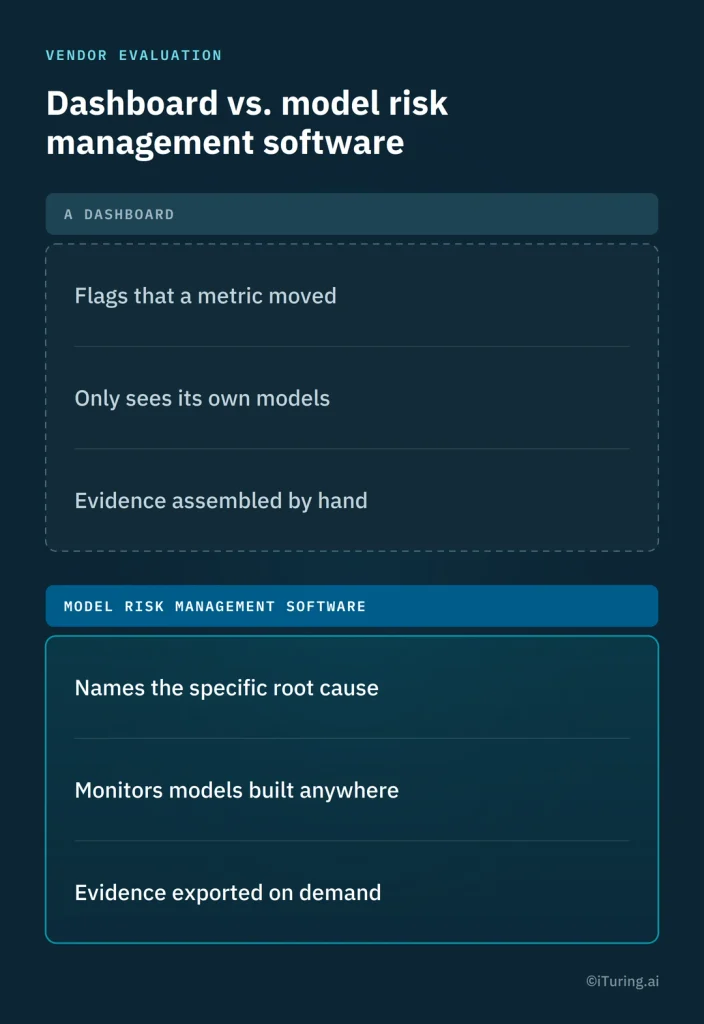
Search “model risk management software” and most of what comes back is a dashboard with a drift chart and the word “AI-powered” somewhere in the hero copy, a monitoring widget wearing a bigger label than it’s earned.
Model risk management software has a specific job: monitor every model in production, including the ones the platform didn’t build, investigate what actually changed when something drifts, and produce evidence a regulator or board committee can act on without someone assembling it by hand. A drift chart alone does none of that.
The five functional layers a complete model risk stack needs are covered in detail separately. This piece is the buyer’s version: the specific, testable things model risk management software has to do, so you can check a vendor’s claims against reality before you sign anything.
It has to monitor models it didn’t build
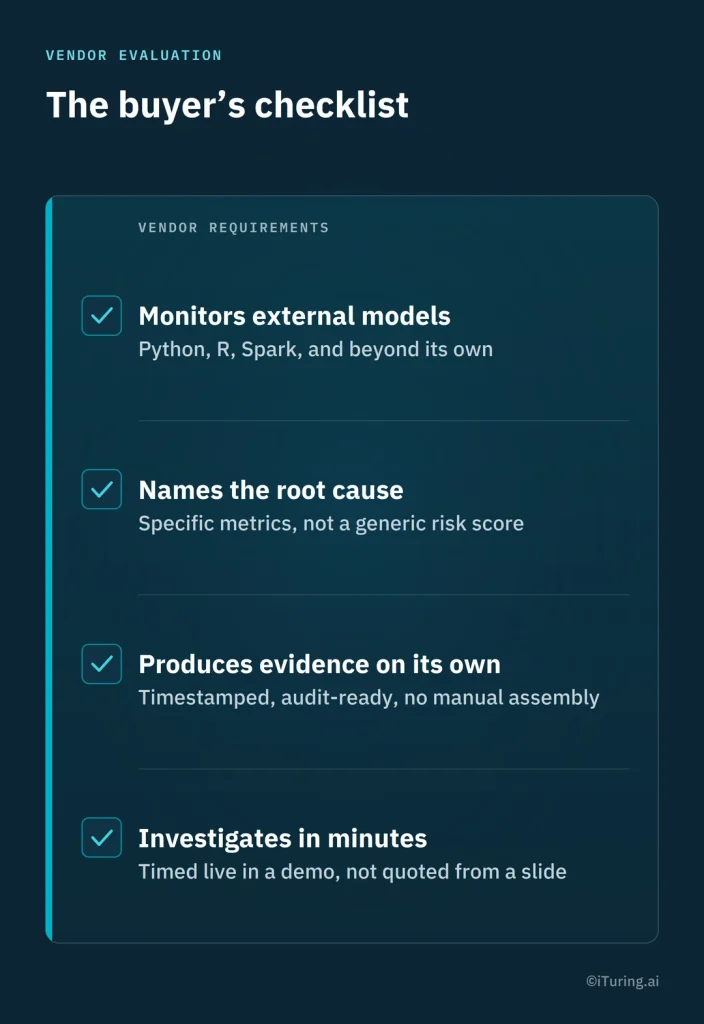
The first real test of model risk management software is whether it can monitor a model the platform didn’t train. Most in-house models run outside a single vendor’s build environment, in Python, R, Spark, or a legacy statistical package, and software that only watches its own models misses most of what actually needs watching.
iTuring’s model risk management module tracks drift across models built in Python, R, Spark, and PyTorch, alongside anything trained on its own platform, with the same complete drift analysis regardless of where the model came from. That’s the bar. A tool that can only see the models it built itself is monitoring a fraction of the institution’s actual model risk.
Most institutions get here because their model inventory grew the way it actually grows: a credit model built by a vendor five years ago, a fraud model a data science team trained in Python last quarter, a pricing model someone inherited from a consultant’s engagement. Software sold as a single platform’s monitoring add-on treats everything outside that platform as invisible, which means the oldest and often riskiest models in the portfolio are exactly the ones nobody is watching.
It has to name what broke
Model risk management software has to identify a specific cause, data drift, feature degradation, or an accuracy drop, rather than flagging that a metric moved without saying why. A tool that reports “model performance declined” without naming which of several possible causes is responsible hands the investigation right back to the team it was supposed to save time for.
A model risk module worth the name runs a structured investigation: detect the early warning signal, analyze drift across the model, its features, and the underlying data simultaneously, identify the specific root cause, then generate a report in a format a board committee can actually read. iTuring’s platform names its own metrics rather than hiding behind a generic risk score: AUC, precision, F1, recall, PSI, CSI, and several others for model drift, alongside separate metrics for feature drift, and a distinct set for data drift itself, distribution shift, missing values, skewness, and variance. Ask any vendor which specific metrics their tool tracks. “Proprietary AI scoring” is not an answer.
This is also where model risk management software earns its distinction from a general governance, risk, and compliance platform. A GRC tool tracks policies, approvals, and organizational risk registers. It has no concept of PSI or feature drift, because it was never built to look inside a model. A risk committee that only owns a GRC platform still has to go find someone who can explain why a specific model’s accuracy dropped, which defeats the point of buying software to answer that question in the first place.
It has to produce evidence without someone assembling it by hand
Model risk management software has to generate audit-ready evidence on its own: a timestamped record of every action, every drift analysis, and every root-cause finding, rather than leaving a risk team to reconstruct that record from spreadsheets when an examiner or board committee actually asks for it.
That record also has to cover who approved what. A model risk committee wants proof of more than the fact that a model was retrained. It wants to see who reviewed the retraining decision and signed off on it before the model went live. Software built around a maker-checker approval step keeps that record automatically, every model change, every reviewer, every timestamp, rather than relying on a change-management ticket in a separate system that nobody remembers to cross-reference during an examination.
For an Indian bank or NBFC, one bar is worth clearing specifically. The RBI issued draft guidance on regulatory principles for model risk management on June 24, 2026, with a public comment window that closed July 24, 2026. It is not yet in force, but it applies broadly: commercial banks, NBFCs, co-operative banks, and asset reconstruction and credit information companies among the entities covered. Software that already produces timestamped, one-click evidence exports is software you won’t have to replace once this guidance is finalized.
It has to be faster than the team it’s replacing
Model risk management software has to turn a root-cause investigation into a matter of minutes, not the days a team spends manually pulling logs, checking feature distributions, and writing up findings by hand. If a vendor can’t say how long their own tool takes end to end, that absence is the answer.
iTuring’s platform runs a full root-cause investigation in about 30 minutes, a claim worth testing directly in a demo rather than accepting on a slide. Ask a vendor to run an investigation live, on a model with a known issue, and time it. A tool that can’t do this on demand can’t do it in production either.
That speed compounds. A model risk team that spends three days on every drift investigation can realistically review a handful of flagged models a month. The same team running a 30-minute investigation can clear a full backlog in an afternoon, which matters more once an institution is running hundreds of models rather than a handful. That speed decides how many of the models actually generating risk get looked at at all.
If your last model risk review took a week to assemble by hand, that week is a tooling gap your team has been quietly covering for. Book a working session with our data science team to see what a 30-minute investigation actually looks like.
Sources
- Reserve Bank of India, press release, “RBI issues draft ‘Guidance on Regulatory Principles for Model Risk Management,'” issued June 24, 2026, comment period closed July 24, 2026, confirmed by direct fetch 2026-09-21.
- iTuring platform page: Model Risk Management, confirmed by direct fetch 2026-09-21.
- Semrush, India database, keyword volume for “model risk management software,” pulled 2026-09-20 by this account’s own prior research on the cluster sibling article.