
TL;DR
- What it is: recovery call recording compliance under RBI’s Responsible Business Conduct directions on loan recovery (finalized August 6, 2026) works by adding a mandatory documentary record of every recovery call, not new harassment penalties.
- The core mechanic: recording of every recovery call and inbound borrower callback, mandatory notification to the borrower that the call is being recorded, retention for six months from the call date or until related litigation concludes (whichever is later), and logging of call time and count.
- Who it applies to: nine categories of regulated entities, NBFCs, commercial banks, small finance banks, local area banks, regional rural banks, urban cooperative banks, rural cooperative banks, all-India financial institutions, and housing finance companies.
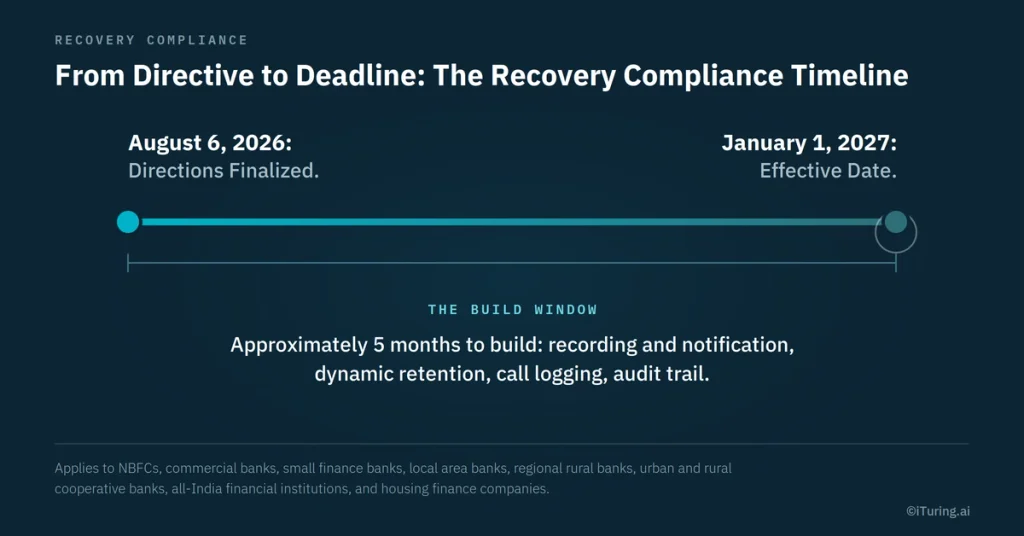
- Key dates: finalized August 6, 2026, effective January 1, 2027. The build has to be done well before that date, not on it.
- One caveat carried through this piece: the NBFC-side paragraph 100P citation is sourced from secondary legal-advisory material, not independently confirmed against the primary RBI text, and doesn’t necessarily apply to the bank-side circular’s numbering.
Recovery Call Recording Compliance Is a New Documentary Requirement, Not a Conduct Update
Anyone searching for what recovery call recording compliance actually requires is usually trying to answer two questions: what the rule mandates, and whether their collections software already meets it. Here’s the direct answer: RBI’s rule requires that recovery calls be recorded, that borrowers be told they’re being recorded, that recordings be retained for a defined minimum period, and that call time and count be logged. Most collections stacks built for the old contact-hour regime aren’t wired to do all four by default.
The instinct, on seeing another RBI recovery directive, is to file it next to the usual list: contact hours (0800 to 1900), no threats, no contacting family without consent. Those rules already exist. This one is different in kind, not degree.
What RBI actually added is a documentary requirement: recovery calls have to be recorded, borrowers have to be told they’re being recorded, the recordings have to be kept for a defined minimum period, and the time and number of every contact has to be logged.
None of that existed as a formal obligation before. The practical effect is that conduct which was previously undocumented now has a record by default.
The Rule Is a Recording, Retention, and Logging Mandate
The directions are part of RBI’s Responsible Business Conduct framework for loan recovery, finalized August 6, 2026. They apply through parallel circulars to nine categories of regulated entities: NBFCs, commercial banks, small finance banks, local area banks, regional rural banks, urban and rural cooperative banks, all-India financial institutions, and housing finance companies.
Three mechanics matter for anyone running or governing a collections operation:
- Recording and notification. Lenders (and, per the directions, their outsourced recovery agents) must record recovery calls, including callbacks the borrower makes to a number the lender provided. Borrowers must be informed the call is being recorded, at the point of the call, not buried in a loan agreement signed months earlier.
- Retention with no fixed ceiling. Recordings must be preserved for six months from the call date, or until any related litigation concludes, whichever is later. That second clause is the one worth sitting with: it functions as a conditional clock that can extend indefinitely, not a fixed compliance calendar entry.
- Call time and count logging. Lenders must document the time and number of calls made to a borrower or guarantor. This is a separate obligation from the recording requirement, and one that has to reconcile against existing contact-hour rules.
The effective date is January 1, 2027. On the NBFC side specifically, the operative recording requirement is cited by secondary legal-advisory sources as falling under paragraph 100P of the directions. That pinpoint citation hasn’t been independently confirmed against the primary RBI text at time of writing and should not be treated as settled, and it does not necessarily carry over to the bank-side circular’s paragraph numbering.
What Changes Is What Evidence Exists When a Complaint Gets Filed
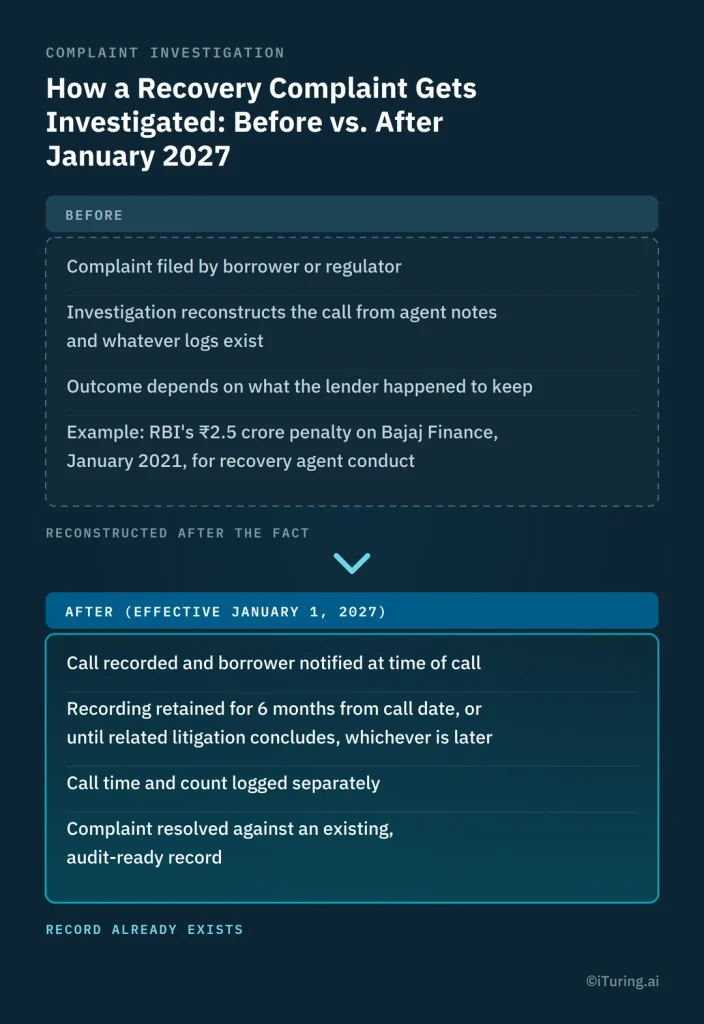
The old model runs on complaints. A borrower or a regulator raises a concern about a recovery call, and only then does an investigation reconstruct what happened, from call logs if they exist, from agent notes, from whatever record the lender happened to keep.
RBI’s 2021 action against Bajaj Finance is the clearest precedent for what that reconstruction looks like in practice. RBI imposed a ₹2.5 crore penalty on the company in January 2021, specifically for failing to ensure its recovery agents did not harass or intimidate customers during collections calls. That penalty was built on the old evidentiary model: conduct investigated after the fact, using whatever documentation existed at the time.
Under the new rule, that same scenario doesn’t need to be reconstructed. It’s on tape, notified to the borrower, retained for six months minimum, and logged by time and count, by default, before a single complaint is filed.
The actual shift is documentary, not punitive: the rule doesn’t raise the penalty for misconduct, it makes the underlying conduct provable the moment it happens. The recordings become discoverable, audit-inspectable artifacts the moment they’re created, not an after-the-fact forensic exercise dependent on what a lender happened to keep.
What Recovery Call Recording Compliance Requires From NBFC Collections Software
January 1, 2027 is the enforcement date, not the build date. Four things need to already be working in the software by then:
- Recording and consent notification at call initiation. The software has to fire the notification as a system-enforced step before the call connects, with the recording starting in the same instant. This can’t depend on an agent remembering to read a script.
- Dynamic retention logic, not a fixed schedule. The software’s retention layer has to check litigation status continuously and extend the hold automatically the moment a case touches an account, because a standard six-month archival policy fails as soon as litigation is involved. That means retention needs a live link to case status, not a one-time flag set at intake.
- Call time and count logging integrated with contact-hour enforcement. The software has to treat these as one system, not two checkboxes: a call logged at 7:45 p.m. has to trip the same enforcement logic that governs the 0800 to 1900 contact window, in real time, not in a monthly audit reconciliation.
- An audit trail linking agent identity, timestamp, and recording. The software has to produce any single call as one linked record, pulled up with who made it, when, and what was said, rather than three systems a compliance team has to reconcile manually.
iTuring’s Agentic execution layer is built to produce the first three of these structurally: autonomous outreach that is timestamped and rule-bound by construction, not by a policy someone has to remember to follow.
Model Governance already does the fourth for model decisions, an immutable audit trail with maker-checker approval, extended to cover the call-level record this rule now requires.
The infrastructure question is whether the recording, retention, and logging are already wired into the same governed system that produces every other audit-traceable decision, or bolted on separately and reconciled by hand later.
Most Existing Content on This Rule Skips the Details That Actually Matter
A lot of what’s already published on RBI’s recovery directions treats it as a headline: new recovery rules, stricter norms, sometimes an uncited compliance-improvement percentage attached for effect.
What that coverage tends to skip:
- The retention period is conditional, not fixed.
- The effective date is a full calendar year out from finalization.
- The paragraph-level citations differ by entity type and, in at least one case, aren’t independently confirmed yet.
Precision is the differentiator here, not volume. A compliance team building toward January 2027 doesn’t need another restatement that RBI tightened recovery rules. It needs the retention logic spelled out conditionally, the scope named by entity category, and the parts of the citation trail that are still unsettled flagged as such, so an internal legal or compliance function isn’t caught relying on a secondhand paragraph number that turns out to be entity-specific or wrong.
What an Audit-Ready Collections Stack Already Looks Like in Production
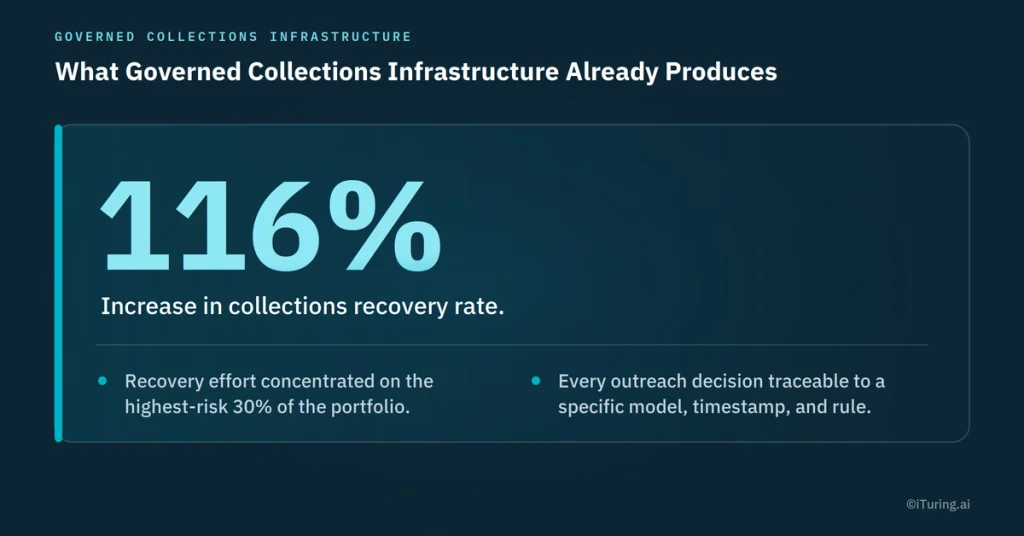
An India-based NBFC client running iTuring’s collections platform, before this rule existed as a requirement, was already operating with the kind of governed, timestamped, auditable outreach infrastructure the new directions now require as a floor.
Predictive default and delinquency-movement models segmented the loan book into risk groups, concentrated recovery effort on the highest-risk 30% of the portfolio, and produced a 116% increase in collections recovery rate, with every outreach decision traceable to a specific model, timestamp, and rule.
That’s what the infrastructure looks like when governance is built into the execution layer from the start, ahead of a January 2027 deadline, rather than retrofitted to meet it.
Next in This Series: RBI’s Device-Locking Rules for Recovery Calls
The same directions also introduce graduated restrictions on locking a borrower’s device as a recovery tactic, beginning as early as 30 days past due, with escalating restriction after 60 days, essential functions like inbound calls, SMS, and emergency services always preserved, and compensation of ₹250 per hour, capped at the loan amount, for wrongful or delayed lockout.
The next post in this series covers what that actually requires operationally, and where the ambiguity sits.
Book a working session with iTuring.ai to see how Agentic execution and Model Governance handle the recording, retention, and logging layer as one linked, audit-ready record, without three systems reconciled by hand.