
TL;DR
- Early bucket intervention prevents accounts reaching late-stage delinquency
- Propensity scoring separates self-cure accounts from intervention accounts
- Right-party contact optimisation is the single highest-impact operational lever
- Self-cure suppression reduces cost without reducing payment outcomes
- SR 11-7 and TCPA compliance must be built into the AI architecture
A US community bank with a $180 million consumer loan portfolio sees between 800 and 1,200 accounts enter the 30-60 DPD bucket every month. The collections team has three full-time agents. With current tools and contact infrastructure, they can realistically work about 600 accounts in a month. The remaining 200 to 600 accounts carry over.
Some of those carryover accounts self-cure before they progress. Some age into the 60-90 DPD bucket. Some charge off. At the start of each month, the collections team does not know which carryover accounts fall into which category. So they work in balance order and accept the uncertainty about what the accounts they cannot reach will do.
AI early bucket collections changes that calculation without changing the number of agents. The AI identifies which accounts are likely to self-cure without any contact. It handles digital outreach for the high-propensity accounts that respond to automated payment reminders. It routes the accounts that need a human conversation to the three agents who can have it, with full account context pre-loaded before the call connects.
The team still has three agents. The difference is which 600 accounts they spend the month working.
This blog covers why early bucket is the highest-value intervention point in the consumer collections stack, what AI does in the 30-60 DPD bucket, why right-party contact rate is the primary economic lever, how the ROI calculation works for community bank scale, and what SR 11-7, TCPA, and fair lending compliance require.
Why Early Bucket Matters More Than Late Stage
The recovery economics of collections are not linear across DPD stages. Accounts resolved in the 30-60 DPD bucket cost materially less to recover than accounts that progress to 90-plus DPD or charge-off. Three factors drive this relationship.
Borrower engagement is highest. A borrower at 30-60 DPD is still within the window where the missed payment is cognitively present, the banking relationship matters to them, and their financial options have not yet narrowed to the point where a payment arrangement is impossible. Most 30-60 DPD borrowers are not strategic defaulters. They missed a payment because of a timing issue, an unexpected expense, or a short-term income disruption. The window where a well-timed reminder or a structured arrangement offer resolves the account is still open.
At 90-plus DPD, the picture changes. The borrower has received multiple contacts, may have spoken with an agent, and may have made and broken commitments. Their financial position has often worsened. Their engagement with the bank’s collections process has typically declined. The treatment cost and the likelihood of a positive resolution have both moved in the wrong direction.
Treatment cost is lowest. A digital payment reminder with an online payment link is the most cost-effective treatment type in the collections stack. It is also the treatment that works best in the early bucket, where borrower willingness is highest and the payment amount has not yet grown to a level that requires a negotiated arrangement. The further an account progresses through the DPD buckets, the more expensive the treatment required to produce a resolution outcome.
Charge-off prevention is worth more than recovery. A charged-off account recovered through a third-party agency or legal process produces a recovery of cents on the dollar after costs. A charge-off prevented through a $12 to $18 digital contact in the 30-60 DPD window preserves the full outstanding balance as a performing asset. For a community bank managing capital ratios and loan loss reserves, the per-account value of charge-off prevention in the early bucket is materially higher than the per-account value of late-stage recovery.
For community banks specifically, early bucket intervention serves a retention function that large national bank collections operations do not prioritise in the same way. A community bank borrower who receives a timely, respectful payment reminder in the 30-60 DPD window, resolves the missed payment, and continues the banking relationship is a retained customer. The same borrower who first hears from the bank at 90-plus DPD through a collections agency is a relationship that has been damaged in a way that is difficult to repair.
Preventing a charge-off through a $15 digital contact in the 30-60 DPD window is materially more valuable than recovering a charged-off account at cents on the dollar after legal costs.
What AI Does in the Early Bucket
Four functions distinguish AI early bucket collections from manual queue management for US community banks.
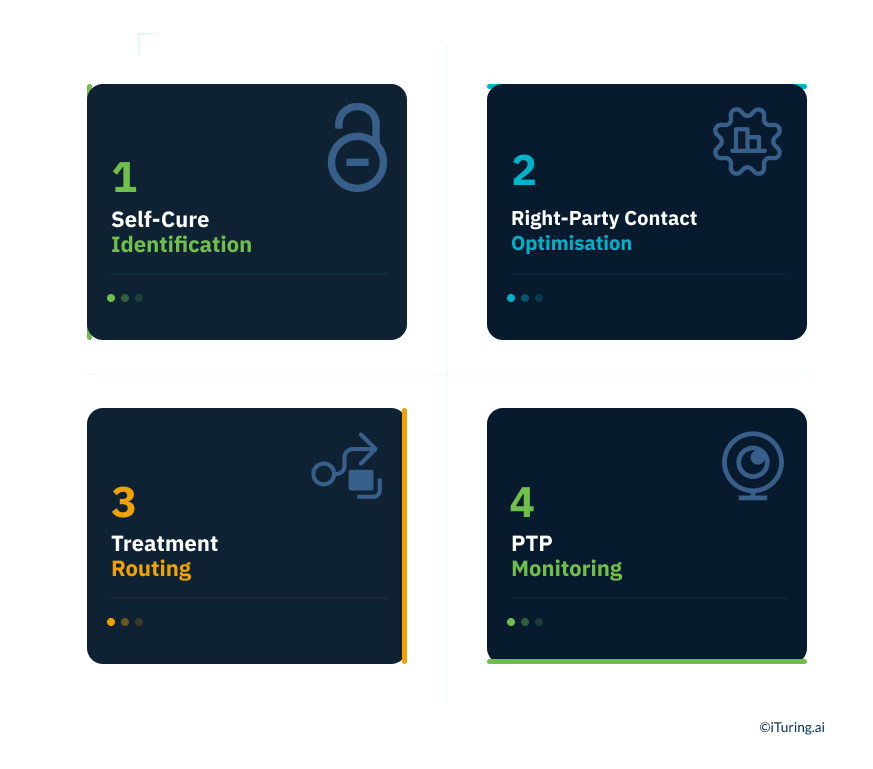
Self-Cure Identification
Self-cure identification assigns each early bucket account a probability estimate for paying within the current cycle without any outbound contact. Accounts above the self-cure threshold are removed from the active outreach queue. The payment outcome on these accounts is maintained at near-zero contact cost.
The signals that drive self-cure propensity in US community bank portfolios include historical self-cure frequency at the same DPD stage, payroll deposit timing relative to the missed payment date, and payment trajectory across the prior three to six cycles. A borrower who has paid at DPD 18 without contact in two prior cycles, whose payroll deposit is expected within five days, and whose prior payment history is strong carries a materially different self-cure profile from a borrower with no self-cure history, no visible income signal, and a deteriorating payment trajectory.
For the community bank with 800 to 1,200 monthly early bucket entries, a conservative self-cure identification rate of 20 to 25% removes 160 to 300 accounts from the active queue each month. These accounts continue to be monitored: if the expected payment does not post within the self-cure window, the account re-enters the active queue with an updated score. But the contact cost on accounts that do self-cure is reduced to the cost of monitoring, not the cost of outreach.
Right-Party Contact Optimisation
Right-party contact optimisation selects the channel, timing, and day for each contact attempt based on the specific borrower’s historical response patterns rather than a uniform strategy applied across the portfolio.
A community bank’s early bucket portfolio contains borrowers with materially different engagement patterns. A small business owner who checks voicemail at 6pm. A shift worker who responds to SMS during a lunch break between 12pm and 1pm. A retiree who calls back promptly if a message is left but never answers an unrecognised number. An agricultural borrower in a rural area with limited data connectivity who pays via online portal when a payment link arrives by email.
A uniform contact strategy, where the system calls every account at 10am on the first business day of the treatment cycle, will reach the retiree and miss everyone else. Per-borrower timing and channel selection based on historical response data closes the gap between when the system wants to make contact and when each specific borrower is most likely to be reachable.
Treatment Routing
Treatment routing assigns each account to the appropriate treatment type based on propensity scores and account state. High pay propensity accounts with high response propensity receive automated digital outreach: a payment reminder with an online payment link, optimised for timing and channel. High pay propensity accounts with low response propensity receive an agent-assisted contact in the window where they are most likely to answer, with the agent pre-loaded with account context before the call connects.
Accounts with active legal or compliance flags, bankruptcy filing, active dispute, TCPA opt-out, or a cease and desist request, are routed to a compliance review queue rather than an outreach treatment. These accounts receive no automated or agent contact until the compliance review is complete and the appropriate treatment path is confirmed.
Promise-to-Pay Monitoring
Every PTP commitment made in the early bucket is tracked against its promised payment date. When the window closes without a payment posting, a follow-up treatment fires in real time: a shorter message with a direct payment link, routed through the channel where the borrower is most likely to engage, with agent escalation if the digital follow-up produces no response within a defined window.
The real-time PTP follow-up eliminates the batch delay described in earlier blogs. A PTP breach on a Friday afternoon does not wait until Monday morning for a follow-up treatment. The follow-up fires within hours of the breach, while the borrower’s awareness of the commitment and the payment intention are still active.
Right-Party Contact Rate as the Primary Economic Lever
Right-party contact rate is the metric that most directly determines early bucket recovery economics for US community banks. A contact attempt that does not reach the borrower produces no recovery value and consumes contact capacity. A productive contact, reaching the borrower at a moment when they can engage with a payment conversation, is the unit of value the entire early bucket operation is built around.
Three components of right-party contact that AI optimises each contribute to the overall rate improvement.
Channel Selection
Community bank consumer loan portfolios span a wide range of borrower demographics and digital engagement levels. A segment of every community bank’s early bucket population will respond more reliably to voice contact. A growing proportion responds to text or email with a payment link. Some borrowers pay through an online portal when prompted but do not engage with voice or text outreach at all.
Per-borrower channel selection using historical response data outperforms a uniform channel strategy at the portfolio level. A borrower who has never answered a voice call in eight months but has completed three online payments after receiving an email payment link should receive an email with a payment link as the primary contact method. Routing this borrower to the voice call queue consumes agent time, produces a non-answer, and delays the payment that the email would have generated.
Building the channel selection logic on each borrower’s own response history rather than on portfolio-level channel performance averages is what produces the improvement in right-party contact rate at scale.
Timing Optimisation
The gap between when the collections batch fires a contact and when the specific borrower is most likely to answer is where right-party contact rates are lost in manual and batch-driven collections operations. A batch that runs at 9am and generates calls for the next four hours will reach the borrowers who are available at mid-morning and miss everyone else.
Per-borrower timing based on historical answer patterns places each contact attempt in the window where that borrower has historically been reachable. For community banks serving populations with predictable daily routines, including rural borrowers, shift workers, and small business owners, the timing signal from prior successful contacts is a reliable predictor of future reachability.
Frequency and Spacing Within TCPA Constraints
TCPA compliance for US banks requires that automated voice and SMS contact on mobile numbers respects prior express consent requirements and the time-of-day restrictions that apply in the called party’s local time zone. Within these constraints, contact frequency and spacing can still be optimised at the individual borrower level.
Over-contact produces opt-outs that remove the borrower from the automated contact population entirely, TCPA complaints that carry significant per-violation liability, and reduced engagement on subsequent attempts as the borrower becomes habituated to ignoring contact attempts. Under-contact leaves productive contact opportunities unused as the account ages through the early bucket toward late-stage delinquency.
AI contact scheduling navigates this balance per borrower, optimising the number and spacing of contact attempts to maximise productive contact probability before the account ages out of the 30-60 DPD window, without generating the frequency pattern that produces opt-outs and complaints.
The ROI Calculation for Community Banks
The ROI case for AI early bucket collections at community bank scale follows a consistent structure. The specific numbers vary by institution, but the calculation logic is the same.
A community bank with a $180 million consumer loan portfolio, 800 to 1,200 monthly early bucket entries at average balances of $8,000 to $12,000, three full-time agents at a fully loaded annual cost of approximately $65,000 each, a current early bucket recovery rate of 72%, and a monthly early bucket charge-off rate of 8% has a specific set of levers that AI affects.
Self-cure suppression reduces contact cost on the 20 to 25% of accounts that carry high self-cure propensity. At a conservative digital contact cost of $12 to $18 per outreach sequence, removing 160 to 300 accounts per month from the active queue produces a direct cost reduction that is measurable within the first quarter of operation.
Right-party contact rate improvement of five to eight percentage points on the active outreach population increases the proportion of early bucket accounts that receive a productive contact before they age into the 60-90 DPD bucket. Each percentage point improvement in productive contact rate translates to a corresponding improvement in the proportion of accounts resolved in the early bucket.
Charge-off prevention is where the ROI calculation becomes most significant. Each percentage point reduction in the monthly early bucket charge-off rate on an $180 million portfolio with 800 to 1,200 monthly entries represents a meaningful reduction in provisioning requirements and a corresponding improvement in net interest margin. The AI investment should be evaluated against this figure, not against the cost of the digital contacts it generates.
Agent capacity reallocation produces a compound benefit. Agents freed from working self-cure accounts and high-propensity digital-resolution accounts can focus on mid-propensity accounts requiring negotiated payment arrangements. Human judgment in a well-structured arrangement conversation produces higher PTP commitment rates and better PTP fulfilment rates than an automated digital message on the same account type. Concentrating agent time on the accounts where that judgment matters most improves arrangement quality across the portion of the portfolio where human contact is genuinely necessary.
AI collections investment should be evaluated against the marginal cost of accounts prevented from progressing to charge-off, not against the cost of the digital contact it replaces.
SR 11-7 and TCPA Compliance for Community Bank AI Collections
Four compliance requirements shape how US community banks implement AI early bucket collections.
SR 11-7 Model Documentation
The propensity scoring model, the treatment matrix that maps scores to treatment types, and the decisioning logic that executes treatment assignments together constitute a model under the Federal Reserve’s SR 11-7 guidance. Pre-deployment validation on the bank’s own consumer loan portfolio data is required before go-live. Validation documentation must cover rank-order accuracy, score distribution review, feature importance, and differential outcome testing across protected borrower groups.
Model inventory registration, ongoing monitoring for Gini coefficient stability and score distribution drift, and a documented retraining trigger threshold are required from the first day of live operation. All documentation must be retained and available for Federal Reserve, OCC, or FDIC examination. For vendor-supplied models, the bank must conduct and own its own validation process. The bank cannot discharge its SR 11-7 obligations by referencing the vendor’s internal testing results.
TCPA Consent and Frequency Compliance
TCPA requires prior express consent for automated voice calls and SMS messages to mobile numbers. The AI contact system must check consent status at every contact trigger, not at the last consent record update. Time-of-day restrictions, generally 8am to 9pm in the called party’s local time zone under TCPA and many state-level equivalents, must be enforced as hard gates in the decisioning engine. A contact attempt generated outside permitted hours is a TCPA violation regardless of whether a human reviewed the contact schedule.
Frequency constraints must be monitored at the individual borrower level. The per-violation statutory damages under TCPA mean that a systematic consent or frequency compliance failure across hundreds of early bucket contact attempts can generate significant aggregate liability before the issue is detected in a batch review.
Fair Lending Review
AI treatment routing that produces systematically different early bucket contact patterns for borrowers by race, national origin, age, or other characteristics protected under the Equal Credit Opportunity Act and the Fair Housing Act exposes the bank to fair lending liability. Pre-deployment differential outcome testing confirms the model does not produce disparate treatment or disparate impact across protected groups at the time of deployment. Ongoing monitoring for differential contact rates and recovery outcomes by borrower segment detects drift that may develop over time as the model updates and the portfolio composition changes.
CFPB UDAAP and Explainability
CFPB examination of AI-driven collections contact focuses on three areas: explainability of individual treatment decisions, documentation of the decisioning logic in a form that supports examination review, and evidence that automated contact does not produce outcomes that violate UDAAP standards for unfair, deceptive, or abusive acts or practices. The decision log generated at every contact trigger, recording the triggering event, account state, scores, eligibility checks, treatment selected, and execution outcome, is the primary examination evidence for all four of these areas.
Three Agents Can Work 600 Accounts. AI Decides Which 600 They Should Be.
The community bank with three agents and 1,000 monthly early bucket entries is not going to hire its way out of the capacity constraint. The economics of community banking do not support a collections staffing level that can manually work every early bucket account with the contact intensity that maximises recovery.
What changes the outcome is not more agents. It is better information about which accounts need an agent, which accounts need a well-timed digital message, and which accounts need nothing at all because they will pay before the month ends.
AI early bucket collections provides that information. The agent capacity the bank already has gets directed at the accounts where it produces the most value. The digital contact budget gets directed at accounts where automated outreach changes the outcome. The self-cure accounts get monitored at minimal cost while they resolve independently.
The 600 accounts the three agents work at the end of the month are a different 600 than the balance-ordered list they started with. That difference is where the early bucket recovery improvement is.
Five markers of a well-implemented AI early bucket collections programme for US community banks:
- Self-cure propensity scores calibrated on the bank’s own portfolio data, with a documented re-entry process for accounts that do not self-cure within the expected window
- Right-party contact optimisation driven by per-borrower historical channel and timing data, not portfolio-level averages
- TCPA consent and time-of-day enforcement as hard gates in the decisioning engine, applied at every contact trigger
- SR 11-7 compliant model documentation with pre-deployment validation on the bank’s own consumer loan data and ongoing Gini and PSI monitoring from day one
- ROI tracking structured around charge-off prevention rate rather than contact cost reduction, with monthly reporting to the chief credit officer and CFO
iTuring’s AI collections platform is configured for US community bank early bucket operations: SR 11-7 compliant model governance, TCPA consent and frequency enforcement, per-borrower right-party contact optimisation, and real-time PTP monitoring with same-session follow-up.