
TL;DR
- Credit unions face a collections tension banks do not: member retention
- Propensity scoring separates members who need outreach from those who do not
- Omnichannel contact strategy maps to each member’s established preferences
- Self-cure suppression preserves the member relationship at zero cost
- NCUA and CFPB compliance requirements shape every stage of implementation
The member who is 45 days past due on their auto loan is also the member who has held a savings account since 1998. Their spouse has a mortgage with the credit union. Their two adult children opened their first checking accounts at the same branch three years ago. The family’s total deposit relationship with the credit union runs to several hundred thousand dollars.
A national bank collections operation does not carry this context. The 45 DPD borrower is an account number in a delinquency queue. The contact strategy is the same as for every other 45 DPD account in the portfolio. Optimise for recovery. Move to the next account.
For a credit union, the contact strategy for this member is different, or should be. The recovery outcome matters. The auto loan is delinquent and needs to be resolved. But what this member feels about the credit union after the contact is made also matters, because the cost of losing this family’s full relationship is not captured in the auto loan’s delinquency balance.
AI collections for credit unions is not about replacing the human relationship. It is about giving the collections team the information they need to protect it. Who needs a payment reminder. Who needs a conversation with someone they know. Who will pay without any contact at all. Who needs a treatment that reflects twenty-five years of membership rather than forty-five days of missed payments.
This blog covers what makes credit union collections structurally different from bank collections, what AI does in the credit union context, how omnichannel contact strategy works for member populations, how the ROI calculation should be structured, and what NCUA and CFPB compliance require.
Why Credit Union Collections Is a Different Problem
Three structural differences between credit union and bank collections shape every AI implementation decision.
Membership Economics
A delinquent credit union member is not just a collections account. They are a member whose relationship value extends well beyond the delinquent loan balance. Their deposit accounts, any other loan products, family member accounts, and insurance or investment products held at the same credit union all represent relationship value that is at risk if the collections experience damages the membership.
This does not mean that delinquent accounts should not be collected. It means the optimisation target for a credit union collections operation is different from a bank’s. A bank optimises primarily for recovery rate and cost per recovery. A credit union must optimise for recovery rate, cost per recovery, and member retention simultaneously. Collections treatment that produces a payment but costs the credit union a full family relationship is a net negative outcome even though the recovery metric improved.
AI collections for credit unions must be configured with this optimisation in mind. The treatment matrix, which accounts receive which contact types, must incorporate membership context alongside propensity scores.
Portfolio Concentration
Credit union consumer loan portfolios are typically more concentrated by geography, employer group, or affinity than commercial bank portfolios. A credit union serving a single metropolitan area, a specific employer group, or a professional affinity cohort has a delinquency portfolio that is sensitive to localised disruptions in ways that a geographically diversified national bank portfolio is not.
A regional employer announcing layoffs can simultaneously affect a significant proportion of a credit union’s consumer loan portfolio. A sector-wide income disruption can move a large number of accounts into the delinquency queue within the same cycle. A natural disaster can disrupt the payment capacity of members concentrated in a single geographic area.
AI models trained on geographically diversified bank portfolio data will not accurately score this concentration-driven simultaneous delinquency. Credit union AI models must be trained on the credit union’s own portfolio data and should incorporate local economic indicators as input features to calibrate for the concentration dynamics of the specific membership.
Regulatory Framework
Credit unions are supervised by NCUA at the federal level, not by the OCC, Federal Reserve, or FDIC. NCUA’s supervisory expectations for AI-driven collections include member protection standards, fair lending requirements consistent with CFPB guidance, and model documentation expectations that align with SR 11-7 principles even though SR 11-7 applies directly only to Federal Reserve-supervised institutions.
NCUA examiners approach collections practices through a member-first supervisory lens that adds a dimension to the compliance review that a bank examiner’s review does not always include. A collections programme that meets recovery performance standards but produces member complaint patterns or treatment disparities that conflict with the credit union’s member service mission will attract NCUA attention regardless of its efficiency metrics.
A delinquent credit union member is not just a collections account. They carry a lifetime relationship value that includes deposits, loans, insurance, and family referrals. Collections treatment that damages that relationship costs more than the missed payment in many cases.
What AI Does in Credit Union Collections
Five functions directly address the specific challenge of credit union collections, where recovery and relationship preservation must both be served.
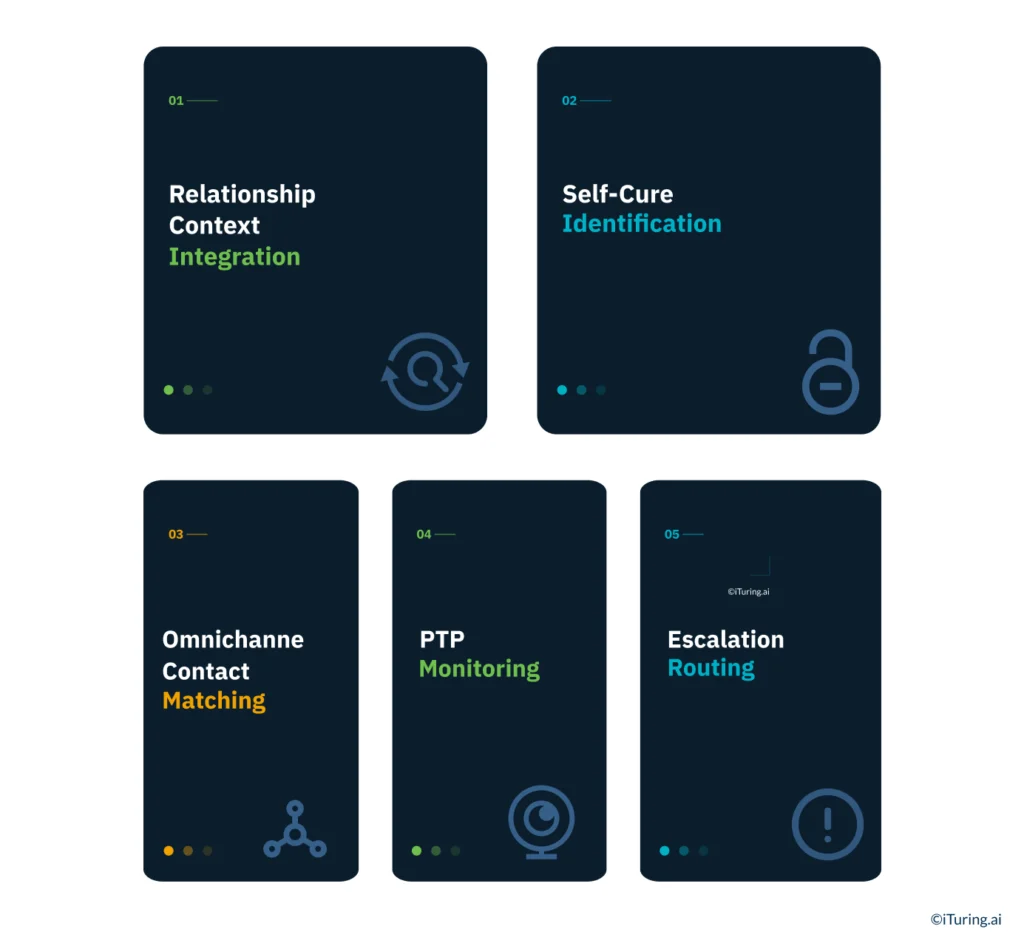
Member-Level Relationship Context Integration
AI collections for credit unions incorporates member relationship signals beyond the delinquent loan account into the treatment decision. Membership tenure, deposit balance trajectory, number of active products held, family member accounts at the same credit union, and prior contact history across all product lines each contribute to the treatment context.
A member with twenty years of tenure, four active products, a deposit relationship in strong standing, and no prior delinquency history receives a materially different initial treatment than a recently joined member with a single loan product and a prior missed payment in their first year. The difference is not in whether they are contacted. It is in the intensity of the first contact, the channel selected, the tone of the outreach, and the authority level of the treatment offered.
The relationship context does not override the propensity score. A high-tenure member with high self-cure propensity is still suppressed from active outreach during the self-cure window, regardless of their relationship depth. The relationship context calibrates treatment intensity and tone when contact is warranted, not whether contact is made.
Self-Cure Identification at Member Level
Members with a strong self-cure history at the same DPD stage, an upcoming payroll deposit timing signal, and a positive deposit balance trajectory carry a high probability of paying without any contact during the current treatment cycle. Suppressing these members from active outreach preserves the relationship at zero contact cost.
The payroll timing signal is particularly valuable for credit unions where a substantial proportion of members have direct payroll deposit. A member whose payroll deposit is arriving in two business days is a materially different contact priority from one whose last visible income signal was three weeks ago and whose deposit balance has been declining. The AI distinguishes between these two member profiles at the start of each treatment cycle and routes them accordingly.
Self-cure suppression matters for the member relationship beyond its cost benefit. A member who receives an outbound collections contact call the day before their payroll arrives and pays independently anyway experiences an interaction that was not only unnecessary but may have been mildly alarming or intrusive. At twenty-five years of membership, the accumulated effect of unnecessary collections contacts erodes the relationship quality in a way that does not show up in any recovery metric but does show up in member satisfaction surveys and eventual attrition.
Omnichannel Contact Matching to Member Preference
Credit union members have established communication preferences that are visible across all their product interactions. A member who logs into the mobile app daily, uses the online payment portal for all bill payments, and has never answered an outbound call from the credit union has a clear communication profile. Routing their collections contact through the mobile app or via an SMS payment link produces a better contact outcome than an outbound call that will go to voicemail.
A member who calls the branch regularly, has a named relationship manager on file, and has never downloaded the mobile app has an equally clear but opposite profile. Routing their collections contact through the outbound call queue with the collections team is the right channel for this member.
AI contact selection uses product usage history, login patterns, branch visit frequency, and prior response history across all product interactions to determine the appropriate channel for each member’s collections outreach. The system does not assume a uniform channel for all members. It uses what the credit union already knows about how each member communicates.
PTP Monitoring and Relationship-Appropriate Follow-Up
Every PTP commitment made by a member in the collections cycle is monitored against its promised payment date. When the window closes without a payment posting, a follow-up treatment fires with the timing, channel, and tone calibrated to both the payment urgency and the member’s relationship context.
A high-tenure member who has missed a PTP commitment for the first time in fifteen years of membership receives a different follow-up message from one whose prior collections history includes repeated PTP breaches. The first member’s breach is most likely a timing issue. The second member’s breach may indicate a deeper financial difficulty requiring a different treatment. The AI treatment matrix distinguishes between these two profiles at the point of follow-up.
Escalation Routing with Relationship Context Pre-Loaded
Accounts that require escalation beyond automated digital outreach are routed to the collections team with full relationship context loaded before the agent interaction begins. The agent knows: how long the member has been with the credit union, what products they hold, whether family members are also members, what their prior collections history looks like across all product lines, and what their established communication preferences are.
The agent enters the conversation knowing who they are speaking with. Not just what the delinquent balance is, but who this person is in the context of the credit union’s membership. That context changes both the quality of the conversation and the likelihood of a resolution that preserves the relationship alongside recovering the payment.
Omnichannel Contact Strategy for Credit Union Members
Credit union member communication patterns differ from those of bank borrowers in ways that directly affect right-party contact rate and the quality of the interaction when contact is made.
Branch as a Contact Channel
Many credit union members have an established relationship with a specific branch or a named relationship manager that does not exist in the same form in most bank collections operations. For certain member segments, high-tenure members, members with complex multi-product relationships, or members whose prior credit union interactions have been primarily branch-based, initiating a collections conversation through the branch relationship produces higher engagement and lower relationship damage than a contact from the outbound collections queue.
AI contact routing incorporates branch relationship flags drawn from the member’s product interaction history. When a member’s profile indicates a strong branch affiliation, the collections workflow routes an alert to the branch relationship manager: a brief notification that the member has a delinquency that warrants a conversation, with the member’s full relationship context available. The branch manager makes the initial contact in the context of their existing relationship with the member, not as a collections agent the member has never spoken with before.
This routing is appropriate for a specific segment of the membership, not for all members. For members with no significant branch relationship, it adds a step without adding value. The AI contact routing identifies which members fall into the branch-appropriate segment and routes accordingly.
Digital Channel Dominance in Younger Member Cohorts
Credit unions with younger member cohorts through employer programs, fintech partnerships, or community outreach increasingly see digital channels as the primary communication point for collections outreach. These members pay through the mobile app, monitor their accounts through online banking, and respond to push notifications and SMS. They do not answer outbound calls from numbers they do not recognise, and voicemail messages from the credit union do not produce callbacks.
AI channel selection based on product usage history identifies this segment reliably without requiring self-reported channel preferences. A member who has logged into the mobile app forty-seven times in the last 90 days and made every prior payment through the online portal has a clear digital engagement profile. Routing their collections contact through a push notification and an in-app payment prompt produces a better right-party contact outcome than the outbound voice queue.
Contact Timing Based on Member Activity Patterns
Mobile app login patterns, online banking session timing, branch visit frequency, and historical payment timing all create a picture of when each member is actively engaged with their credit union relationship. A member who logs into the mobile app every Sunday evening to review their account balances represents a specific timing window for a digital collections outreach that is far more likely to produce a productive response than a Tuesday morning contact attempt when this member has no established engagement pattern.
Timing collections contact to coincide with each member’s established engagement patterns, rather than the batch schedule the delinquency queue fires on, reduces the proportion of contacts that are made when the member is unreachable or unengaged and increases the proportion that arrive in a window where the member is already thinking about their financial accounts.
The ROI Case for Credit Union AI Collections
The ROI calculation for AI collections at a credit union must include both the recovery economics and the retention value of relationship-appropriate contact. A calculation that covers only the recovery economics understates the full return.
Recovery Economics
Self-cure suppression reduces contact cost on members who carry high self-cure propensity without reducing the payment rate on those accounts. For a credit union where the typical monthly delinquency bucket includes a meaningful proportion of self-cure accounts, this cost reduction is measurable within the first two to three treatment cycles.
Right-party contact rate improvement through omnichannel matching increases the proportion of delinquent members who receive a productive contact before their account ages to the next DPD bucket. The improvement comes from routing each member through the channel where they are most likely to respond, rather than the uniform outbound call strategy that produces a high non-answer rate across the portions of the membership whose communication preferences do not match that channel.
Agent capacity freed by AI automation of routine reminder and informational contacts redirects experienced collections staff to the relationship conversations where their knowledge of the member, their tenure, their product portfolio, their situation, produces the best outcomes. A small credit union collections team that handles both routine reminders and complex relationship conversations through the same agents is under-using the relationship knowledge those agents carry. AI separates the two functions and routes each to the appropriate resource.
Retention Value
A credit union member who resolves a delinquency through a contact that felt appropriate to their relationship with the credit union, the right channel, the right tone, the right person, is more likely to remain a member and to continue deepening their product relationship than one whose collections experience felt like a generic call centre interaction unrelated to the membership they have held for two decades.
For credit unions that track member net promoter score, the difference between these two experiences is measurable. Credit unions that track member lifetime value can quantify the retention differential between members who experienced AI-optimised relationship-appropriate collections contact and those who experienced standard outbound dialler treatment. Both measures belong in the ROI calculation alongside the recovery rate improvement.
Cost Structure Alignment
Credit union collections operations are typically staffed for the relationship model: a small number of experienced staff who know their members rather than a large agent pool working high volumes on a per-contact incentive. AI collections amplifies this model by automating the routine contacts, payment reminders, self-cure monitoring, PTP tracking, and concentrating human staff time on the conversations where their relationship knowledge changes the outcome.
A credit union that uses AI to automate 60 to 70 percent of its routine collections contacts, while directing its experienced staff to the 30 to 40 percent of accounts requiring a genuine relationship conversation, produces both a better recovery outcome and a better member experience from the same staff headcount.
For credit unions, the ROI of AI collections includes both the recovery rate improvement and the retention differential between members who experienced relationship-appropriate contact and those who did not.
NCUA and CFPB Compliance for Credit Union AI Collections
Four compliance requirements specifically shape how credit union AI collections programmes are designed and operated.
NCUA Examination Expectations
NCUA examiners apply a member-first supervisory lens to collections practices that extends beyond the recovery and cost metrics a bank examiner focuses on. AI-driven contact systems must demonstrate that automated contact respects member communication preferences, does not generate treatment patterns inconsistent with the credit union’s stated member service standards, and maintains documentation available for NCUA examination on request.
NCUA’s model risk management guidance for federal credit unions follows the same principles as SR 11-7, pre-deployment validation, model inventory, ongoing monitoring, and documented governance for every material change, even though SR 11-7 applies directly only to Federal Reserve-supervised institutions. A credit union that cannot produce a model inventory entry, a pre-deployment validation record, and a monitoring log for its AI collections system will find this gap visible in an NCUA examination.
CFPB Fair Lending and UDAAP
CFPB’s fair lending and UDAAP requirements apply to credit union collections contact. AI treatment routing that produces systematically different contact patterns, recovery rates, or settlement terms for members based on characteristics protected under ECOA or the Fair Housing Act triggers fair lending liability regardless of whether the credit union is CFPB-supervised or NCUA-supervised.
Pre-deployment differential outcome testing confirms the model does not produce disparate treatment across protected member groups at the time of deployment. Ongoing monitoring for differential contact rates and recovery outcomes by member segment detects drift that may develop as the portfolio composition changes and the model updates. The decision log at every contact trigger is the primary evidence base for any CFPB or NCUA fair lending examination.
TCPA Consent and Frequency Requirements
TCPA requires prior express consent for automated voice and SMS contact on mobile numbers. For credit union members who have provided multiple phone numbers across different product applications, consent status must be tracked at the member level and checked at every contact trigger. A mobile number provided with consent for account alerts does not automatically carry consent for collections contact.
Time-of-day restrictions, generally 8am to 9pm in the called party’s local time zone, must be enforced as hard gates in the contact decisioning engine. Per-violation statutory damages under TCPA mean that a systematic timing or consent failure across hundreds of member contact attempts creates significant aggregate liability before the issue surfaces in a batch review.
Model Documentation
Every AI model used in the collections workflow, the propensity scoring model, the contact routing model, the PTP monitoring system, must be documented with a clear purpose statement, a named owner, pre-deployment validation records, and an ongoing monitoring programme. The documentation must be maintained in a format retrievable for NCUA examination on request. Changes to any model, including retraining cycles and treatment matrix updates, must be documented with a rationale and sign-off before deployment.
Recovery Is the Outcome. The Member Relationship Is What Makes It Worth Doing Right.
A credit union that recovers a delinquent auto loan through a contact strategy that made a twenty-five-year member feel like an account number in a call centre queue has achieved one metric and damaged another. The recovery rate improved. The net promoter score moved in the other direction. The family’s deposit relationship is now at risk.
AI collections does not resolve the tension between recovery and relationship by choosing one over the other. It resolves it by giving the collections team better information than they have ever had before: which members will pay on their own, which ones need a well-timed reminder through the channel they actually use, which ones need a conversation with someone who knows them, and which ones need a treatment designed with the full scope of their membership in view.
The recovery outcome does not change when the relationship context is incorporated into the treatment decision. But the member’s experience of the credit union through the collections process changes significantly. And that experience is what determines whether the membership continues after the delinquency is resolved.
Five markers of a well-implemented AI collections programme for credit unions:
- Member relationship context signals incorporated into the treatment matrix alongside propensity scores, with treatment intensity calibrated to membership tenure and product depth
- Self-cure suppression based on payroll timing and deposit trajectory, with a documented re-entry process for members who do not self-cure within the expected window
- Omnichannel contact routing based on each member’s established communication preferences across all product interactions, including branch relationship routing for appropriate member segments
- TCPA consent checked at every contact trigger, time-of-day restrictions enforced as hard gates, and fair lending differential outcome monitoring in place from day one
- NCUA-aligned model documentation with pre-deployment validation on the credit union’s own portfolio data, model inventory maintenance, and ongoing Gini and score distribution monitoring with retained logs
iTuring’s AI collections platform is configured for credit union member relationship dynamics: relationship context integration, self-cure identification using payroll timing signals, omnichannel contact routing based on member usage history, and NCUA-aligned model governance documentation.