TL;DR
- What it is: AI model monitoring is the ongoing practice of tracking a model’s behavior after it goes live, so problems surface before they show up in losses or an examiner’s questions.
- The core mechanic: A dashboard that watches accuracy is one piece, not the whole program. A complete program tracks performance, drift, data quality, and whether the model can still explain itself.
- Who it applies to: Any regulated lender running models continuously in production, not just at launch: collections, credit decisioning, deposit retention, fraud.
- Key distinction: Monitoring is continuous. Validation is periodic. They answer different questions on different clocks, and a regulated lender needs both.
- One caveat: The RBI’s June 2026 draft guidance expects ongoing oversight of live models but does not prescribe a specific monitoring architecture. What a program should cover, described here, is practitioner standard, not an RBI checklist.
Most teams that say they monitor their models are watching one number: is accuracy still where it should be. That’s a real signal, and it’s also a small fraction of what a lender that has to answer to an examiner actually needs to be watching.
A Dashboard That Tracks Accuracy Is Not a Monitoring Program
Accuracy monitoring tells you the model still works today. It doesn’t tell you why a number moved, whether the population being scored has changed, whether the data feeding the model is still clean, or whether anyone could reconstruct what happened if a regulator asked. A single dashboard tracking a single metric is a start. It isn’t a program.
The difference matters because the failure that actually costs a regulated lender rarely shows up as “accuracy dropped 3 points.” It shows up as a model that’s still technically accurate on aggregate while quietly failing a segment, or a model whose inputs have shifted in a way nobody can explain when asked. Catching that needs more than one dial to watch.
What a Complete Monitoring Program Actually Covers
A monitoring program that’s actually complete tracks four distinct things, not one.
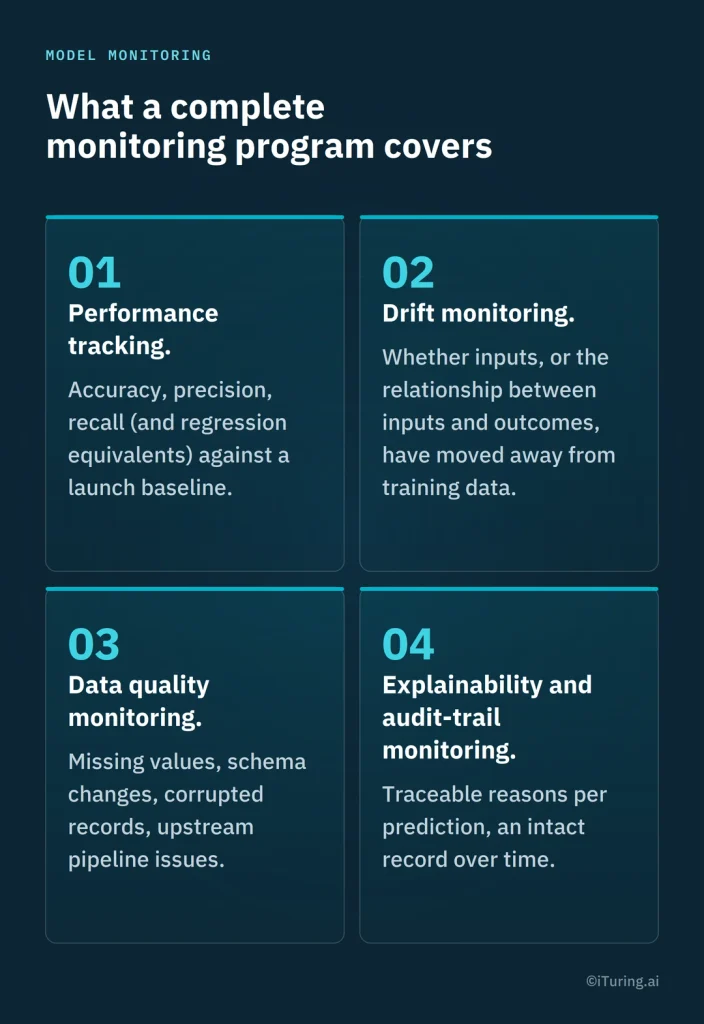
Performance tracking. The baseline layer: accuracy, precision, recall, and the equivalent regression metrics, tracked against what the model delivered at launch. This is necessary and still the least of it.
Drift monitoring. Whether the model’s inputs, or the relationship between those inputs and outcomes, have moved away from what the model was trained on. This is its own deep discipline, covering how it’s measured, what the standard thresholds are, and how often to check, and it’s covered in full in our guide to model drift.
Data quality monitoring. Missing values, schema changes, corrupted records, a new data source feeding an old field. A model can look like it’s drifting when the real problem is upstream, in the data pipeline feeding it, and this layer is what catches that distinction.
Explainability and audit-trail monitoring. Whether every prediction still carries a traceable reason, and whether the record of what the model did and why remains intact over time. This is the layer generic monitoring guides skip almost entirely, because it isn’t about keeping the model accurate. It’s about being able to prove what happened.
Why “Ongoing” Monitoring Is a Different Discipline From Periodic Validation
Validation and monitoring get treated as the same thing because they’re both checks on a model. They aren’t the same check. Validation is the periodic, independent test of whether a model is conceptually sound, run on a schedule. Monitoring is continuous, the tripwire in between validations that catches a model drifting away from soundness before the next scheduled review would have caught it.
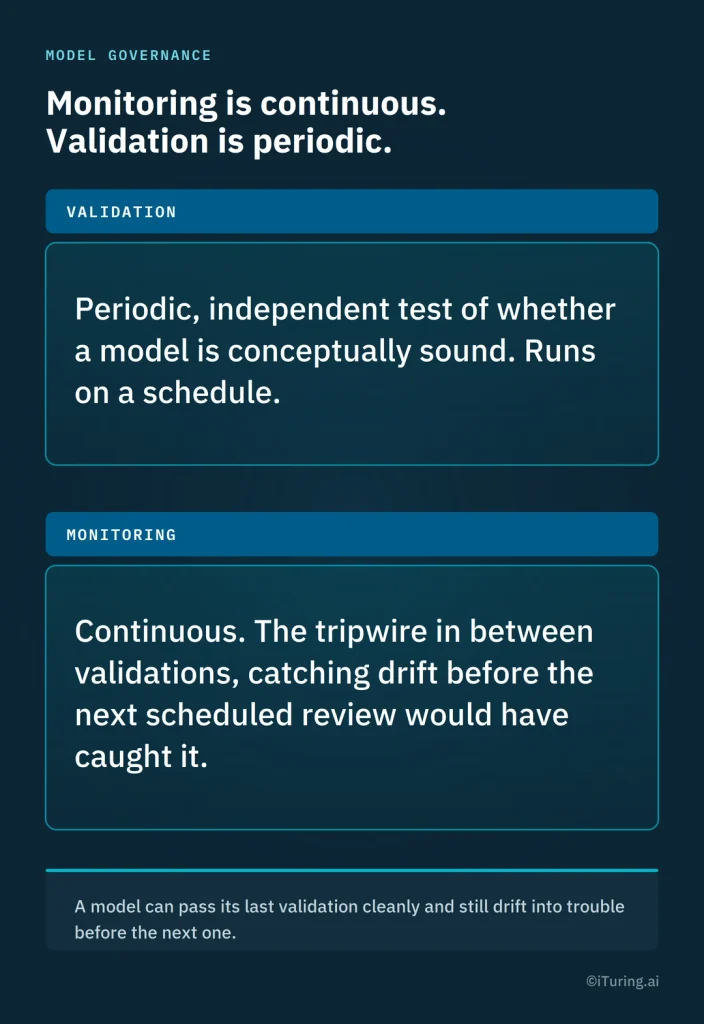
This distinction isn’t unique to India. Banking regulators elsewhere draw the same line explicitly: the European Central Bank treats ongoing monitoring of banks’ capital models as continuous compliance oversight, separate from periodic validation and benchmarking exercises that happen on a set calendar, though that’s EU capital-model supervision, a different market and regulatory regime from India’s retail-lending AI. The RBI’s own draft guidance doesn’t name a specific monitoring architecture, but the expectation it sets, that a model’s soundness can’t be assumed to hold between one scheduled review and the next, follows the same logic. A model can pass validation cleanly and still need to be watched every day after.
What Monitoring Has to Prove to an Examiner, Not Just to a Data Science Team
A generic MLOps monitoring stack is built to answer one question: does the model still perform. That’s the right question for a product team. It isn’t the full question for a regulated lender.
An examiner’s question is different: not just whether the model still performs, but why any given number moved, whether the people who changed the model were authorized to, and whether the evidence for all of that still exists months later. This is where the RBI draft’s third source of model risk, time-suitability, a model becoming less fit for purpose as conditions change even though nothing about it broke, actually gets caught in practice: not by noticing the model feels wrong, but by monitoring built to surface the specific, dated reason it started drifting. The same standard applies to vendor and third-party models. The RBI draft is explicit that accountability doesn’t transfer just because a model was bought rather than built, so a third-party model needs the same monitoring coverage as one built in-house.
Building Monitoring That Scales Across a Model Portfolio
None of the four dimensions above is hard to monitor for one model. The difficulty is doing it for every model in a growing portfolio, continuously, without a team spending its week reconstructing what happened after the fact.
A governed platform builds this in rather than bolting it on. Every prediction carries a traceable explanation, so when a metric moves in any of the four dimensions, the cause is visible immediately. Every model change runs through maker-checker approval before it reaches production. The full lineage from data to decision sits in an immutable audit trail, so monitoring produces evidence a validator or examiner can actually review, not a dashboard someone has to translate after the fact.
A leading NBFC in India used this approach to rank borrowers by risk and focus collections on the highest-risk segment, seeing a 116% improvement in collections and 86% predictive accuracy, deployed in two weeks. Monitoring built into the platform from day one was part of what kept that accuracy holding after launch, not just at it.
If your team is scoping what a monitoring program should cover across your model portfolio, book a working session with our data science team to map the four dimensions against what you’re tracking today.
This sits inside the wider model risk management framework, which covers the governance, inventory, and validation that work alongside monitoring to oversee an institution’s full model portfolio
Sources
- Fiddler AI, “ML Model Monitoring Best Practices,” 2026. Source for the four-dimension monitoring taxonomy (performance/prediction assessment, drift, data quality and adversarial risk, alerting practice). General industry framework, not India- or RBI-specific.
- European Central Bank, “Ongoing model monitoring – Banking supervision,” 2026. Used only to illustrate that a banking regulator elsewhere treats continuous “ongoing monitoring” as a distinct supervisory concept from periodic validation and benchmarking. This is EU capital-model (IRB) supervision, not retail-lending AI and not RBI; not presented as an RBI-equivalent program or requirement.
- Reserve Bank of India, Draft Guidance on Regulatory Principles for Model Risk Management, Press Release 2026-2027/528, issued 24 June 2026; public comments closed 24 July 2026. Reused unchanged from the cluster’s verified facts table (same fact set as articles #1-6, no re-fetch drift): time-suitability and third-party accountability. (Secondary summary: corplawupdates.in; verify final wording against the RBI primary document before publish.)
- iTuring case study, “Improve Collections and Optimize Efforts” (Leading NBFC in India): 116% collections improvement, 86% predictive accuracy, two-week deployment. Source: ituring.ai live case study.