
Your Installment Model Isn’t Underperforming on Cards. It’s Answering a Different Question.
TL;DR
- Installment loan models score distance from a fixed amortization schedule. Credit cards have no fixed payoff trajectory, so that entire signal family doesn’t transfer to revolving portfolios.
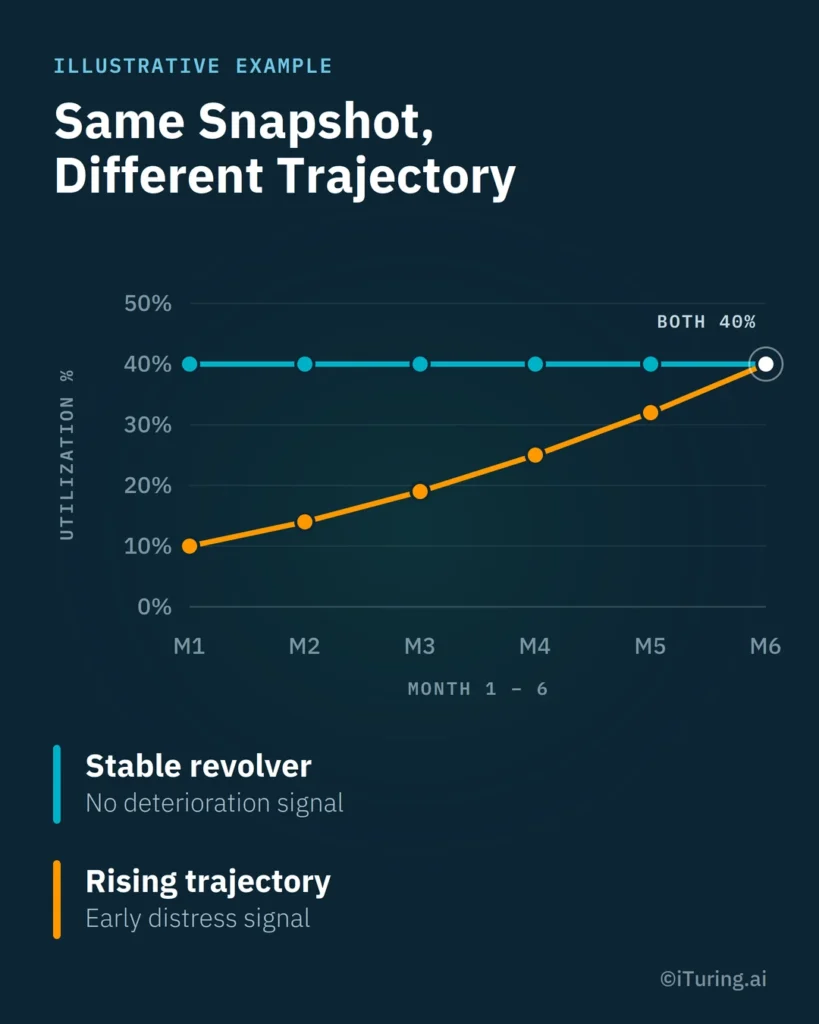
- Utilization trajectory, the rate of change in balance-to-limit ratio over time, is a stronger revolving signal than a static utilization snapshot, and most installment-tuned models only capture the snapshot.
- Consecutive minimum-only payments predict different risk than a single missed payment, and a model built on installment logic often can’t distinguish the two.
- Balance transfers and cash advances are card-specific distress signals with no meaningful installment-loan equivalent.
- Blending revolvers and transactors into one scoring population degrades model performance for both segments, not just one.
- US credit card delinquency stood at 2.9% at Q1 2026 per Federal Reserve data, down from a 3.2% peak in 2024 but still above the 2.6% pre-pandemic baseline, with small-bank issuers running delinquency rates roughly double those of large banks.
A collections model that performs well on personal loans and auto loans, then quietly underperforms the moment it’s pointed at a credit card portfolio, isn’t a model that needs more data. It’s a model answering a question revolving credit doesn’t ask.
Why an Installment-Tuned Model Misreads Revolving Behaviour
An installment loan has a fixed schedule: a set payment, a set number of remaining payments, a defined payoff date. A collections model built for this product scores how far a borrower has drifted from that schedule, days past due, missed payment count, remaining balance against remaining term.
A credit card has none of that structure. There’s no fixed payoff date, no schedule to drift from, and a cardholder can carry a stable revolving balance indefinitely without ever being “off schedule” in the way an installment model understands the concept. Point an installment-trained model at this data and it either ignores the features that don’t map, or worse, it tries to force-fit them, treating a long-standing revolving balance as equivalent to a borrower who’s fallen behind on a fixed schedule. Neither produces a useful signal.
Utilization Trajectory as the Core Revolving-Specific Signal
Most collections models that do get pointed at card portfolios use a static utilization snapshot: current balance divided by current limit at a point in time. That’s a weaker signal than it looks. A cardholder sitting at 40% utilization who’s been steady at 40% for two years is in a completely different position than one who was at 10% six months ago and has climbed steadily to 40% since.
Utilization trajectory, the rate of change over a rolling window rather than a single snapshot, captures the second cardholder’s deterioration before it shows up as delinquency. This is a genuinely revolving-specific feature. An installment loan doesn’t have a comparable “utilization” concept to track a trajectory for, which is exactly why models built for installment products don’t naturally include this signal family at all.
Minimum Payment Behaviour and What It Actually Predicts
A single missed payment on a card is one signal. Three or four consecutive cycles of minimum-only payments is a different signal entirely, and it’s one an installment-trained model tends to underweight because installment products don’t have a “minimum payment” concept distinct from “the payment.”
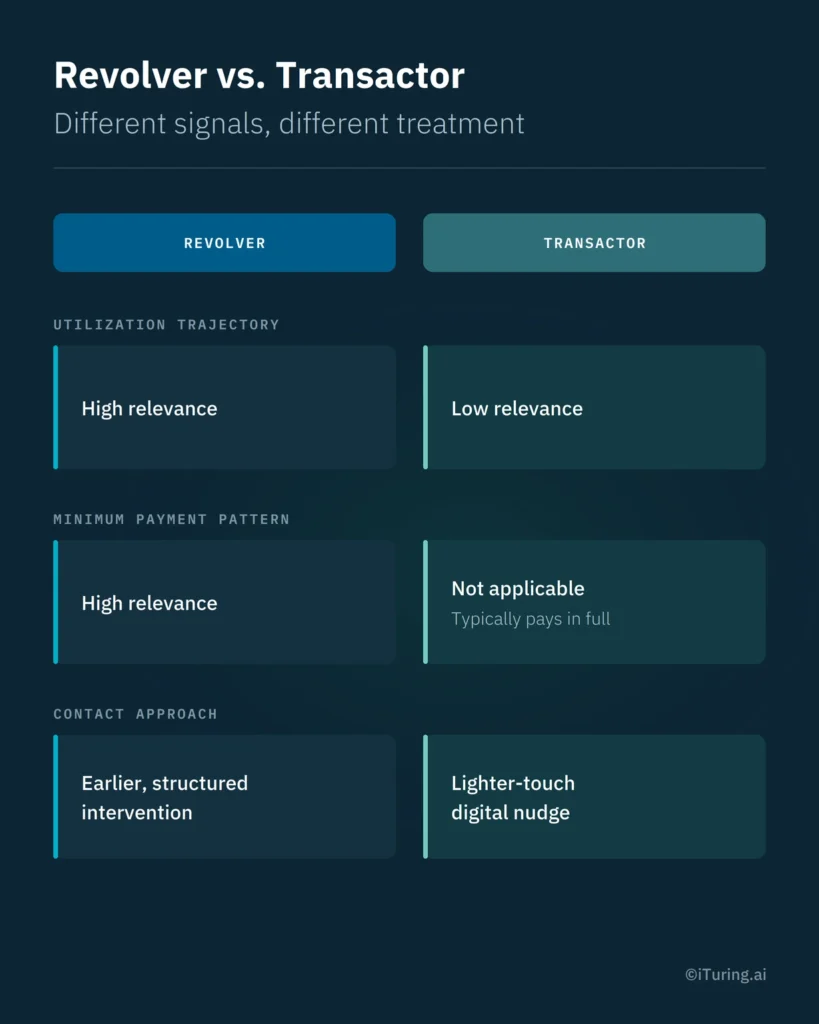
Consecutive minimum-only behaviour, tracked over multiple cycles rather than flagged at a single point, distinguishes a cardholder managing genuine but temporary cash flow pressure from one on a structural decline toward default. The distinction matters for treatment strategy: the first cardholder often responds to a lighter-touch nudge, while the second needs earlier, more structured intervention. A model that only sees “missed payment: yes or no” can’t make this distinction, because the signal that matters lives in the pattern across cycles, not in any single cycle.
Balance Transfers and Cash Advances as Distress Signals
Balance transfers and cash advances have no meaningful installment-loan equivalent, and both carry real predictive signal for card collections specifically. A cardholder taking a cash advance is often doing so because other liquidity options have already been exhausted, a materially different signal than a routine purchase transaction. Balance transfer timing and destination, particularly transfers into an account that’s already carrying elevated utilization, can indicate a borrower cycling debt across products rather than paying it down.
An installment-tuned model has no feature slot for either of these behaviours, because the product it was built for doesn’t have them. This isn’t a gap that more installment data closes. It’s a gap that only card-specific feature engineering closes.
Segmenting Revolvers from Transactors Before You Score
Not every cardholder in a delinquent-risk model is the same kind of cardholder. A transactor, someone who pays their statement balance in full most months, and a revolver, someone who consistently carries a balance, have fundamentally different risk profiles and respond to fundamentally different signals. Blending both populations into one scoring model dilutes the signal for both groups: the model ends up compromising between two different behavioural patterns instead of getting either one right.
Segmenting the portfolio into revolvers and transactors before scoring, rather than scoring the whole card book with one model and hoping the segmentation happens implicitly, is what actually lets utilization trajectory and minimum-payment-pattern features do their job. A transactor showing early signs of becoming a revolver is itself a meaningful transition signal that a properly segmented approach can catch early. A blended model just sees noise.
Contact Strategy Differences by Segment
Segment-aware scoring should drive segment-aware contact strategy. Transactors showing early distress signals generally respond well to lighter-touch digital nudges, since the underlying relationship with credit is different from a borrower already carrying a heavy revolving balance. Revolvers showing utilization trajectory deterioration benefit from earlier, more structured intervention, payment plan conversations, hardship program routing, before the account reaches a delinquency stage where options narrow.
This isn’t just a modeling refinement. It changes channel mix, timing, and the content of outreach in ways that a one-size-fits-all collections strategy built on an installment foundation simply can’t replicate.
Where iTuring Fits
iTuring’s AutoML+ builds product-specific propensity models without months of manual feature engineering, including the revolving-specific feature families, utilization trajectory, minimum payment pattern history, balance transfer and cash advance signals, that a card portfolio actually needs. Segmentation between revolvers and transactors happens at the model design stage, not as an afterthought layered onto a generic scorecard.
Sources
- Board of Governors of the Federal Reserve System, Delinquency Rate on Credit Card Loans, All Commercial Banks (DRCCLACBS), Q1 2026 data via FRED
- Federal Reserve G.19 Consumer Credit Report
- Federal Reserve Bank of New York, Quarterly Report on Household Debt and Credit, Q1 2026
- Industry issuer 10-Q disclosures on portfolio-level delinquency (verify current-quarter figures at time of publication)