
Clean FCRA Documentation on Underwriting Doesn’t Cover What Collections Is Doing With the Same Bureau Data
TL;DR
- Permissible purpose to pull bureau data in a collections context is a distinct legal basis from origination, and an AI system pulling bureau data for propensity scoring needs this documented on its own terms, not inherited from the origination compliance file
- FCRA’s accuracy obligations apply to bureau data used anywhere in the collections pipeline, including as training input for a propensity model, not just at the point a human reviews a credit decision
- The FCRA dispute reinvestigation window, generally 30 days under 15 U.S.C. § 1681i, applies to collections-related disputes just as it does elsewhere, and an AI-driven account update process has to respect that window
- Furnishing obligations under 15 U.S.C. § 1681s-2 trigger whenever a collections decision affects what gets reported to a credit bureau, which means AI-driven treatment decisions can create furnisher obligations even when no human directly decided what to report
- FCRA carries both a private right of action and multiple enforcement authorities, FTC, CFPB, state attorneys general, so reduced federal enforcement capacity in one agency doesn’t mean reduced overall exposure on FCRA specifically
- Treating FCRA as fully “handled” once origination compliance is built leaves the collections-specific obligations unaddressed, and that gap is exactly where an examination or a dispute tends to surface it
A bank can have a clean, well-documented FCRA compliance program for its underwriting models, permissible purpose logic, dispute workflows, furnishing controls, all built and reviewed. Ask the same institution to produce equivalent documentation for how its collections AI pulls, uses, and furnishes bureau data, and the answer is often thinner, sometimes because the assumption was that origination compliance covers it. It doesn’t.
Why Origination FCRA Compliance Doesn’t Cover Collections
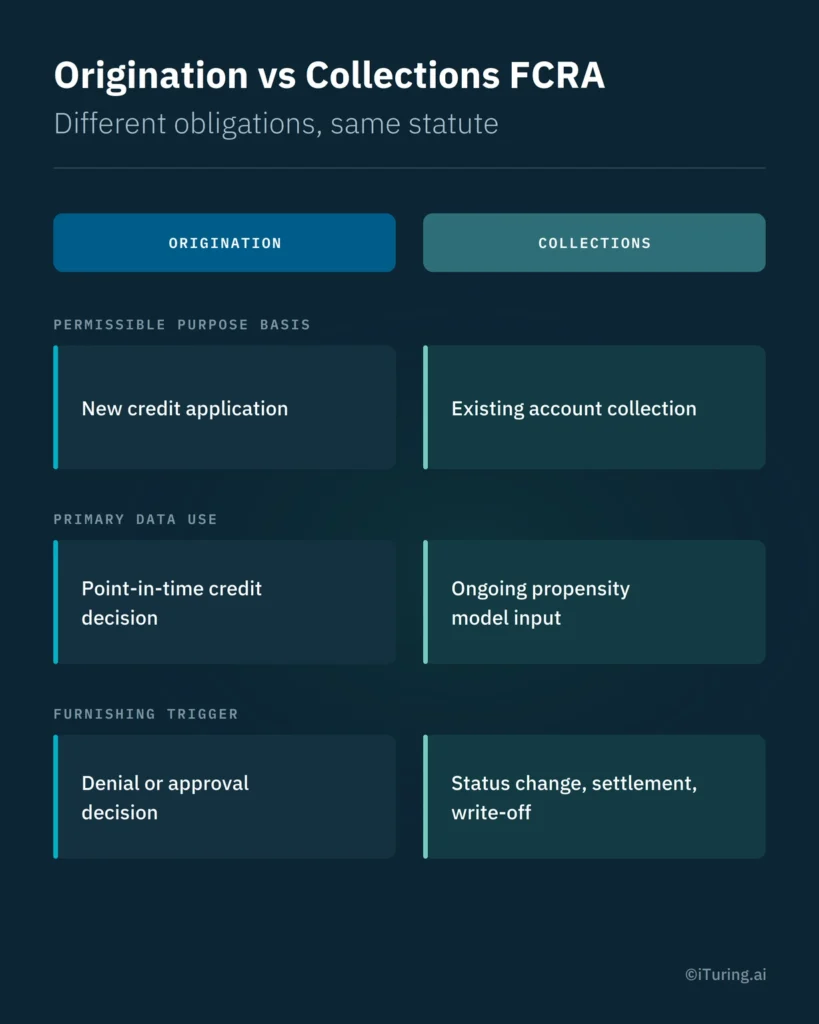
FCRA compliance built around origination is designed to answer origination-specific questions: what permissible purpose justifies pulling a bureau report to decide on a new credit application, how bureau data feeds an underwriting model, what disclosure obligations apply when an application is denied. These are real, necessary controls, but they’re built around a different moment in the credit lifecycle than collections, and the compliance logic doesn’t automatically transfer.
Collections involves its own bureau data activities: pulling updated bureau data on an existing delinquent account, using that data to train or run a propensity model, and furnishing updated account status back to the bureaus based on collections outcomes. Each of these has its own FCRA basis, and none of them is satisfied simply because the institution has strong origination-side FCRA controls.
Permissible Purpose for Collections Bureau Pulls
FCRA’s permissible purpose framework, at 15 U.S.C. § 1681b, sets out the specific circumstances under which a bureau report can be obtained. Pulling a report in connection with a credit application is one basis. Pulling a report in connection with the collection of an account is a related but distinct basis, tied to the existing account relationship rather than a new application decision.
An AI collections system that pulls current bureau data to feed a propensity score needs its own documented permissible purpose logic reflecting this collections-specific basis, not an assumption inherited from whatever justified the original underwriting pull. If an examiner asks why a specific bureau pull happened on a specific delinquent account, the answer needs to point to the collections-specific legal basis, not the origination file from months or years earlier.
Accuracy Obligations for Bureau Data Feeding Propensity Models
FCRA’s accuracy requirements don’t stop applying once bureau data moves from a point-in-time credit decision into an ongoing model training pipeline. If a propensity model is trained on bureau data that’s inaccurate, whether because it’s stale, mismatched to the wrong consumer, or reflects a data quality issue upstream, the accuracy obligation is implicated even though no single human ever looked at that specific data point in isolation.
This matters operationally: a collections AI system needs its own data quality and accuracy validation layer for bureau inputs feeding the model, not a general assumption that if the data came from a reputable bureau, it’s automatically clean enough for any downstream use.
The 30-Day Dispute Window and What AI Systems Must Respect
Under 15 U.S.C. § 1681i, when a consumer disputes information, generally furnishers and bureaus have a defined window, generally 30 days, extendable in some circumstances, to investigate and respond. This applies to collections-related disputes, a consumer disputing a delinquency status or an amount owed to a collections entity, just as it applies to any other FCRA dispute.
An AI-driven collections system needs a dispute-handling workflow that recognizes when a dispute has been raised, whether through a bureau-forwarded dispute or a direct consumer dispute, and respects this timing requirement, including pausing or flagging any automated furnishing activity on the disputed item while the investigation is pending. A system that continues automated collections and furnishing activity on an account without checking for an active, unresolved dispute risks compounding a dispute-handling failure with continued action on the very item under dispute.
Furnishing Obligations When AI Decisions Affect Credit Reports
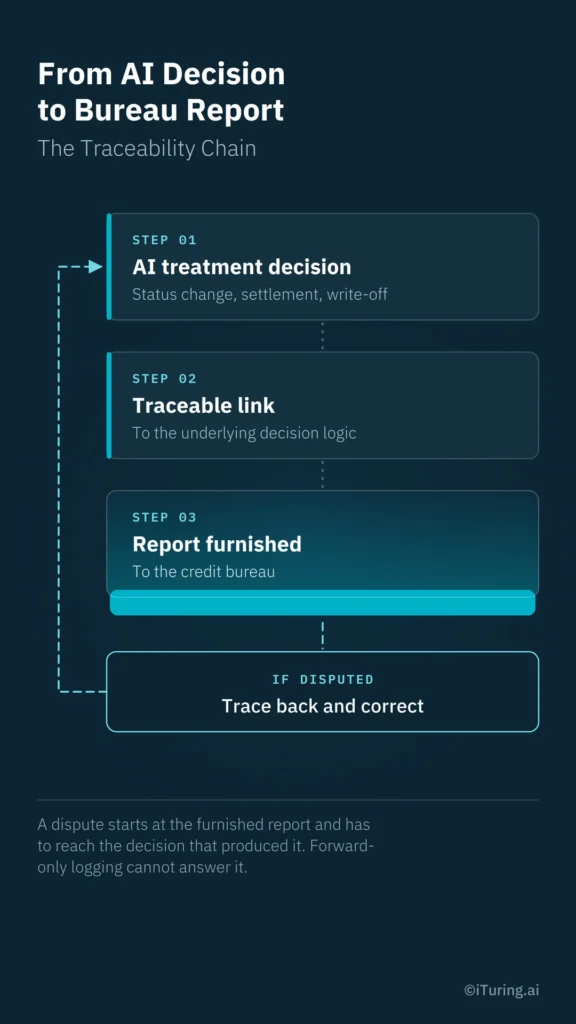
Furnisher responsibilities under 15 U.S.C. § 1681s-2 require accurate reporting to bureaus and specific conduct once a dispute is received, including investigating and correcting or deleting inaccurate information. These obligations trigger based on what gets reported, not based on who or what made the underlying decision. If an AI system’s treatment decision, a status change, a settlement outcome, a determination that an account is uncollectable, results in a specific report to a bureau, the furnishing obligations attach to that report regardless of whether a human or a model produced the underlying decision.
This means an AI collections system needs traceable logic connecting its decisions to whatever eventually gets furnished, so that when a dispute arrives, the institution can actually reconstruct why a specific status was reported and correct it if the AI-driven decision was itself in error.
What an FCRA Examination Now Asks About Collections Specifically
Examiners increasingly treat collections-side FCRA practices as their own line of inquiry rather than folding them into origination review, asking questions like: what permissible purpose basis supports bureau pulls in the collections workflow, how is bureau data accuracy validated before it feeds a model, and how does the dispute process work specifically for collections-related disputes. An institution that can only answer these questions by pointing back to its origination FCRA program is showing a gap, not a strength.
It’s also worth noting that FCRA sits somewhat apart from the general narrowing of CFPB enforcement capacity affecting some other consumer protection areas: FCRA carries a private right of action, is enforceable by the FTC as well as CFPB, and remains a live area for state attorney general activity, so the overall exposure on FCRA specifically hasn’t diminished the way exposure tied purely to CFPB rulemaking and enforcement priority has in other areas.
Where iTuring Fits
iTuring’s Model Gov and Data Accelerator modules build collections-specific FCRA logic as its own governed layer: permissible purpose documentation tied to the collections context specifically, bureau data accuracy validation before it enters any model pipeline, dispute-aware workflows that automatically pause conflicting furnishing activity, and full traceability from AI-driven treatment decisions through to whatever gets furnished, so the record exists before an examiner or a dispute ever asks for it.
Sources
- 15 U.S.C. § 1681b (Permissible purposes of consumer reports), Fair Credit Reporting Act
- 15 U.S.C. § 1681i (Procedure in case of disputed accuracy), Fair Credit Reporting Act
- 15 U.S.C. § 1681s-2 (Responsibilities of furnishers of information), Fair Credit Reporting Act
- Federal Trade Commission and CFPB joint FCRA enforcement authority guidance
- Current FCRA examination manual references (verify against current CFPB/FTC examination guidance at time of publication)