
A Scripted Letter Can Be Wrong. A Generative System Can Be Wrong Differently, at Scale.
TL;DR
- FDCPA Section 807, codified at 15 U.S.C. § 1692e, prohibits any false, deceptive, or misleading representation in connection with debt collection, and lists specific prohibited conduct without limiting the general rule
- A static, pre-approved script has a fixed, reviewable false-representation risk profile. A generative AI system composing messages dynamically does not, because the exact wording was never reviewed in advance
- AI hallucination, asserting a balance detail, legal status, or consequence that isn’t actually true, creates false representation liability through a mechanism scripted human outreach never had
- Section 807 carries a private right of action, meaning this risk runs through consumer litigation and class actions regardless of federal regulatory enforcement posture, which matters given that CFPB’s own enforcement capacity has visibly narrowed through 2025 and 2026
- State attorneys general in states including California, New York, and Illinois have stepped up debt collection enforcement as federal activity has receded, adding another layer of exposure beyond private litigation
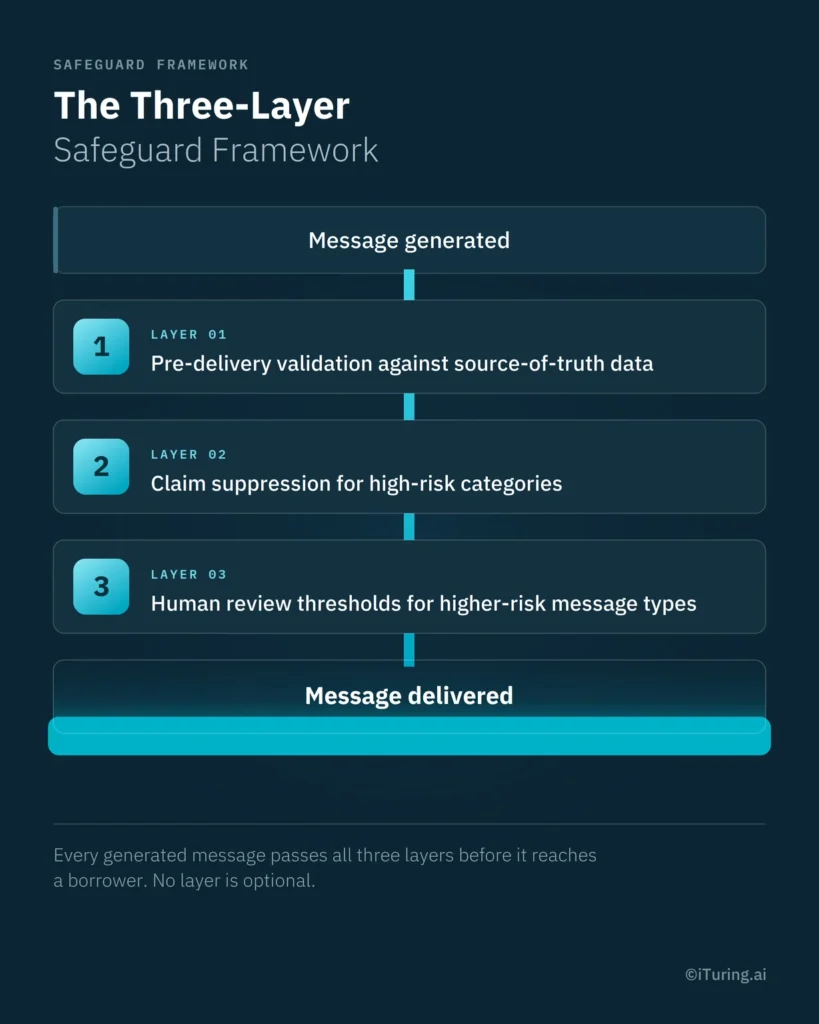
- A safeguard framework needs three layers: pre-delivery validation against source-of-truth account data, a suppression list for any claim that can’t be verified, and human review thresholds for higher-risk message types
A collections letter written by a compliance team and approved once can be wrong, but it’s wrong in a way someone already reviewed and signed off on. A generative AI system composing a new message for every borrower, every time, doesn’t have that same fixed risk profile. It can produce a message asserting something that simply isn’t true, a wrong balance figure, an overstated consequence, a legal status the account doesn’t actually have, and nobody reviewed that specific sentence before it went out. That’s a new category of Section 807 exposure, and it’s one plaintiffs’ firms are increasingly positioned to find.
What Section 807 Actually Prohibits, and Why Scripts Were the Old Safe Harbor
Section 807, at 15 U.S.C. § 1692e, prohibits a debt collector from using any false, deceptive, or misleading representation or means in connection with collecting a debt, and enumerates specific examples: falsely implying affiliation with a government entity, misrepresenting the character or amount of a debt, threatening action that can’t legally be taken, and communicating false credit information, among others. Critically, the statute states these examples don’t limit the general prohibition, meaning conduct doesn’t need to match a listed example to violate the section.
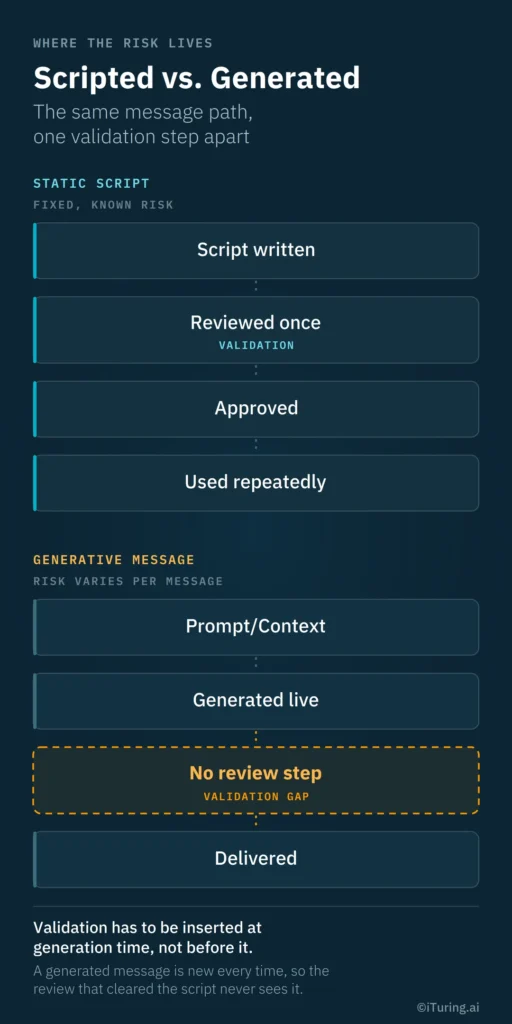
A pre-approved script gave collectors a practical, if imperfect, safe harbor: the exact words were reviewed once, and every subsequent use of that script carried the same known risk profile. If the script was compliant, every instance of using it was compliant in the same way.
How Generative AI Creates a New Category of 807 Risk
A generative system composing a message for each interaction breaks that model entirely. The words themselves aren’t fixed and reviewed in advance. They’re generated in response to the specific account and conversation context, which means the exact sentence a borrower receives may never have existed before that moment, and may never exist again in that exact form.
This is where hallucination becomes a genuine Section 807 mechanism rather than an abstract AI risk category. If a generative system asserts a balance figure that’s slightly wrong, implies a legal consequence that doesn’t actually apply to that account, or characterizes the debt’s status inaccurately, that’s a false representation under the statute, produced by a process that never had a human review the specific claim before it reached the consumer.
Pre-Delivery Validation: Checking Claims Against Source-of-Truth Data
The first safeguard layer is straightforward in concept and demanding in execution: before any AI-generated message goes out, every factual claim in it, balance, status, consequence, needs to be checked against the account’s actual current data, not against what the model believes to be true based on its training or context window. This is a validation step separate from message generation itself, a gate the message has to pass through, not a hope that generation was accurate.
Claim Suppression: What an AI System Should Never Be Allowed to Say
Some categories of claim carry disproportionate false-representation risk if they’re wrong even slightly: statements about legal consequences, statements implying a specific timeline for legal action, and statements about a consumer’s rights or the collector’s authority. A suppression list defines categories of claim the system either can’t make at all, or can only make using pre-approved, unmodified language rather than dynamically generated phrasing. This is the layer that prevents the highest-risk categories of hallucination from reaching a consumer in the first place, regardless of how the validation layer performs.
Human Review Thresholds for Higher-Risk Message Types
Not every message needs the same level of scrutiny. Routine payment reminders carry different risk than messages addressing a dispute, a legal threshold, or a borrower who has explicitly raised a hardship or dispute claim. Building explicit thresholds, message types or account situations that route to human review before an AI-generated message is finalized, concentrates oversight where the false-representation risk is actually highest, rather than spreading a fixed review capacity thinly across every message regardless of risk level.
What Reduced Federal Enforcement Means for This Risk, Not Less Exposure, Different Exposure
It’s worth being precise about where the real risk sits right now. CFPB’s federal enforcement capacity has narrowed meaningfully through 2025 and 2026, with reduced staffing, funding uncertainty, and a stated shift toward lighter-touch oversight and fewer sweeping rulemakings. That doesn’t mean Section 807 risk has gone away. It means the risk has shifted toward two channels that don’t depend on CFPB enforcement priorities at all.
First, Section 807 carries a private right of action, so consumer plaintiffs and class action counsel can bring claims directly, and that channel operates independent of the Bureau’s current posture. Plaintiffs’ firms handling FDCPA matters have increasingly used call recordings and message transcripts as direct evidence, which makes a generated message’s exact wording, not just the process that produced it, directly discoverable and reviewable in litigation. Second, state attorneys general in states including California, New York, and Illinois have stepped into the enforcement gap left by reduced federal activity, and several have coordinated directly with remaining CFPB capacity on debt collection matters. Reduced CFPB enforcement doesn’t reduce Section 807 exposure. It moves the primary exposure from regulatory action toward private litigation and state-level enforcement, both of which are, if anything, becoming more active in this specific area.
Where iTuring Fits
iTuring’s Generative AI module is built with the validation and suppression layers as part of the message generation pipeline itself, not as a separate review step applied after the fact. Every generated claim checks against source-of-truth account data before delivery, high-risk claim categories route to pre-approved language or human review automatically, and the full generation and validation record is retained, giving a defensible answer to exactly what was said, why, and what was checked before it went out.
Sources
- 15 U.S.C. § 1692e (FDCPA Section 807, false or misleading representations)
- FTC, Fair Debt Collection Practices Act, official text compendium
- CFPB Consumer Laws and Regulations manual, FDCPA section
- Reporting on CFPB 2025-2026 funding and enforcement capacity constraints (verify current status at time of publication, this is an evolving situation)
- State attorney general debt collection enforcement activity, California, New York, Illinois (verify current specific actions at time of publication)