TL;DR
- What it is: Model risk management services usually means buying a project, an independent validation engagement, a framework build, or extra hands, not a system that runs on its own.
- The core problem: RBI’s draft guidance treats model risk oversight as continuous, with tiering reviewed at least annually and validation reports due to the board committee within three months, so a one-time engagement gets bought again every cycle.
- The buying decision: build an internal second line function, hire a consulting engagement project by project, or run a platform that produces the evidence as a byproduct of operating the models.
- What doesn’t change: the Board and its Risk Management Committee keep approval authority no matter who staffs the work.
- Honest caveat: This guidance is still a draft under RBI review, not yet in force, so build your buying criteria around what a system can prove, not around a fixed calendar RBI hasn’t set.
A bank buys a model risk management assessment from a consulting firm, gets a report with a scorecard and a set of recommendations, and six months later ships three new models with none of that report’s process attached to them. The engagement ended. The obligation didn’t.
Model risk management services can mean several different things depending on who is selling them: an independent validation project, a framework design engagement, staff augmentation for a validation team, or a software platform that runs validation and monitoring as a built-in function. Buying the wrong one for the actual problem is expensive twice, once for the purchase and again when the same gap resurfaces at the next model cycle.
This page separates what each type of service actually delivers, when a one-time engagement is the right call, where it runs out of road, and what a purchase can never change no matter which one gets picked.
What counts as “model risk management services”?
Model risk management services span two categories. One is a project: a consulting engagement scoping fixed work, such as an independent validation or a framework design, for a set period. The other is a system: a software platform that runs validation, monitoring, and evidence generation continuously, as part of how models are deployed.
The project category covers what most people mean by “MRM services.” An outside team validates a model or a small set of models, delivers a report, and the engagement ends. It fits a one-time need: validating a single high-stakes model ahead of a regulator’s exam, or writing a framework document a bank does not have the internal expertise to draft.
The system category covers a platform that generates the same kinds of evidence, drift readings, root cause analysis, audit trails, board-ready reports, as a continuous output of running the models, not a deliverable someone hands over once.
Most banks need both at different points. The mistake is buying only the project version for a problem that never stops.
When a bank actually needs to buy something here
A missing function triggers the purchase, not a general modernization impulse. RBI’s draft guidance requires three separate lines of defense: model owners, an independent model risk management and validation function, and internal audit. When the second line does not exist or cannot produce evidence on demand, that specific gap is what to fill.
Under paragraph 15 of the RBI’s draft guidance, the independent second line has to be separate from the people who build and use the models. A small institution running a handful of models might reasonably staff that function with one or two people. A larger one running dozens of models across lending, collections, and underwriting usually cannot keep that function independent and current without either hiring more people or running a system that handles the continuous parts on its own.
If you have not mapped the Risk Management Committee’s specific review duties yet, start there before buying anything. What the committee has to see determines what any purchased service actually has to produce.
Where a project-based engagement runs out of road
A one-time engagement answers the question as of the day it was delivered, then the gap it filled reopens at the next cycle. RBI’s draft requires model risk tiering reviewed at least annually and validation reports reaching the Risk Management Committee within three months of completion, obligations that repeat on a schedule a single project was never built to cover.
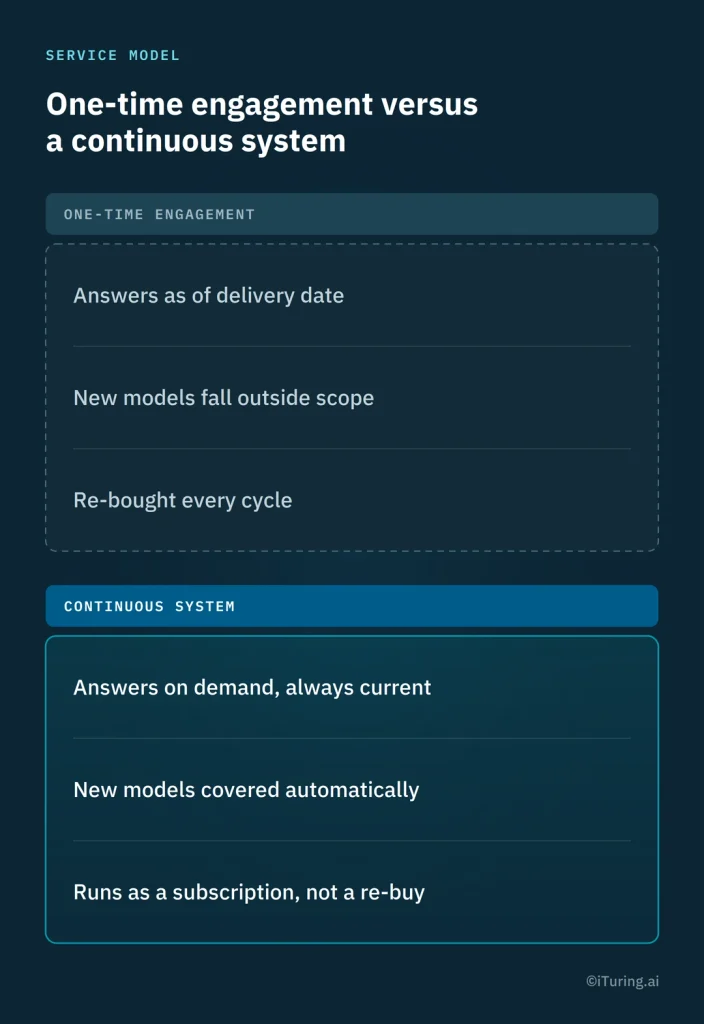
A one-time engagement answers the question as of the day it was delivered. A validation report from March says nothing about the model retrained in September, or the three new models shipped since.
A continuous system answers the same question every time someone asks it, because the evidence is generated as models run rather than reconstructed when someone requests it.
Institutions that buy only the project version end up re-buying the same engagement every year, once for each new model cohort and once for the annual tiering review paragraph 12 requires. That recurring cost rarely gets compared against the cost of the alternative, because it is booked as a series of separate purchases rather than one ongoing line item.
Build, hire, or run it on a platform: what each path commits you to
Three real paths exist here. Building an internal team costs the most upfront and takes the longest to reach competence. Hiring a consulting firm project by project costs less upfront but repeats every cycle. Running a platform that generates evidence as a byproduct of operating models costs a subscription and scales without adding headcount per model.
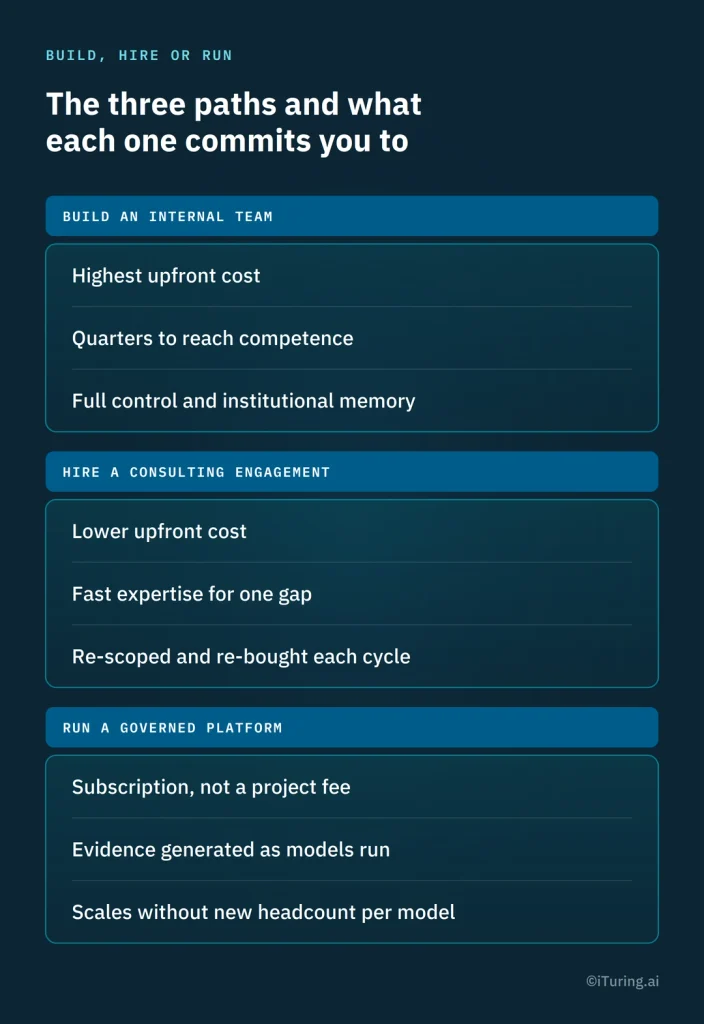
Building an internal second-line team means hiring people with validation and model-risk expertise, who are in short supply and expensive to retain. It gives full control and institutional memory, at the cost of a hiring timeline measured in quarters, not weeks.
Hiring a consulting engagement project by project gets expertise fast for a specific model or a specific gap. It does not create a standing function, so the same review has to be re-scoped and re-bought at the next cycle.
Running a governed platform turns validation and monitoring into a system output instead of a project. A leading NBFC in India used this approach on its collections models and saw a 116% improvement in collections and 86% predictive accuracy, deployed in two weeks. The audit trail and lineage that made that deployment fast are the same records a validation team pulls from when a report is due, instead of reconstructing evidence from five separate systems.
None of these paths is wrong on its own. A bank validating one legacy model ahead of an exam has a project problem. A bank running forty models across three business lines has a continuous problem, and buying it in project-sized pieces is how gaps reopen every year.
What buying the service does not change
No purchase moves accountability. The Board approves the model risk framework and the Risk Management Committee reviews validation reports and tiering regardless of whether the work behind them was done by an internal team, a consulting firm, or a platform. Buying a service changes who does the work, not who answers for it.
Under paragraphs 11 and 12 of the RBI’s draft guidance, the Board approves the overall framework and the institution’s risk appetite, and the Risk Management Committee reviews validation reports for high-risk models, tiering at least annually, and any breach or exception. Nothing in the guidance lets that review move to a vendor’s sign-off instead of the committee’s.
This matters when evaluating any MRM service, whether it is a project or a platform. Ask what evidence it hands the committee, not what activity it performs. A vendor that validates a model and keeps the findings in its own system has not actually closed the gap. The Risk Management Committee still needs the report, on the institution’s schedule, in a form it can review.
If you are scoping what to buy versus build for your model risk function, book a working session with our data science team to map the gap against what a governed platform would close on its own.
Sources
- Reserve Bank of India, Draft Guidance on Regulatory Principles for Model Risk Management, Press Release 2026-2027/528, 24 June 2026. https://www.rbi.org.in/scripts/BS_PressReleaseDisplay.aspx?prid=63006
- Reserve Bank of India, Draft Guidance on Regulatory Principles for Model Risk Management (guidance document), paragraphs 11, 12, 13, 15, 33. https://www.rbi.org.in/Scripts/bs_viewcontent.aspx?Id=5089
- iTuring case study, “Improve Collections and Optimize Efforts” (leading NBFC in India): 116% collections improvement, 86% predictive accuracy, two-week deployment. https://ituring.ai/case-study/improve-collections-and-optimize-efforts/
- iTuring.ai, Model Risk Management platform page. https://ituring.ai/platforms/model-risk-management/