
An AI System That Contacts a Borrower Mid-Review Isn’t Efficient. It’s a Violation.
TL;DR
- Regulation X prohibits dual tracking: contacting a borrower for collections or moving toward foreclosure while a complete loss mitigation application sits under review. An AI system that doesn’t check loss mitigation status before every automated contact recreates this violation at machine speed, across every account at once.
- Single point of contact under Reg X requires continuity of case knowledge, not one dedicated human. An AI system can satisfy this if it maintains consistent case context across every interaction, but most collections platforms weren’t built to prove that.
- Early intervention under 12 C.F.R. § 1024.39 has specific timing windows and required notice content. Automated outreach still has to hit those windows and generate the documentation an examiner will ask for.
- When AI determines a borrower is ineligible for loss mitigation, that determination needs its own audit trail. An unexplained “ineligible” flag is not a defensible record.
- State foreclosure moratoria stack on top of federal Reg X requirements and have to function as hard gates in the decision logic, not manual overlays a servicer remembers to check.
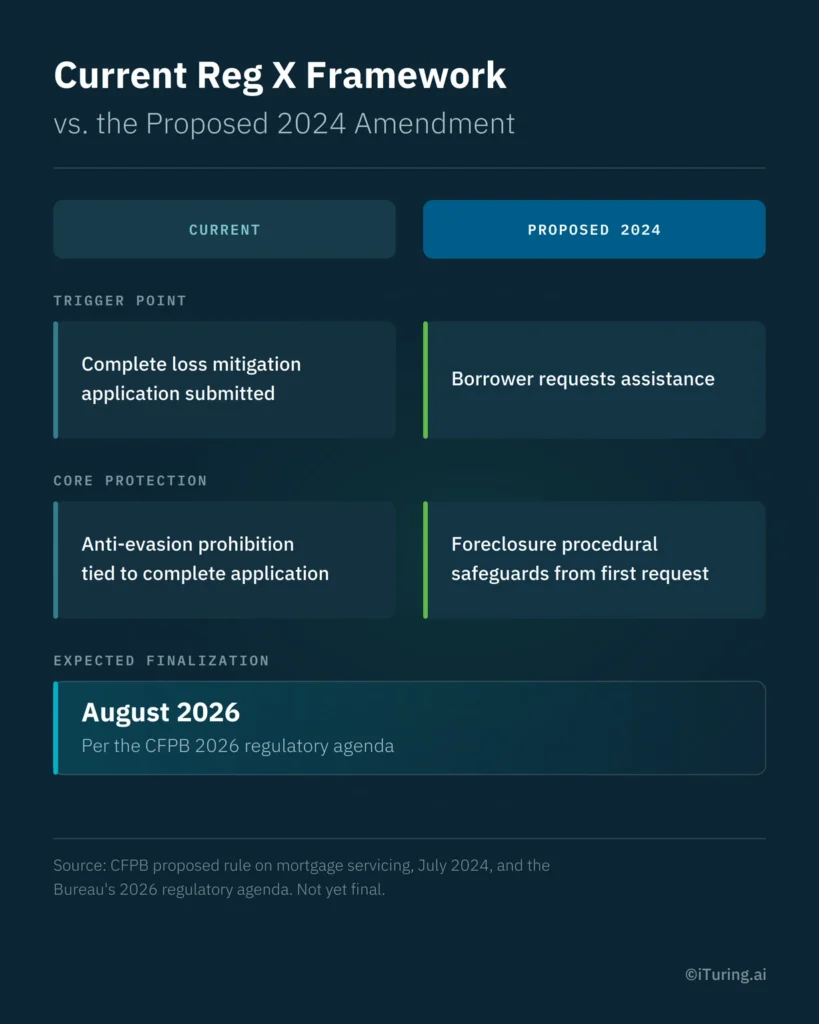
- CFPB proposed removing much of the current loss mitigation “complete application” framework in July 2024, and its 2026 regulatory agenda lists an anticipated final rule the same month this piece publishes. Build for the direction of travel, not just the current text.
A mortgage servicer’s AI collections system flags a delinquent account for outreach. The borrower submitted a loss mitigation application eleven days earlier. It’s still under review. The system doesn’t know that, because nobody wired loss mitigation status into the contact decision. The call goes out anyway.
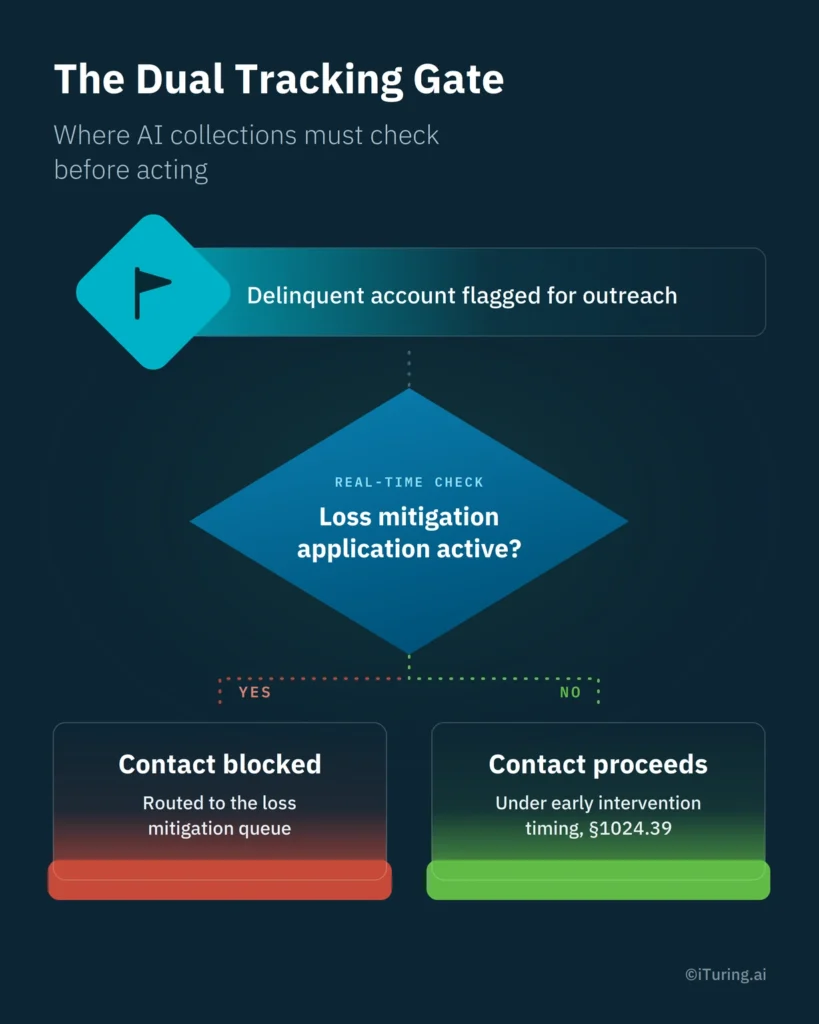
That call is a Regulation X violation the moment it happens, and it happened because the system was built to optimize for contact and recovery, not because anyone decided to break the rule. This is the failure mode automation reproduces at scale unless someone designs against it deliberately: dual tracking isn’t a policy the AI needs to be told about once. It’s a gate the AI has to check every single time it considers reaching out.
What Dual Tracking Actually Means, and Why AI Recreates It by Default
Regulation X, at 12 C.F.R. § 1024.41, prohibits a servicer from moving forward with foreclosure while a borrower’s complete loss mitigation application is pending review, and separately restricts collections contact that conflicts with an active application. The rule exists because the 2008 foreclosure crisis produced exactly this pattern at scale: borrowers working in good faith with a loss mitigation team while a separate part of the same institution kept the foreclosure clock running.
A collections model trained to maximize right-party contact and recovery has no inherent concept of loss mitigation status. That status lives in a different system, often a different department’s workflow, and unless someone explicitly builds a real-time check into the contact decision, the model treats a borrower under active review exactly like any other delinquent account. It doesn’t skip the call. It doesn’t know there’s a reason to.
This is the core design problem: dual tracking prevention isn’t a compliance feature you bolt onto a collections model after building it. It has to be a gating condition the model checks before it decides to act, every time, on every account.
Single Point of Contact, When the Contact Is an AI Agent
Reg X’s continuity-of-contact requirement doesn’t mandate one specific employee stay assigned to a borrower forever. It requires that whoever is in contact with the borrower has access to the borrower’s current status and history, so the borrower isn’t re-explaining their situation to someone starting from zero each time.
An AI system can satisfy this requirement if it maintains a single, consistent case record that every interaction, automated or human-escalated, draws from. What it can’t do is satisfy this requirement by accident. If the automated contact logic and the human escalation path pull from different data sources, or if case context resets between channels, the system fails continuity of contact even if a human never touches the file. The fix isn’t adding a human back into the loop. It’s making sure the AI’s case record is the single source of truth every touchpoint references.
Early Intervention Timing and Documentation Requirements
Section 1024.39 sets specific timing requirements for early intervention outreach and requires the notice to include specific content: available loss mitigation options, and how the borrower can find out more. An automated system generating this outreach has to hit the required timing window and produce a notice that satisfies the content requirements, and it needs to generate a record proving it did, for every account, not a sample.
This is where automation genuinely helps rather than just needing to be constrained. A manual process depends on someone remembering to send the notice inside the window. An automated system can be built to trigger the notice at the exact required moment and log that it happened, which is a stronger compliance position than most manual processes ever achieve. The requirement doesn’t change. The reliability of meeting it does.
Where AI Determines Ineligibility, and What Must Be Documented
When a loss mitigation application comes back ineligible, whether from an AI-assisted review or a human underwriter, the servicer has to be able to explain why. An AI system that outputs “ineligible” without a traceable reason is not defensible in an examination, and it’s not fair to the borrower either.
The documentation standard here is the same one that applies to any automated decision affecting a consumer: what data was reviewed, what criteria weren’t met, and a plain-language explanation a borrower or examiner could actually follow. If the AI system can’t produce that explanation on demand, it shouldn’t be making the eligibility call unassisted.
State Foreclosure Moratoria and Timeline Interactions
Federal Reg X sets a floor. Several states layer additional foreclosure timeline restrictions and moratoria on top of it, and these vary by state and can change with local economic or emergency conditions. A collections and loss mitigation system operating across multiple states needs the current moratorium status for each jurisdiction built in as a gate, not tracked separately by a compliance team checking a spreadsheet.
This matters more, not less, as automation scales. A manual process that misses a state moratorium update affects the accounts one team is working. An automated process that misses the same update can act on every affected account in a portfolio before anyone notices.
The Pending Reg X Amendment and What It Means for What You Build Now
In July 2024, CFPB proposed a rule, “Streamlining Mortgage Servicing for Borrowers Experiencing Payment Difficulties,” that would remove most of the current application-based loss mitigation provisions from § 1024.41 and replace them with a framework built around foreclosure procedural safeguards triggered as soon as a borrower requests assistance, rather than only once a complete application is submitted. CFPB’s 2026 regulatory agenda lists a final rule as anticipated in August 2026.
That timing means a system built rigidly around today’s “complete application” trigger could need meaningful rework within months of going live. The practical move is architectural, not aspirational: build the gating logic around the underlying principle, protect borrowers actively seeking help from parallel collections or foreclosure action, rather than hard-coding the current procedural trigger as the only thing that matters. A system built that way absorbs the amendment as a configuration update. A system built around today’s specific mechanics has to be rebuilt.
Where iTuring Fits
iTuring’s Model Gov and Agentic AI modules are built to treat loss mitigation eligibility as a gate a collections decision has to pass, not a parallel process reconciled after the fact. Every automated contact decision checks current loss mitigation status in real time, every ineligibility determination generates its own explainable audit trail, and state-specific moratorium rules run as configurable gates rather than manual overlays. When the underlying regulation changes, the configuration changes with it. The architecture doesn’t.