
TL;DR
- Post 1 covered RBI’s 2026 amendment directions on recovery calls (effective January 1, 2027). Those directions don’t stand alone, they amend the RBI (NBFC – Responsible Business Conduct) Directions, 2025, issued November 28, 2025.
- That 2025 instrument is itself a consolidation of the decades-old Fair Practices Code (FPC), not a replacement of its substance.
- Most collections-compliance content online still cites pre-2025 FPC circular numbers with no acknowledgment that a consolidation happened.
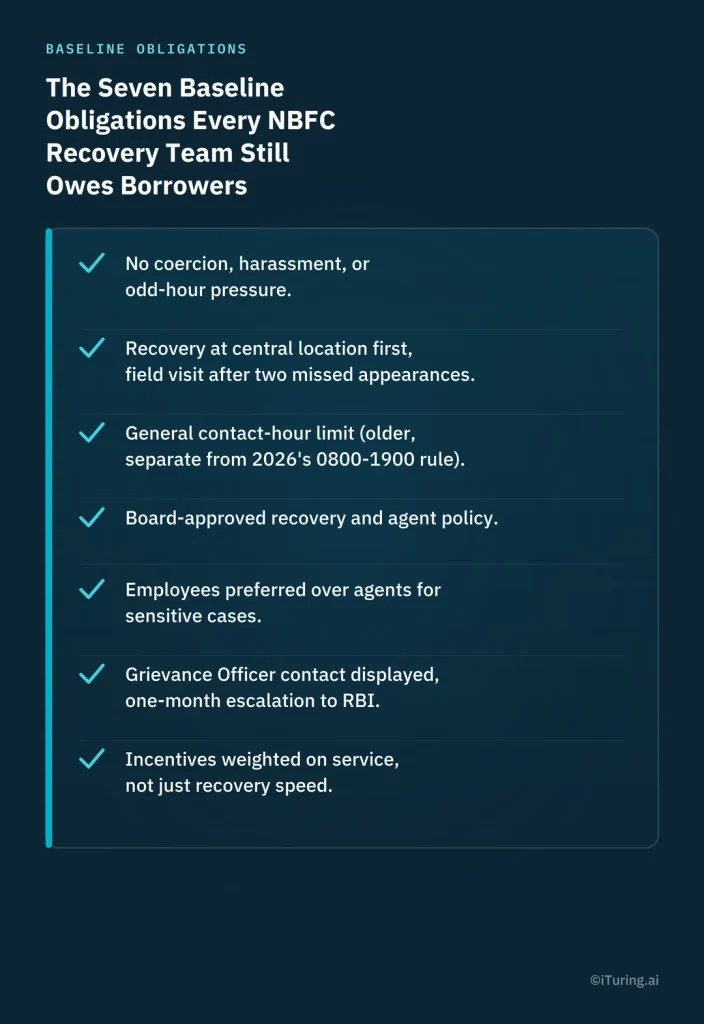
- Seven baseline obligations from RBI’s Master Circular on Fair Practices Code predate and survive every recent amendment: non-coercion, centralized recovery, contact-hour limits, board-approved policy, employee preference for sensitive cases, grievance redressal, and non-recovery-only incentive design.
- NBFC-side chapter and paragraph citations in this piece (Chapter II para 7, Chapter III paras 20 and 89-101) are secondary-source confirmed, not verified against RBI’s own PDF, and are not asserted to match bank-side numbering.
- The real value of this series is a reusable lens, instrument, consolidation, amendment, for reading every future RBI notification, not a one-time news update.
Most collections compliance guides are citing an instrument that no longer stands alone
Anyone evaluating RBI Fair Practices Code collections software right now is really asking two questions at once: what does the Fair Practices Code actually require, and does the tool in front of me meet it. The honest answer starts with a complication most vendor content skips: the Fair Practices Code, as a standalone instrument, no longer exists to cite.
A search for NBFC collections compliance content turns up a familiar pattern: articles citing “the Fair Practices Code circular” by its old number, walking through the same non-harassment and contact-hour points, and stopping there.
The substance holds up. The instrument citation doesn’t.
As of November 2025, the Fair Practices Code isn’t the document an NBFC’s compliance team should be pointing to when a board member or auditor asks where a rule comes from. The FPC’s obligations were folded into a new, consolidated direction. Citing the old circular number without acknowledging that consolidation is the compliance equivalent of quoting a repealed section of a contract: the underlying obligation may well still be real, but the citation won’t survive scrutiny from anyone who checks it.
This matters practically for three reasons:
- Audit trails need the current instrument name. A recovery policy document that cites a pre-2025 FPC circular as its authority looks stale to a regulator, even if its content is fine.
- Every future RBI notification amends the new instrument, not the old one, including the 2026 amendment directions covered in post 1 of this series.
- Treating each new notification as an isolated event, rather than an amendment to a known structure, invites the wrong response, a fire drill instead of an update to a system the compliance team already understands.
How the Fair Practices Code became the 2025 Responsible Business Conduct Directions
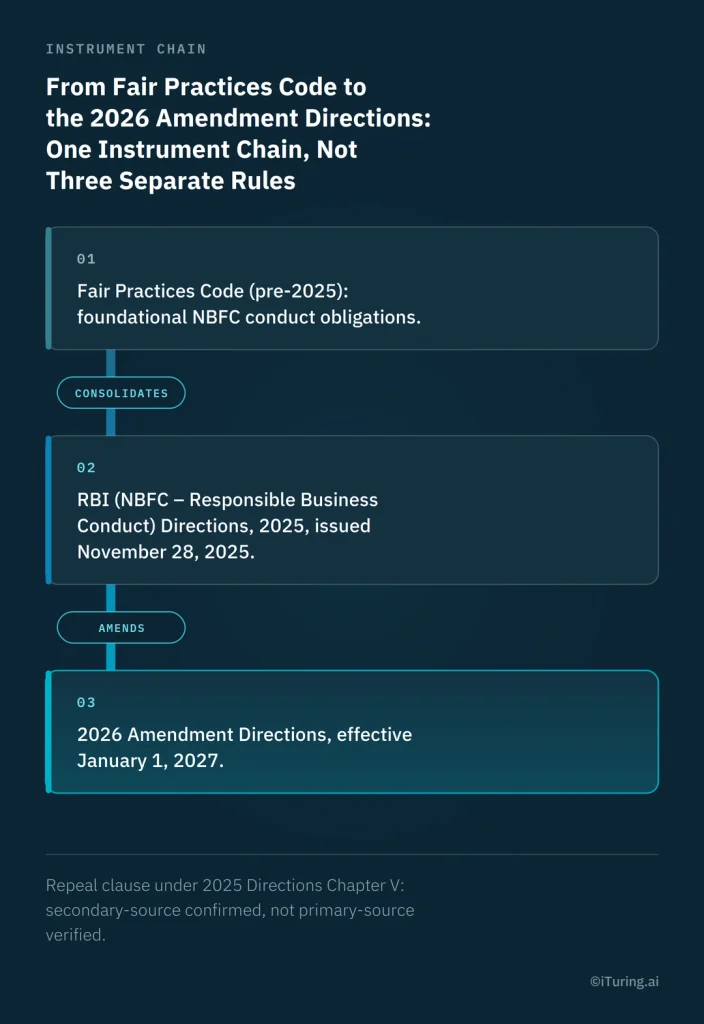
The instrument chain, as best confirmed:
- The Fair Practices Code (FPC), originating in the early 2000s, consolidated and refined by RBI over subsequent years through master circulars and directions specific to NBFCs.
- RBI (NBFC – Responsible Business Conduct) Directions, 2025, issued November 28, 2025. This consolidates the FPC and related NBFC conduct requirements into a single direction.
- The 2026 amendment directions covered in post 1 of this series, effective January 1, 2027, which amend the 2025 Directions, not the original FPC.
A hedge worth stating plainly: the claim that the 2025 Directions include a repeal clause superseding prior FPC circulars, reportedly under Chapter V, is secondary-source confirmed. It comes from Taxguru’s coverage, corroborated by one other independent source, but has not been verified against RBI’s own primary-source PDF at the time of writing. Readers relying on this for a live compliance filing should confirm paragraph and chapter numbering against RBI’s official text before citing it externally.
What can be said with more confidence: post 1’s 2026 amendment directions are structured as amendments to the 2025 Directions, which is the operative reason this series treats 2025 as the baseline instrument rather than the FPC circulars that preceded it.
What Chapter III and Chapter II actually require of NBFC recovery teams
This section is scoped to NBFCs specifically, and the citations below are secondary-sourced. They have not been checked against RBI’s primary PDF paragraph-by-paragraph, and they are not asserted to apply to banks under the same numbering.
- Board-approved recovery policy (Chapter II, para 7): recovery and agent-engagement practices must be governed by a policy the board itself approves, not one issued at the operational level alone.
- Recovery conduct provisions (Chapter III, paras 20 and 89-101): the substantive rules covering how recovery contact is conducted, escalation to field visits, and related conduct standards for NBFC recovery staff and agents.
Two things worth being explicit about, given how often compliance content gets this wrong:
- This piece does not cite, and does not rely on, any “Chapter VIII.” If you see that citation elsewhere, treat it with skepticism until it’s checked against RBI’s own text.
- Nothing here should be read as confirming that bank-side collections teams operate under the same chapter and paragraph numbers. That mapping is unconfirmed.
The 7 baseline obligations that predate and survive every recent amendment
This section rests on RBI’s own Master Circular on Fair Practices Code, the best-grounded layer in this piece, and is stated here without the chapter-numbering hedge used above.
- Non-coercive recovery. No harassment, no persistent contact at odd hours, no use of muscle power or threatening language by recovery staff or agents.
- Centralized recovery location. Recovery is normally conducted at a designated central place. Field visits to a borrower’s residence or workplace are contemplated only after the borrower fails to appear at that designated location on two or more successive occasions.
- A general contact-hour restriction, distinct from post 1’s specific rule. Older formulations of this baseline describe recovery contact windows in general terms, roughly 9am to 6pm in some versions. This is a separate, older provision from a different instrument and year than post 1’s specific 0800-1900 contact-hour rule, the two should not be treated as the same requirement restated.
- Mandatory board-approved recovery and agent-engagement policy. Covering recruitment, training, and supervision of recovery staff, whether employed directly or outsourced.
- General preference for employees over outsourced agents in recovery situations considered sensitive.
- Grievance redressal. Grievance Redressal Officer contact details must be displayed prominently at branches. Complaints unresolved within one month escalate to RBI’s Regional Office.
- Incentive design. Staff incentive structures cannot be based solely on recovery volume or speed; they must weight borrower service and satisfaction.
Why this baseline is the model to apply to every future RBI notification, not just this one
The point of laying out the instrument chain isn’t historical completeness. It’s a mental model.
Every time RBI issues a new circular, amendment, or direction touching collections conduct, the same question applies: is this a new baseline, or an amendment to a baseline that already exists? In this case, it’s the latter, twice over, the 2025 Directions amended the FPC’s carrier instrument, and the 2026 amendment directions amend the 2025 Directions.
A compliance or collections operations team that internalizes this structure reads the next RBI notification differently. Instead of asking what needs to be built from scratch, the question becomes which layer of the existing baseline a new notification touches, and what changes. That’s a materially faster, more accurate response than treating each notification as a standalone event requiring a full re-read of NBFC conduct rules from zero.
This is also why the series is structured the way it is: each post builds on the instrument-lineage lens established here, rather than treating each new rule as isolated news.
What RBI’s Fair Practices Code Requires From Collections Software
Reading the seven baseline obligations as policy language only answers half the question a compliance or operations team actually has. The other half: what should the software itself be doing so those obligations hold up under audit, rather than living only in a training manual. Each obligation implies a specific system requirement.
- Non-coercive recovery conduct. Contact scripts, timing, and channel selection need to be system-enforced and rule-bound, not left to an individual agent’s discretion on a given call.
- Centralized recovery location and the two-visit rule. Escalation to a field visit should be a system-gated step, triggered only after two logged failed contacts at the designated location, not a manual judgment call by the agent or supervisor.
- Contact-hour restrictions (both the general FPC rule and the 0800-1900 window from post 1). Outreach timing needs to be enforced at the dialer or scheduling layer itself, not documented as policy and left to individual compliance.
- Board-approved recovery and agent policy. The system needs a version-linked record of exactly which policy was in force for any given contact, so a board-approved document and live practice can be reconciled on demand rather than assumed to match.
- Preference for employees over agents in sensitive cases. Case routing logic needs to be able to flag sensitive-case criteria and route those accounts to employee handling rather than third-party recovery agents by default.
- Grievance redressal. Complaint intake and the RBI Regional Office escalation timeline (the one-month clock) should be tracked and alertable inside the system, not tracked on a manual tickler file that depends on someone remembering to check it.
- Incentive design that doesn’t reward coercion. Performance and incentive reporting drawn from the system should include service-quality metrics alongside recovery speed, so an NBFC can show its incentive structure the way it’s actually built, not just its recovery numbers.
Two of these seven have a direct operational dependency worth naming specifically, because they’re the ones that fail first when a recovery operation can’t show, on demand, what contact happened, when, under what scoring logic, and why.
- Non-coercive conduct and centralized recovery (Chapter III, and the first two obligations above) depend on recovery contact happening the same way every time, regardless of which agent or which day. iTuring’s Agentic execution enforces this at the platform level: outreach timing, channel, and escalation to field visits follow rule-bound autonomous logic rather than individual agent judgment, which is the direct mechanism for demonstrating non-coercion and centralized-recovery adherence rather than relying on after-the-fact agent training records.
- Board-approved policy and its evidentiary trail (Chapter II para 7, and the board-approved-policy obligation) depend on being able to show, on demand, that the recovery policy in force matches what the board actually approved and that no undocumented change crept in. iTuring’s Model Governance module maintains an immutable audit trail with maker-checker approval on model and policy changes, so a board-approved recovery policy has a system-level record of what was approved, by whom, and when it last changed, rather than a static document nobody can verify against live practice.
iTuring’s collections use case, “Improve Collections and Optimize Efforts,” was deployed by an India-based NBFC to bring this governed, auditable scoring and outreach timing into a recovery operation that needed both better recovery outcomes and a defensible audit trail.
The functional match to the baseline obligations above is direct: consistent, logged scoring supports the non-coercion and central-location principles by replacing ad hoc agent judgment with a documented, reviewable process, and the board-approved-policy requirement is easier to demonstrate when the underlying system produces its own record.
The measured result from that deployment: a 116% increase in collections recovery rate.
This case study is a functional match, a governed, auditable operation that makes demonstrating compliance with the baseline obligations more tractable. It doesn’t replace the policy and training obligations themselves, and isn’t presented here as a direct Fair Practices Code compliance tool.
Compliance Teams Need to Update Their Citations, Not Just Their Practices
RBI’s fair-practice obligations remain in force. The instrument carrying them changed, and NBFC collections teams still citing pre-2025 circular numbers, or treating each new notification as an unrelated event, are working from an outdated map.
If your team wants a governance and audit-readiness review against the current instrument chain, iTuring’s team can walk through what a governed, traceable collections operation looks like against these specific obligations. Book a 15-minute discovery call to start that conversation.