
Every Bank and NBFC Is About to Operate Under the Same Recovery Conduct Standard for the First Time
TL;DR
- On February 10, 2026, RBI released a draft circular proposing uniform recovery agent norms across banks, NBFCs, and other regulated entities, previously governed by different, layer-specific rules
- Recovery agents will need training and certification under the Indian Institute of Banking and Finance’s debt recovery agents’ programme, a requirement that didn’t previously apply uniformly across all regulated entity types
- Institutions must maintain a documented Code of Conduct for recovery agents and employees engaged in loan recovery, with signed undertakings secured before assignment, not after
- Call documentation becomes explicit and specific: the draft requires recording the time and number of calls made to borrowers or guarantors, and restricts recovery agents to contacting only the borrower or guarantor directly, not relatives or other associates
- The draft was open for public comment until early March 2026, but the direction of the regulation is settled even before the final circular is issued
- Institutions should run a gap analysis now against the draft’s specific requirements rather than waiting for the final text, since the core obligations, training, documentation, contact restrictions, are unlikely to change materially
Most regulatory circulars tighten an existing rule. This one does something rarer: it puts every bank, NBFC, and other regulated entity onto the same recovery conduct standard for the first time, rather than each operating under its own layer-specific recovery agent rules. That’s a meaningfully bigger structural change than the typical incremental circular, and a lot of institutions are treating it like a routine update to wait out.
What the February 2026 Draft Actually Proposes
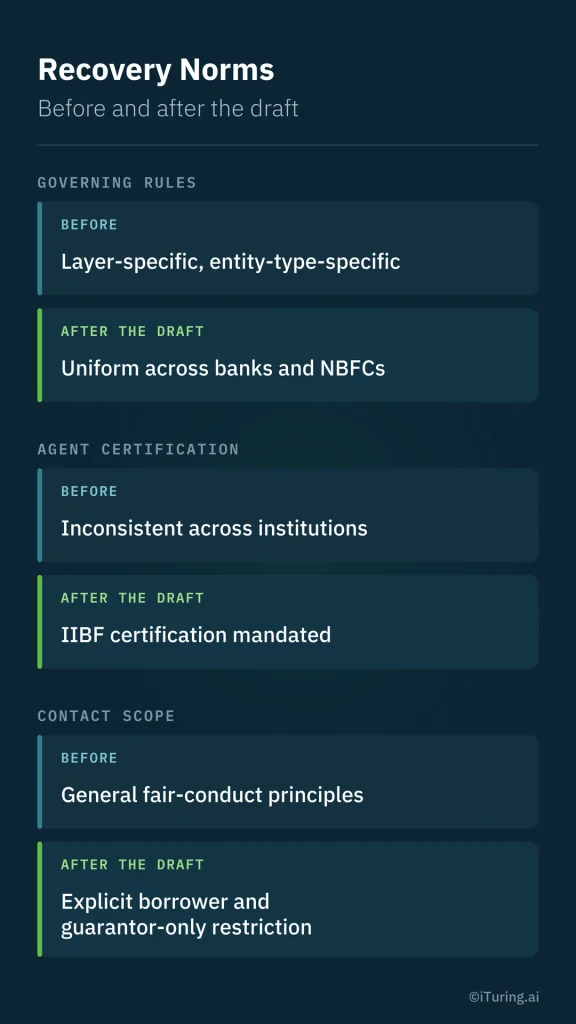
On February 10, 2026, RBI released a draft circular proposing a harmonised recovery agent framework applying uniformly across banks and NBFCs, rather than the layer-specific and entity-type-specific rules that had governed recovery conduct previously. The draft requires regulated entities to formulate a separate, dedicated policy on recovery of loan dues, engagement of recovery agents, and taking possession of security, distinct from broader outsourcing or sourcing-stage conduct policies covering areas like mis-selling.
This came as part of a broader February 6, 2026 Statement on Developmental and Regulatory Policies, which touched several areas at once, but the recovery agent framework is one of the more operationally significant pieces for any institution running collections at scale, given how directly it changes day-to-day recovery agent conduct requirements.
The IIBF Training and Certification Requirement for Recovery Agents
The draft mandates that recovery agents undergo training and obtain certification from the Indian Institute of Banking and Finance under its debt recovery agents’ programme. This formalises a requirement that many institutions had implemented informally or inconsistently, and makes it an explicit compliance obligation rather than a best practice some institutions chose to follow and others didn’t.
For institutions that haven’t systematically tracked recovery agent certification status, this creates an immediate documentation gap to close: knowing, for every active recovery agent working an account, whether they hold current IIBF certification, and being able to demonstrate this on request.
Code of Conduct and Due Diligence Obligations
Regulated entities must maintain a comprehensive Code of Conduct specifically for recovery agents and employees engaged in loan recovery, and secure signed undertakings from them to abide by these standards before they’re assigned to recovery work, not retroactively. The draft also requires due diligence and periodic verification of recovery agency employees and representatives, with the periodicity and scope of that verification specified in the institution’s own policy.
This is a meaningful shift from a general institutional code of conduct toward a recovery-specific one, with its own due diligence framework distinct from the broader outsourcing due diligence many institutions already run under RBI’s Outsourcing Directions, 2025.
Call Documentation: What Must Be Recorded and Why
The draft requires institutions to document the time and number of calls made by employees or recovery agents to borrowers or guarantors, and to ensure these calls are recorded. This moves call documentation from a general good practice into a specific, auditable requirement: not just whether contact happened, but precisely when and how often, tracked at the level of detail an examiner could actually verify against a borrower’s own account of contact frequency.
Restrictions on Who Recovery Agents Can Contact
Recovery agents may interact only with the borrower or the guarantor, and are restricted from contacting relatives or other associates of the borrower. This closes a practice that has generated borrower complaints in the past, contacting family members, employers, or other third parties in an effort to pressure repayment, and makes it an explicit prohibition rather than something addressed only through general fair-conduct principles.
Building a Gap Analysis Before the Final Circular
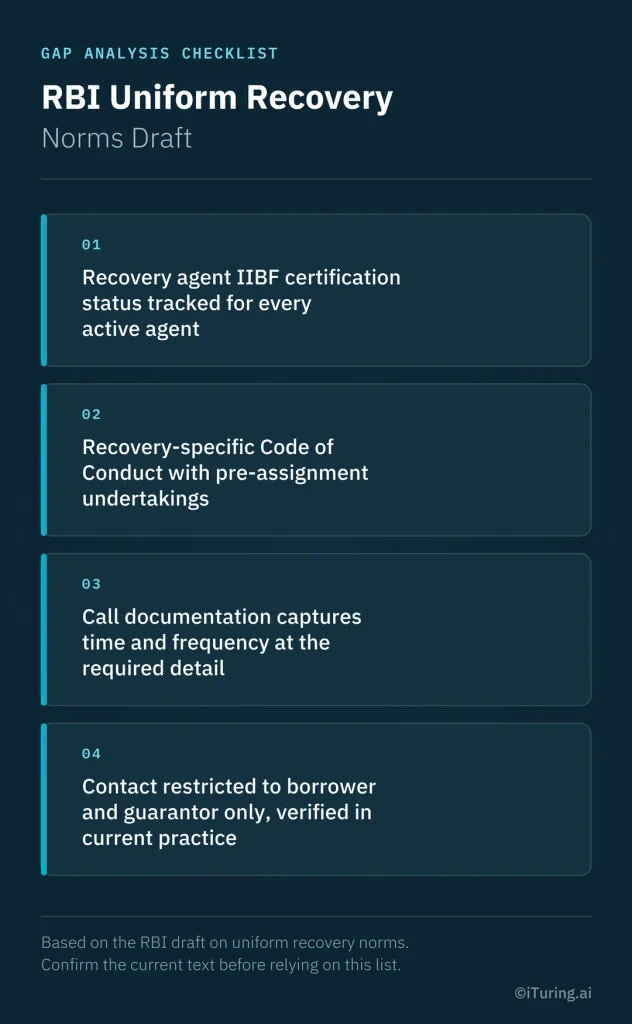
The draft’s comment period closed in early March 2026, and while the final circular’s exact wording may still evolve, the core substantive obligations, IIBF certification, documented Code of Conduct with pre-assignment undertakings, specific call documentation, and the borrower/guarantor-only contact restriction, are the kind of foundational requirements unlikely to be substantially removed in finalisation. A practical gap analysis run now should cover: current recovery agent certification status against the IIBF requirement, whether a recovery-specific Code of Conduct exists separate from general outsourcing policy, whether call documentation currently captures time and frequency at the level of detail the draft requires, and whether current contact practices are already restricted to borrower and guarantor only.
Where iTuring Fits
iTuring’s Model Gov and Agentic AI modules are built to generate the call documentation, agent activity tracking, and contact-scope enforcement this framework requires as a byproduct of normal operation, rather than a separate compliance exercise layered on afterward. Recovery agent certification status, Code of Conduct undertakings, and per-call time and frequency records are tracked as part of the platform’s standard audit trail.
Sources
- RBI, draft circular on uniform recovery agent norms, February 10, 2026
- RBI, Statement on Developmental and Regulatory Policies, February 6, 2026
- RBI Outsourcing Directions, 2025
- Indian Institute of Banking and Finance, debt recovery agents’ certification programme
- Verify final circular text once published, as this piece is based on the draft stage