TL;DR
- Real-time decisioning acts on account events the moment they occur
- Salary credit date alignment creates India-specific trigger opportunities
- Batch processing gaps cost Indian lenders measurable recovery value
- WhatsApp and UPI payment rails demand real-time response architecture
- RBI compliance constraints must be hard-coded into the decisioning engine
At 2:17pm on the 5th of the month, a borrower receives a salary credit notification. Her personal loan EMI was due on the 1st. She is now four days past due. At the moment her salary lands, her propensity to pay is at its highest point for the rest of the month. She has the funds. The missed payment is mentally present. A WhatsApp message with a pre-filled UPI payment link, arriving in that window, reaches her at exactly the moment when payment is most likely.
Under a batch processing system, the collections engine does not know her salary has landed. No trigger is wired to her salary credit event. The next batch runs tonight. A contact attempt fires tomorrow morning, after the batch has processed overnight and the queue has been updated.
By tomorrow morning, the salary funds have begun allocating to other obligations. Groceries. Rent. School fees. A contribution to a relative’s expense. The payment window has not closed, but the frictionlessness of that first hour, when the funds are present, the missed obligation is fresh, and nothing else has claimed the money, is gone.
Real-time decisioning is built for that window. This blog covers what real-time decisioning means specifically for India’s digital lending market, where batch processing loses the most recovery value, how the decisioning logic adapts to India-specific triggers and constraints, why WhatsApp and UPI change what collections infrastructure can accomplish, and what RBI requires before a real-time system goes into production.
What Real-Time Decisioning Means for Indian Digital Lenders
Real-time decisioning means every treatment decision is made at the moment of the triggering event, using current account data, without waiting for a scheduled batch cycle to process it.
India’s digital lending market has three characteristics that make real-time decisioning more valuable here than in most Western credit markets.
Salary credit date concentration. A large proportion of personal loan borrowers in Indian NBFC portfolios pay within 48 to 72 hours of monthly salary credit. The salary credit event is predictable, high-value, and directly wirable as a trigger. In a Western credit market, payment behaviour is more distributed across the month. In an Indian personal loan portfolio, there are specific windows, clustered around the 1st, 5th, 10th, and 15th of the month for different employer salary schedules, when a significant proportion of past-due accounts move into peak payment propensity simultaneously. A real-time system can act on each salary credit event individually. A batch system processes them overnight after the window has narrowed.
UPI payment infrastructure. UPI enables payment completion within seconds of a contact attempt, with no bank account details required, across all major Indian banks. A real-time decisioning system that sends a WhatsApp message with a pre-filled UPI deeplink can receive a completed payment within minutes of the trigger firing. This payment completion path has no direct equivalent in Western collections markets, where payment requires navigating to a portal, entering account details, or making a card transaction.
WhatsApp as the primary engagement channel. For many Indian NBFC borrower segments, WhatsApp response rates are materially higher than voice or SMS. A real-time channel sequencing architecture that starts with WhatsApp and escalates to voice only on non-response operates differently from a batch-driven outreach model where the channel sequence is determined by the schedule rather than the borrower’s actual response pattern.
These three characteristics combine to create a real-time collections decisioning opportunity specific to India that does not exist in the same form in the US or South African markets.
In Indian digital lending, salary credit, UPI, and WhatsApp form a three-part infrastructure for real-time collections response that has no direct equivalent in Western credit markets.
Where Batch Processing Loses Recovery Value in India
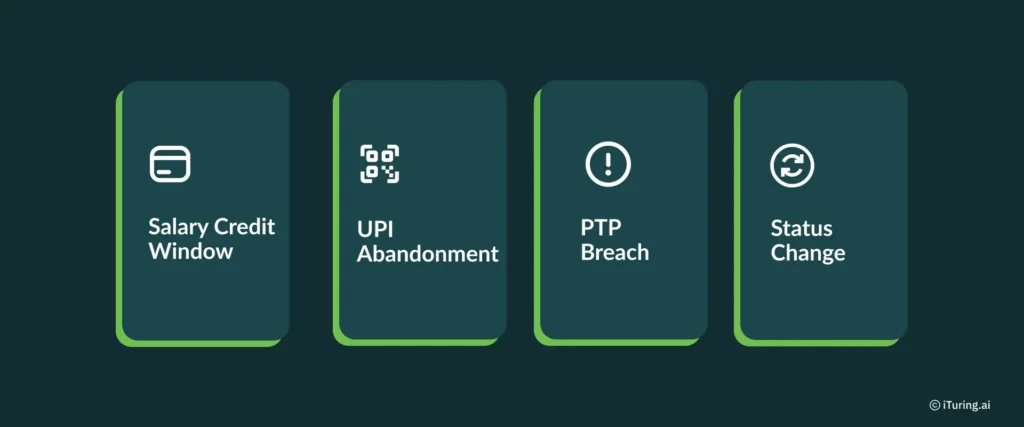
Four scenarios account for most of the recovery value that batch processing cannot capture in an Indian digital lending portfolio.
The Salary Credit Window
The scenario described in the opening. A borrower is past due. Her salary lands. Her payment propensity is at its peak. A real-time system wired to her salary credit event fires a WhatsApp message with a UPI deeplink within minutes. A batch system fires a contact the following morning, after competing financial obligations have begun allocating the available funds.
For a portfolio of 20,000 personal loan accounts where salary-linked payment behaviour is prevalent, the aggregate effect of missing this window across a single month represents a recovery gap that compounds with each passing cycle.
The UPI Payment Abandonment Signal
A borrower receives a WhatsApp message with a UPI payment link. He opens it. He navigates to the UPI payment screen. He does not complete the transaction. He puts the phone down.
This abandonment event contains clear intent signal. The borrower was at the payment screen. Something interrupted the completion: a phone call, a distraction, uncertainty about the exact amount, or the friction of confirming a large payment on a mobile screen.
Batch processing does not capture this signal until the next cycle, by which time the intent window has likely passed. Real-time decisioning fires a follow-up within a defined short window, a shorter message with a single-tap UPI deeplink for the exact overdue amount, while the borrower is still within the same session of engagement.
The Promise-to-Pay Breach
A borrower commits to paying by Friday. The payment does not post. The batch runs Monday. The follow-up treatment fires four days after the breach. In the Indian context, a PTP breach often coincides with a salary delay. A real-time follow-up sent the same day the PTP window closes can include a payment arrangement offer calibrated to the delayed salary timeline. A Monday batch contact has no way to incorporate this context because it does not know the salary delay is the reason for the breach.
Account Status Change
When an NBFC’s legal team issues a formal demand notice, or when a borrower enters a debt recovery tribunal process, the account status changes immediately. Under batch processing, automated outbound contact continues until the next batch updates the account status. Each contact generated in that window is a compliance risk under RBI’s recovery agent guidelines. Real-time decisioning checks account status at every trigger point and suppresses contact the moment the status change is recorded in the system.
The Decisioning Logic in an Indian Digital Lending Context
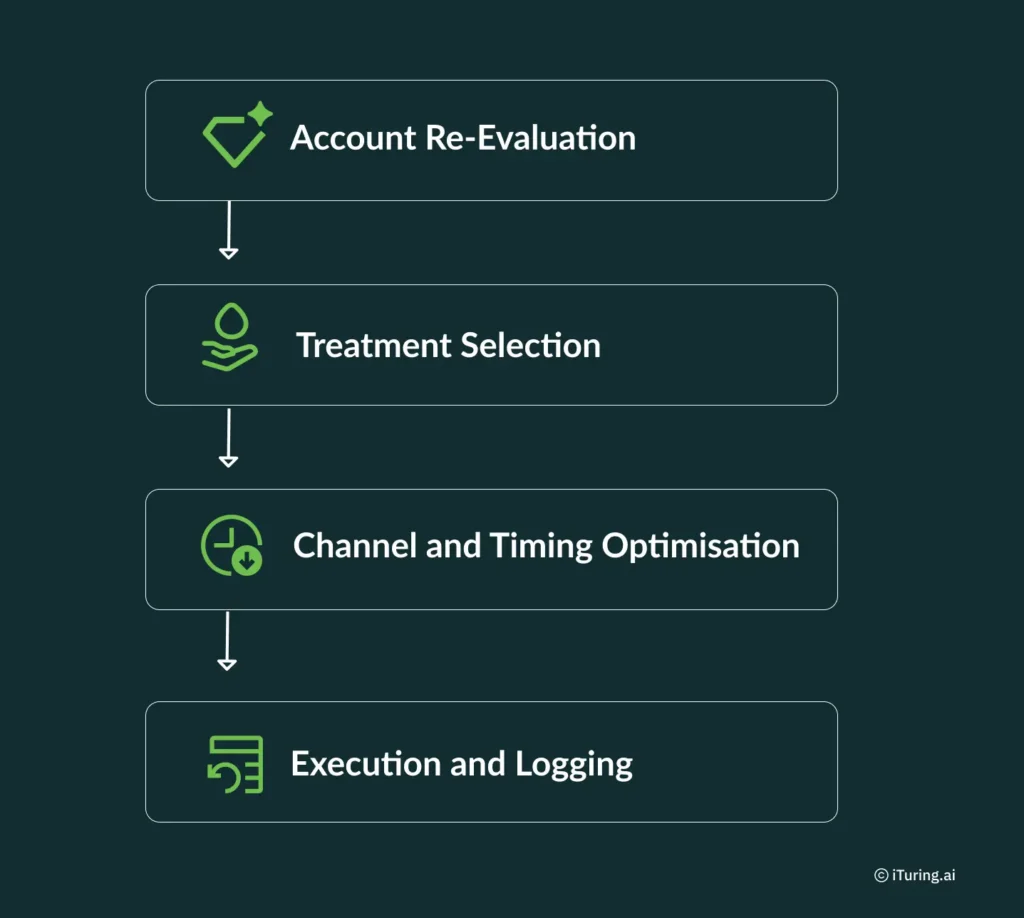
When a triggering event fires, the decisioning engine runs a four-step sequence adapted to the specific characteristics of Indian NBFC portfolios.
Step 1: Account Re-Evaluation
The engine pulls the current account state: balance, DPD, EMI schedule, payment history, open arrangements, and full contact history including channel, outcome, and timestamp for every prior attempt. It then re-scores the account using propensity models calibrated on Indian NBFC portfolio data, incorporating salary credit date alignment, historical payment-to-salary-credit lag, seasonal payment patterns, and product-type norms for the specific loan type on the account.
Eligibility checks run at this step: RBI fair practices code compliance status, active legal notice or debt recovery tribunal process status, opt-out status across all channels, active payment arrangement status, and RBI-mandated contact hour restrictions. An account that fails any eligibility check is suppressed regardless of its propensity scores.
Step 2: Treatment Selection
The engine matches the current score and account state to the treatment matrix. For Indian digital lenders, the treatment matrix must reflect three considerations that do not appear in the same form in Western collections policy.
Product-type norms: personal loan, two-wheeler loan, and MSME loan accounts have different appropriate escalation timelines and contact intensity levels that reflect both borrower expectations and RBI’s differentiated guidance across product categories.
Regulatory escalation constraints: RBI’s recovery agent guidelines define what contact types are permissible at each DPD stage. The treatment matrix must be built within these constraints, with escalation paths that respect the regulatory framework as accounts age through the DPD buckets.
Language preference routing: a borrower whose historical interactions have been conducted in Tamil, Telugu, or Marathi should receive treatment in that language. Generic English-language templates applied uniformly across an Indian NBFC borrower base produce lower engagement rates and, in some circumstances, may not meet RBI’s fair practices requirements for clear and transparent communication.
Step 3: Channel and Timing Optimisation
Within the selected treatment, the engine applies contact optimisation logic specific to the Indian digital lending context.
WhatsApp-first sequencing applies to borrower segments where historical response data supports it. The engine routes to WhatsApp as the lead channel for the first contact attempt, with voice escalation on non-response within a defined window, rather than defaulting to a voice-first strategy driven by legacy contact centre infrastructure.
UPI deeplink integration applies to every payment-ready contact. Each WhatsApp payment message includes a pre-filled UPI deeplink for the exact overdue amount. The link opens directly to a payment confirmation screen, reducing the action to a single tap.
Salary credit timing optimisation applies to accounts with documented salary credit date patterns. The engine weights the contact timing for these accounts toward the post-salary window, scheduling the contact attempt for the hours immediately following the expected salary credit rather than the time the trigger fired.
RBI contact hour enforcement runs as a hard gate on every outbound contact trigger. A salary credit event at 11pm queues a contact for the permitted window the following morning. The gate applies to all automated outbound channels without exception.
Step 4: Execution and Logging
The engine routes to the appropriate automation workflow or agent queue and generates a structured decision log. The log records the triggering event and timestamp, the full account state at decision time, the propensity scores applied, the eligibility check results, the treatment selected and the matrix logic that produced it, the channel and timing rationale, and the execution outcome.
This log is the audit trail for RBI model monitoring, fair practices review, and any supervisory examination of the NBFC’s AI collections operations.
WhatsApp and UPI as Real-Time Collections Infrastructure
In the Indian digital lending market, WhatsApp and UPI are not simply two channels among several. They are infrastructure that changes what real-time collections decisioning can achieve within a single contact session.
WhatsApp Business API enables automated message delivery within RBI-approved content templates. Rich media support allows payment buttons, PDF account statements, and structured repayment schedule messages to be delivered within the same conversation thread. Delivery and read receipts provide a documented communication trail that SMS cannot match, and that meets RBI’s Digital Lending Directions requirement for transparent and auditable borrower contact.
For Indian NBFC borrower populations across income segments and geographies, WhatsApp reaches borrowers where they are already active, in a channel they use daily, without requiring them to navigate to a separate application. Response rates reflect this. A contact that arrives in a channel the borrower uses constantly is more likely to be seen and acted on than one that arrives in a dedicated banking app or a voice call at an inconvenient moment.
Human agent escalation within WhatsApp allows the conversation to move from automated message to live agent within the same thread when the borrower’s response indicates a need for negotiation, a restructuring discussion, or a complaint. The transition is invisible to the borrower. The agent receives the full conversation history. No context is lost in the handoff.
UPI
UPI reduces the payment completion path to a single action. A pre-filled UPI deeplink embedded in a WhatsApp message opens directly to a payment confirmation screen showing the borrower’s name, the NBFC’s name, and the exact overdue amount. The borrower confirms with their UPI PIN. The payment is complete in seconds.
This payment path is materially faster and lower-friction than any equivalent in Western collections markets. There is no need to navigate to a payment portal, enter account or card details, wait for an OTP, or complete a multi-step transaction. In the salary credit window, where the first hour is the most productive, this frictionless completion path converts borrower intent into payment resolution at a rate that a redirect to a web payment portal cannot match.
RBI Compliance Constraints in Real-Time Decisioning
Three specific RBI compliance areas must be built into the decisioning engine as hard architectural constraints, not advisory guidelines applied at the discretion of the operations team.
Contact Hour Restrictions
RBI’s fair practices code restricts collections contact to defined hours. In a real-time system, every automated outbound trigger must pass through a contact hour gate before execution. A salary credit event at 11pm queues a contact for the following morning within the permitted window. A PTP breach detected at 6am queues a contact for the first permitted minute of the working day. The gate applies to WhatsApp, voice, and SMS equally. A real-time system that fires contacts faster also generates contact hour violations faster if the gate is not built in architecturally.
Recovery Agent Conduct Standards
RBI’s guidelines on recovery agent conduct apply to AI-generated contact as well as human agent contact. Automated messages must meet the content and tone standards defined in RBI’s recovery agent guidelines and the NBFC’s board-approved collections policy. Message templates used in the decisioning engine’s WhatsApp and SMS workflows must be reviewed against these standards before deployment and version-controlled so that any content change goes through the appropriate approval process.
Consent and Opt-Out Processing
RBI’s Digital Lending Directions require documented borrower consent for automated collections contact and immediate processing of opt-out instructions. The decisioning engine must check consent status at every contact trigger. An opt-out instruction received through any channel must suppress all subsequent automated contact immediately, not at the next batch cycle. In a real-time system, the window between an opt-out instruction and the next contact attempt is measured in seconds if consent logic is not built into the engine. Every contact generated in that window is a regulatory breach.
The Salary Credit Window Closes in Hours. The Batch Runs Tomorrow.
The Indian digital lending market has a collections timing advantage that most lenders are not fully using. Salary credit dates are known. UPI makes payment completion frictionless. WhatsApp puts the contact in a channel the borrower is already in. The window where all three align is short, but it is predictable.
Batch processing cannot act in that window because it does not know the window has opened. Real-time decisioning can act because it is wired to the event that opens it.
Building a real-time decisioning infrastructure for Indian NBFC collections requires data latency measured in seconds, RBI compliance constraints built in as gates rather than guidelines, and treatment logic that reflects the product-type norms, language preferences, and regulatory escalation constraints specific to the Indian market. The operational and compliance requirements are substantive. The recovery economics of getting them right are clear.
Five markers of a well-implemented real-time decisioning programme for Indian digital lenders:
- Salary credit event wired as a trigger, with contact timing optimised for the post-salary window for accounts with documented payment date patterns
- UPI deeplink integrated into every payment-ready contact message, with pre-filled amount and single-tap completion
- WhatsApp-first channel sequencing applied to borrower segments where historical response data supports it, with voice escalation on non-response within a defined window
- RBI contact hour restrictions enforced as a hard gate on every automated outbound trigger, across all channels
- Decision logs generated natively at every trigger event and retained for RBI model monitoring and fair practices audit
iTuring’s AI collections platform is built for India’s digital lending infrastructure: real-time event-driven triggers, WhatsApp and UPI payment integration, salary cycle-aware contact timing, and native RBI compliance documentation at every decision point.