
TL;DR
- Charged-off portfolios have different scoring dynamics than early bucket
- Propensity scoring on legacy portfolios must use different signal sets
- Right-party contact is harder but more valuable in charged-off recovery
- FDCPA and CFPB compliance requirements intensify at the charged-off stage
- SR 11-7 governance applies even when the model is vendor-supplied
A charged-off portfolio on a US bank’s balance sheet has a specific financial character. The accounts have been written down. The provision has been taken. The loss is already on the books. Recovery at this stage is pure upside against a cost base that has already been absorbed.
The standard model for working that upside has not changed substantially in three decades. A third-party collection agency receives a placement file. The agency works the file with a standard dialler strategy and whatever skip tracing tools it has access to. Recovery rates hover between fifteen and twenty-five cents on the dollar for consumer debt before commission. The bank receives its share after the agency’s cut. The accounts close or return as uncollectable.
What this model cannot do is distinguish, before the first contact attempt, between the accounts in that placed file where active outreach will produce a settlement and the accounts where it will not. Every account receives the same dialler strategy. The contact budget is distributed uniformly regardless of individual account recovery probability. The placement commission applies to accounts that settle and accounts that do not.
AI changes three things simultaneously: which accounts in a charged-off portfolio are worth pursuing with active outreach, at what contact intensity, and through which channels. The result is a higher net recovery rate on the accounts that can be recovered and a materially lower cost on the accounts that cannot.
This blog covers why charged-off recovery is a different AI problem from early bucket collections, what AI does differently in this context, how the ROI calculation works for a US bank’s charged-off portfolio, what FDCPA and CFPB compliance require, and what SR 11-7 governance demands for models operating on charged-off debt.
Why Charged-Off Recovery Is a Different AI Problem
The signal environment for a charged-off account is materially different from an account in the 30-60 DPD early bucket. Using the same propensity model across both stages produces a model that is miscalibrated for at least one of them.
Payment history has terminated. The primary signal category for early bucket propensity scoring is recent payment behaviour: the recency, frequency, and trajectory of payments over the prior three to six cycles. A charged-off account has no recent payment behaviour to model. The last payment may have occurred 180, 270, or 360 days ago. The payment history signal that drives early bucket scoring is absent.
Contact history has accumulated. During the pre-charge-off collections process, most accounts have received dozens of contact attempts across multiple channels. Each attempt produced a response or non-response signal. Each channel produced an answer rate. Each PTP commitment produced a fulfilment or breach record. This accumulated contact history is the primary predictive signal for charged-off recovery. It has been sitting in the data throughout the collections process and is available to an AI model that is built to use it.
Legal and regulatory status has changed. Charged-off accounts may be subject to statute of limitations considerations that vary by debt type and state. Bankruptcy filings and discharge reviews must be checked before any contact is made. FDCPA third-party placement rules apply when accounts are placed with an agency. CFPB post-charge-off communication standards govern the content and conduct of collection contact. None of these applied in the same way during the early bucket stage.
Balance composition has shifted. Interest, fees, and collection costs have typically been capitalised into the outstanding balance by the time of charge-off. The balance shown on the file may not reflect what the borrower believes they owe or what they are willing to settle for. Settlement propensity modelling must account for this gap between file balance and perceived obligation.
Two outcomes matter in charged-off recovery: full settlement, where the borrower pays the full outstanding balance, and negotiated settlement, where the borrower pays a defined percentage in a lump sum or structured arrangement. A well-designed charged-off recovery model produces separate propensity estimates for each, because the treatment strategy for a full-balance recovery account is different from the treatment strategy for a negotiated settlement account.
A charged-off account’s most predictive signals are not payment history signals. They are contact response signals from the collections history that accumulated before charge-off, and they have been sitting in the data the whole time.
What AI Does Differently in Charged-Off Recovery
Four functions produce measurable improvement over standard agency placement models in charged-off recovery.
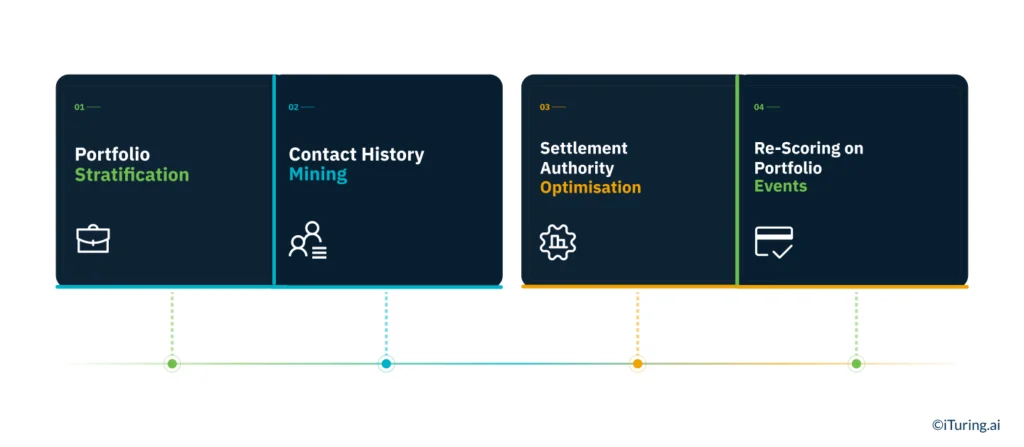
Portfolio Stratification Before Placement
Before any account is placed with an agency or worked in-house, AI scores every account in the charged-off portfolio on three dimensions: settlement propensity, full-balance recovery propensity, and contact-responsiveness based on pre-charge-off response history.
This stratification drives three placement decisions. Accounts with low propensity on all three dimensions are not placed for active outreach. They are held for passive monitoring or periodic re-scoring as portfolio events occur. The placement commission on these accounts is eliminated entirely, because they were not going to produce recovery outcomes regardless of the contact intensity applied.
Accounts with high settlement propensity but low full-balance propensity are placed for negotiated settlement outreach with pre-defined settlement authority loaded into the contact workflow. These accounts receive a settlement offer within the first contact attempt rather than a full-balance demand followed by a negotiation that was always going to land at a discount. The contact cost per recovery on these accounts decreases because the first productive contact closes the account rather than opening a negotiation cycle.
Accounts with high full-balance propensity, typically borrowers with short charge-off histories, a documented pattern of full commitment fulfilment, and a contact-responsiveness signal indicating they will engage, receive a structured payment plan outreach designed to recover the full balance over an agreed schedule.
Contact History Mining
The contact history accumulated during the pre-charge-off collections process is the single most valuable signal source for charged-off recovery contact optimisation. Most banks and agencies do not use it systematically, because the systems that hold it were built for operational collections rather than AI feature extraction.
AI mines this history to build a contact profile for each account: which channels produced answers, at what times of day and days of week, what message content types produced the highest response rates, and what the borrower’s PTP commitment and fulfilment pattern looked like across the prior collections cycle.
A borrower who answered voice calls between 6pm and 8pm on weekday evenings, responded to SMS payment links but not to voice messages, and committed to PTPs that she fulfilled in four out of five instances represents a highly specific contact and settlement profile. The first charged-off outreach attempt for this account should be a voice call between 6pm and 8pm on a weekday, with an SMS follow-up containing a settlement payment link if she does not answer, and a structured settlement offer that mirrors the payment arrangement format she has historically fulfilled.
Without contact history mining, this account receives the same dialler strategy as every other account in the placed file. With it, the first contact attempt is calibrated to her specific response profile from the ground up.
Settlement Authority Optimisation
Different borrowers respond to different settlement structures. Some settle on a single lump sum at a meaningful discount. Some need a three-payment structured arrangement to commit. Some will engage only with an extended payment plan that reduces the monthly obligation to a manageable amount. Presenting the wrong structure in the first contact often produces a non-response that requires additional contact attempts to recover.
AI predicts which settlement structure is most likely to produce a commitment from each specific borrower based on their prior arrangement behaviour, account balance, and contact profile. Pre-loading the outreach attempt with the appropriate structure reduces the negotiation cycle, increases the proportion of contacts that close on the first or second attempt, and reduces the total contact cost per settled account.
For a bank managing a charged-off portfolio in-house or through a preferred agency relationship, this means defining settlement authority tiers before the placement file is generated: accounts routed to the lump sum discount workflow, accounts routed to the structured three-payment workflow, and accounts routed to the extended plan workflow. The AI scoring determines the routing. The agent or automated workflow executes within the pre-approved authority for that tier.
Re-Scoring on Portfolio Events
A charged-off portfolio is not static. Over months and years, accounts experience events that change their recovery prospects and their compliance status. Bankruptcy filings change the legal status of outreach. Statute of limitations timelines advance. Credit bureau updates may surface new address or employment information. Skip tracing results may identify a previously unreachable borrower.
AI re-scores affected accounts when these events fire, routing them to the appropriate treatment rather than waiting for the next periodic portfolio review. An account that surfaces new contact information through a skip tracing update moves from the passive monitoring queue to the active outreach queue with an updated contact profile. An account that files for bankruptcy moves immediately to a contact suppression hold pending discharge review. An account approaching the statute of limitations in its state moves to a legal review queue before any further outreach is attempted.
The ROI Calculation for Charged-Off AI Recovery
The ROI structure for AI in charged-off recovery differs from early bucket collections because the primary value driver is net recovery rate improvement across the full portfolio, not individual contact cost reduction.
A US bank with a $45 million face-value charged-off consumer portfolio, accumulated over three years, with an average account age at charge-off of 210 days past due and an average balance of $4,200, working under a current third-party agency placement model that produces 18 cents on the dollar gross and approximately 12 to 14 cents net of commission, has a specific set of economic levers that AI affects.
Portfolio stratification before placement produces a direct commission cost reduction by removing low-propensity accounts from active placement. If 30% of the portfolio carries low propensity on all three dimensions, settlement, full-balance recovery, and contact-responsiveness, placing those accounts for active outreach generates commission costs without recovery outcomes. Removing them from active placement and routing them to periodic re-scoring eliminates that cost category while maintaining the option to activate them if portfolio events change their status.
Right-party contact rate improvement addresses the specific challenge of charged-off portfolios: high rates of address and phone number obsolescence. Borrowers who have been in collections for 180 or more days have often changed contact information. AI-driven skip tracing prioritisation concentrates the skip tracing budget on accounts where the investment is most likely to produce a contactable address or number, rather than applying it uniformly across the portfolio. Reducing the proportion of contact budget spent on genuinely unreachable accounts improves the effective cost per productive contact across the portfolio.
Settlement structure optimisation increases the proportion of placed accounts that convert to a settlement arrangement within the first three contact attempts. The current industry average for first-contact settlement conversion in standard agency placement is low. Pre-loading each account with the settlement structure most likely to produce a commitment shifts this conversion rate materially for accounts where the contact profile supports a well-targeted first approach.
Re-scoring on bankruptcy and statute of limitations events prevents contact cost and compliance risk on accounts where outreach is legally prohibited or economically futile. Each prevented outreach attempt on a bankrupted or time-barred account is a saved contact cost and an avoided compliance risk. At the volume of a $45 million charged-off portfolio, these savings across a 12-month recovery cycle are measurable in the ROI calculation.
The correct ROI metric is not the reduction in cost per individual contact. It is the improvement in net recovery rate, gross dollars recovered minus all placement, contact, and compliance costs, across the full portfolio measured over the recovery cycle.
AI investment in charged-off recovery should be evaluated against the improvement in net recovery rate across the full portfolio, not against the cost of any individual contact.
FDCPA and CFPB Compliance in AI Charged-Off Recovery
Four compliance requirements shape how AI is used in US bank charged-off recovery, and each intensifies relative to the early bucket stage.
FDCPA Third-Party Placement Rules
When a charged-off account is placed with a third-party collector, the FDCPA’s full consumer protection framework applies. This includes the debt validation notice requirement, which must be delivered within five days of the initial communication. It includes cease and desist processing, which must suppress all further contact immediately on receipt. It includes prohibited contact methods and hours, and the prohibition on harassment, abuse, and false representations.
AI-generated contact through a placed agency must comply with all of these requirements. Critically, the bank retains liability for FDCPA compliance on accounts it has placed. A bank that places accounts with an agency using AI contact automation cannot disclaim responsibility for FDCPA violations in the AI’s output. Vendor and agency contracts should clearly allocate compliance responsibility, and the bank should conduct diligence on the agency’s AI contact practices as part of the placement agreement and ongoing oversight process.
Statute of Limitations Monitoring
Attempting to collect on a time-barred debt without proper disclosure violates CFPB’s debt collection rules. Using collection tactics that could revive a time-barred debt without appropriate disclosures under applicable state law creates additional exposure. The applicable statute of limitations varies by debt type and state, and the rules governing what actions may revive a time-barred debt also vary by state.
The AI contact system must incorporate statute of limitations status as an eligibility check, updated as accounts age through the portfolio and as relevant state law dates are reached. Accounts approaching or past the applicable statute must be routed to a legal review queue before any further outreach is initiated, and the review must confirm the appropriate disclosure requirements before contact resumes.
Bankruptcy Discharge Review
Contacting a borrower about a debt that has been discharged in bankruptcy violates the discharge injunction under 11 U.S.C. § 524 and may violate the automatic stay under 11 U.S.C. § 362 during the pendency of a bankruptcy case. The liability for willful violations includes actual damages, punitive damages, and attorney fees.
The AI contact system must check bankruptcy status at every contact trigger, not at the last system update. A bankruptcy filing or discharge notification received through the court’s PACER system, a credit bureau update, or direct borrower notification must immediately suppress all contact on the affected account pending a legal review of the discharge scope and any remaining non-discharged obligations.
CFPB UDAAP and Communication Standards
CFPB’s UDAAP authority applies to all charged-off collection contact, whether generated by a human agent, an automated dialler, or an AI messaging system. AI-generated contact templates that misrepresent the current balance, imply legal action that has not been initiated, create false urgency, or omit required disclosures violate UDAAP standards regardless of whether a human reviewed the message content before it was sent.
All AI-generated contact templates used in charged-off recovery must be reviewed against UDAAP standards and applicable FDCPA communication requirements before deployment. Templates must be version-controlled so that any content change goes through an approval process before reaching borrowers. The decision log at every contact trigger must record the template version used, enabling the bank to demonstrate exactly what content was sent to each borrower in any CFPB examination or consumer complaint investigation.
SR 11-7 Governance for Charged-Off Recovery Models
Three SR 11-7 requirements apply specifically and distinctly to AI models used in charged-off debt recovery.
Pre-Deployment Validation on Charged-Off Portfolio Data
Pre-deployment validation on early bucket data does not demonstrate that a model performs on the materially different signal environment of a charged-off account. If the bank is using a vendor-supplied propensity model that was validated on the vendor’s benchmark dataset or on the bank’s early bucket portfolio, that validation record does not satisfy SR 11-7 for charged-off recovery use.
The bank must conduct pre-deployment validation specifically on its charged-off portfolio data: accounts that have reached charge-off, with the contact history, balance composition, and legal status characteristics of charged-off accounts in the bank’s own book. The validation must demonstrate rank-order accuracy and appropriate score distribution on that specific population.
Separate Model Inventory Entry
A charged-off recovery model is a distinct model from the early bucket or mid-bucket propensity model, even if it is supplied by the same vendor and built on the same underlying architecture. It operates on a different population, uses a different feature set, and optimises for different outcomes. It requires its own model inventory entry with its own documented purpose, owner, validation record, and monitoring programme.
A bank that registers a single model inventory entry for a vendor platform covering all stages of the collections lifecycle has an inventory documentation gap that will be visible in a Federal Reserve or OCC model risk examination.
Ongoing Monitoring for Portfolio Aging Effects
A charged-off portfolio changes composition as it ages. A model validated on a newly charged-off cohort will face a different population distribution six months and twelve months later, as the composition shifts toward older accounts, accounts with different statute of limitations profiles, and accounts whose skip tracing results have changed their contactability status.
Gini coefficient monitoring and score distribution monitoring must detect this drift. The monitoring programme for a charged-off recovery model should run at least quarterly, with a documented threshold for initiating a re-scoring review when distribution shift exceeds the defined tolerance. The monitoring log must be retained and available for examination from the first day of live operation.
The Recovery Rate Is Not Fixed. The Decision of Which Accounts to Pursue Determines What It Is.
A charged-off portfolio’s recovery rate is not a fixed characteristic of the portfolio. It is the output of a series of decisions: which accounts to place for active outreach, at what contact intensity, through which channels, with what settlement authority, and at what timing. The standard agency placement model applies the same decisions to every account in the file. The recovery rate it produces reflects that uniformity.
AI changes the decision logic before the first contact is made. Stratification directs placement cost at accounts where recovery probability justifies it. Contact history mining directs outreach timing and channel at the windows where each specific borrower is reachable. Settlement authority optimization directs the opening offer toward the structure each borrower is most likely to commit to.
The recovery rate that results from these decisions is higher than the one produced by uniform placement because the decisions made before the first contact are better.
Five markers of a well-implemented AI charged-off recovery programme for US banks:
- Portfolio stratification scores run on every account before placement, with documented authority thresholds for full-balance, settlement, and passive-monitoring routing
- Contact history mining that systematically extracts pre-charge-off response signals into per-account contact profiles used in every recovery outreach attempt
- Statute of limitations and bankruptcy status checked at every contact trigger as hard eligibility gates, with accounts failing either check routed immediately to legal review
- FDCPA and CFPB UDAAP compliance reviewed in all AI-generated contact templates before deployment, with version control and decision logging at every contact event
- Separate SR 11-7 model inventory entry, pre-deployment validation on charged-off portfolio data, and quarterly Gini and score distribution monitoring from day one of live operation
iTuring’s AI collections platform includes charged-off recovery scoring, contact history mining, settlement authority routing, and native SR 11-7 governance documentation for US banks operating across early bucket and legacy charged-off portfolios.