TL;DR
- What it is: Model monitoring is the continuous check on a model already in production, tracking whether its predictions, its data, and its explainability still hold up after deployment.
- The core distinction: Monitoring is continuous. Validation is a periodic, independent review. They are different jobs, and conflating them leaves a real gap.
- What it covers: Four things: performance, drift, data quality, and explainability and audit-trail, not just one accuracy dashboard.
- Who it matters most for: Regulated lenders, where a monitoring gap isn’t just missed maintenance. It’s a question an examiner can ask directly.
- One caveat: The RBI’s June 2026 draft guidance names the underlying risk, “time-suitability,” but sets no numeric monitoring schedule. That guidance is a draft, with comments closed 24 July 2026, not yet in force.
A model that has stopped being right doesn’t stop predicting. It just keeps going, quietly wrong.
A Model Does Not Send an Error When It Stops Being Right
A model that stops being reliable doesn’t throw an exception or fail a build. It keeps running, keeps producing confident-looking outputs, and keeps being wrong, until someone checks.
That’s the practical reason monitoring exists. Model accuracy degrades quietly: the data feeding it drifts away from what it was trained on, market conditions shift, or a borrower population changes, and none of that trips an alarm on its own. Monitoring exists specifically to catch degradation a team would otherwise only notice after it already cost something: a bad approval, a missed fraud signal, a policy that lapsed because nobody flagged it in time.
Four Things a Monitoring Program Has to Cover
A complete monitoring program checks four things, not just one dashboard number.
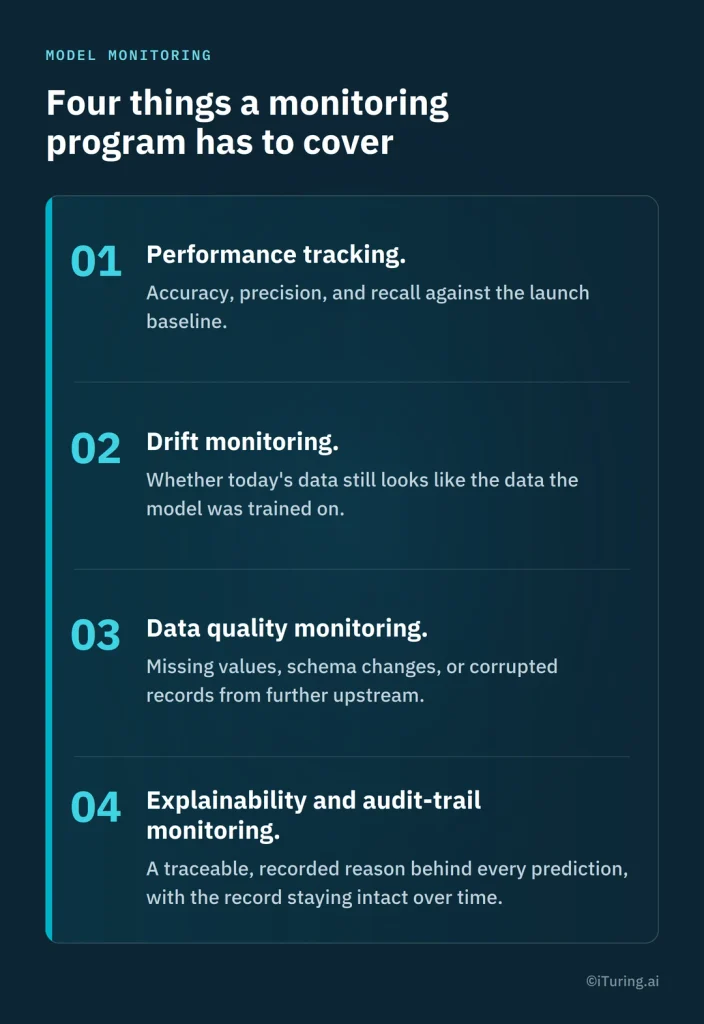
Most teams start by watching accuracy and call that monitoring. It’s one of the four, not all of it.
Monitoring and Validation Are Not the Same Job
Validation and monitoring are different disciplines that get treated as one, and confusing them leaves a real gap. Validation is a periodic, independent review, usually run by a team with no stake in the model’s outcome, checking it before and after major changes. Monitoring is continuous: it’s the tripwire that runs in the gap between one validation and the next, catching whatever breaks in between.
A Monitoring Gap Is an Examiner’s Question, Not an Engineering One
For a regulated lender, a monitoring gap is the kind of question an examiner asks directly: how do you know this model is still doing what it was approved to do?
The Reserve Bank of India’s Draft Guidance on Regulatory Principles for Model Risk Management, Press Release 2026-2027/528, released 24 June 2026, names this directly with the term time-suitability: a model that was right when it was approved can become wrong later as conditions change, without anything about the model itself breaking. Monitoring is what would let a lender show, on demand, that a model is still time-suitable rather than assume it.
This RBI guidance is a draft, with public comments closed 24 July 2026, not yet in force, and it sets no numeric monitoring schedule. This page stays at the definition. For the mechanics of how one specific kind of drift is detected and measured, see Model Drift: Catching Decay Before It Reaches the Regulator. For what a complete monitoring program looks like end to end for a regulated lender, including what it has to prove to an examiner rather than just to a data science team, see AI Model Monitoring for Regulated Lenders.
iTuring Ties Monitoring to Governance on One Platform
iTuring builds monitoring into the same governed architecture as the model itself, not a separate system added on after deployment.
A leading NBFC in India used this approach to rank borrowers by risk and focus collections on the highest-risk segment, seeing a 116% improvement in collections and 86% predictive accuracy, deployed in two weeks.
This sits inside the wider model risk management framework, which covers the governance, inventory, and validation that work alongside monitoring to oversee an institution’s full model portfolio. Talk to iTuring about monitoring for your own model portfolio.
Sources
- Fiddler AI, “ML Model Monitoring Best Practices,” 2026. Source for the four-dimension monitoring taxonomy (performance, drift, data quality, explainability/audit-trail). General industry source, an ML observability vendor, not a named competitor in iTuring’s category and not cited by name in body copy. Reused unchanged from article #7, no re-fetch drift.
- Reserve Bank of India, Draft Guidance on Regulatory Principles for Model Risk Management, Press Release 2026-2027/528, issued 24 June 2026; public comments closed 24 July 2026. Reused unchanged from the cluster’s verified facts table (same fact set as articles #1-7, no re-fetch drift). (Secondary summary sources cross-checked: corplawupdates.in, rmaindia.org; verify final wording against the RBI primary document before hard publish sign-off, per the cluster’s standing open item.)
- iTuring case study, “Improve Collections and Optimize Efforts” (Leading NBFC in India): 116% collections improvement, 86% predictive accuracy, two-week deployment. Source: ituring.ai live case study. Pulled verbatim from article #7’s delivered copy.