TL;DR
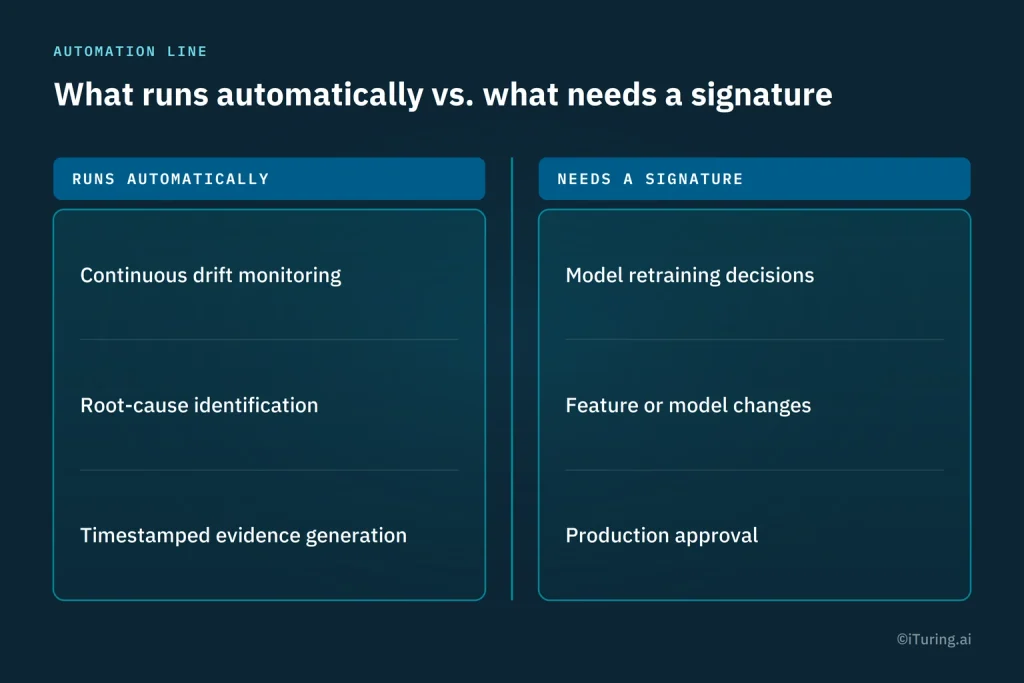
- What “automated” actually covers: continuous monitoring, drift detection, and evidence generation that run without a person watching a dashboard.
- What it doesn’t cover: the decision to retrain a model, change its features, or approve it for production. That still needs a signature.
- Why the distinction matters: a regulator asking who approved a model change wants a name, not a log entry from an unattended system.
- The regulatory read: RBI’s draft guidance treats automated monitoring as the evidence a reviewer works from, not a substitute for the reviewer.
- The real risk: automation that runs quietly enough that nobody notices no one has looked at its output in months.
- Honest caveat: automating the parts that should be automated frees up a team’s time. It doesn’t remove the team.
A model risk team hears “automated model risk management” and pictures something close to unattended: drift gets caught, evidence gets filed, and nobody has to sit through a status meeting to find out a model is degrading. Half of that picture is accurate. The other half is where teams get into trouble.
Automated model risk management should run the parts of the job that are genuinely mechanical: watching every model in production for drift, flagging what changed, and producing a record of what happened without someone assembling it from spreadsheets. What it should not do, and what no regulator expects it to do, is decide on its own that a model gets retrained, changed, or pulled from production. What model risk management software has to do covers the buyer’s side of this question. This piece is about the automation itself: which parts of the job it can carry, and which parts still need a person’s name attached to them.
What automated model risk management actually automates
Automated model risk management runs continuous monitoring, drift detection, and evidence generation without a person triggering each one manually, across every model in production regardless of the vertical it serves. That is a genuine shift from a quarterly manual review, not a rebranding of one.
A credit model, a deposit-retention model, a fraud model, and an insurance underwriting model all drift on their own schedule, and a team that only checks them quarterly is working from data that is already stale by the time anyone looks at it. Software that watches continuously catches a shift in feature distribution or prediction accuracy the week it starts, not the quarter someone finally opens the dashboard.
The evidence side matters as much as the detection side. A model risk function that has to reconstruct what happened, which model drifted, when, and by how much, from logs and spreadsheets after the fact is doing manually what the automation should have already produced: a timestamped record of every drift event and every finding, ready before anyone asks for it. iTuring’s platform runs this monitoring across 140+ use cases already in production, spanning credit, deposits, fraud, and insurance models, on the same drift and evidence logic regardless of which one it’s watching.
What it can’t automate away
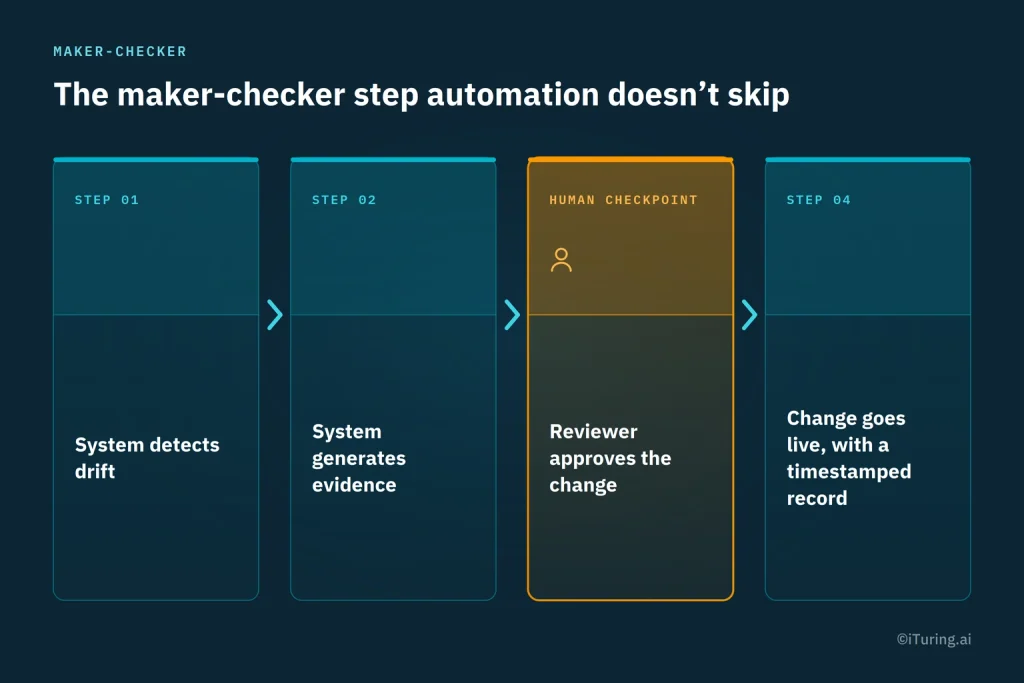
Automated model risk management cannot automate the decision to retrain a model, change its features, or approve it for production. That decision requires a person’s judgment and a person’s name on the approval record, not a system acting on its own findings.
This is where the “automated” label gets misread. A system that detects drift and flags it has done real work. A system that then retrains itself and redeploys without anyone reviewing the change has quietly removed the one step a model risk committee exists to perform. iTuring’s platform keeps a maker-checker approval step on every model change, an immutable, timestamped record of who reviewed a retraining decision and signed off before it went live, so the automation produces the case for a decision without ever making the decision itself.
The distinction sounds procedural until a model gets retrained on bad data and nobody can say who approved it. A system that automated the sign-off along with the monitoring has no answer to that question. One that kept a person in the approval chain does, and that answer is the entire point of having a model risk function in the first place.
Why RBI’s draft guidance treats automation as evidence, not a decision
RBI’s draft guidance on model risk management treats an institution’s monitoring systems as the source of the evidence a reviewer works from, not as a decision-maker a reviewer can defer to. Automation that produces better evidence supports the review it doesn’t replace it.
The RBI issued draft guidance on regulatory principles for model risk management on June 24, 2026, with a public comment window that closed July 24, 2026. It is not yet in force, but it applies broadly, covering commercial banks, NBFCs, co-operative banks, and asset reconstruction and credit information companies. Nothing in that draft asks an institution to prove its models are unsupervised. It asks the opposite: that model risk management functions can demonstrate account-level explainability and a documented review process on demand, which is a standard automation supports by producing the record, not one it satisfies by removing the reviewer.
An institution that has already built continuous monitoring with a maker-checker approval step in place is closer to that bar than one still assembling drift reports by hand every quarter. The gap this draft guidance will widen is not between manual and automated. It’s between automation that produces evidence for a person to act on, and automation nobody has designed a review step around at all.
What over-trusting automation actually costs
Over-trusting automation in model risk management means letting continuous monitoring run without anyone regularly reviewing what it finds, which produces the same blind spot as no monitoring at all, just later and with a longer paper trail proving nobody looked.
A model that has been quietly degrading for three months while its drift alerts sat unread in a dashboard nobody checks is not meaningfully better off than one running with no monitoring at all. The institution can point to a system that was watching. It can’t point to anyone who acted on what it saw. That gap is exactly what a regulator’s account-level explainability question is designed to expose, and it’s the gap that shows up first in an examination, not in day-to-day operations.
iTuring’s platform runs models 97% faster to production than the manual build cycles it replaces, a speed advantage that only holds up if the review step scales with it. Automation that makes it faster to deploy a model and faster to detect its drift, without a corresponding review cadence, just moves the bottleneck from build time to oversight, and an institution finds that out during an audit rather than before one.
If your model risk process can tell you a model drifted but not who reviewed the fix, automation solved the wrong half of the problem. Book a working session with our data science team to see where the review step in your process actually sits.