
Building Toward a Rule the Bureau Itself Withdrew Solves Nothing
TL;DR
- The CFPB’s May 2024 interpretive rule, which treated BNPL providers issuing “digital user accounts” as Regulation Z card issuers, was withdrawn on May 12, 2025, alongside dozens of other guidance documents
- In June 2025, the CFPB stated plainly that it does not intend to reissue the rule, calling the open-end credit framework a poor fit for BNPL’s typically closed-end loan structure
- With federal classification gone, states have moved first: New York signed a first-in-the-nation BNPL licensing law in May 2025, and its Department of Financial Services issued proposed implementing regulations on July 15, 2026, meaning the law is close to taking effect but not yet fully live
- New York’s law imposes disclosure, ability-to-repay, dispute resolution, fee caps, and data privacy requirements directly on BNPL lenders, independent of any federal classification
- Regardless of product classification, standard consumer protection principles, no false or deceptive communication, fair dispute handling, still apply to any collections activity on a BNPL account
- BNPL delinquency and portfolio growth are real operational realities that make calibrated collections AI genuinely necessary, even without a federal rule driving that need
If your BNPL collections build is still oriented around satisfying the CFPB’s card-issuer classification, it’s worth pausing to check the date. The Bureau withdrew that rule in May 2025 and confirmed the following month it has no intention of bringing it back in that form. The real compliance conversation for BNPL collections in 2026 has moved almost entirely to the state level, and treating the withdrawn federal rule as the reference point means missing where the actual obligations now live.
What Actually Happened to the CFPB’s BNPL Rule
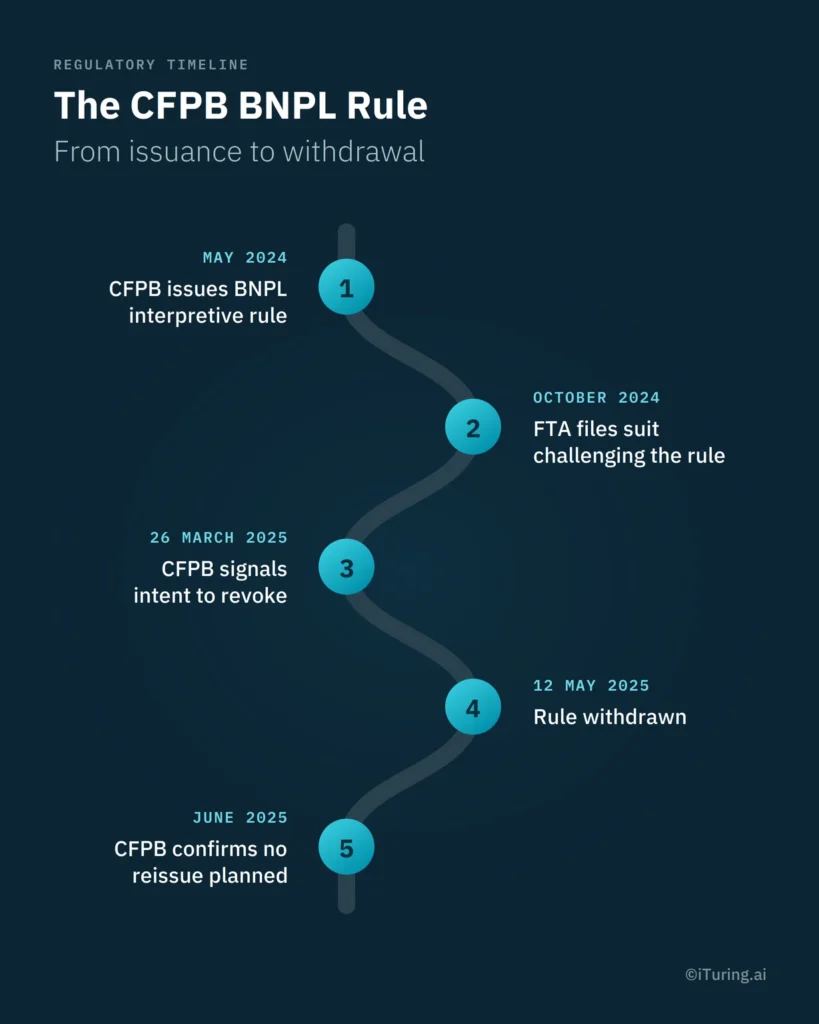
In May 2024, the CFPB issued an interpretive rule stating that BNPL providers offering “digital user accounts” to access credit for retail purchases should be treated as “card issuers” under Regulation Z, subjecting them to disclosure, dispute, and billing requirements designed for open-end credit products like credit cards. The Financial Technology Association sued in October 2024, arguing the rule improperly imposed new substantive obligations through an interpretive rule rather than notice-and-comment rulemaking, and that it applied ill-fitting open-end credit rules to a product that’s typically structured as closed-end, fixed-installment credit.
On March 26, 2025, the CFPB filed a court notice stating it planned to revoke the rule. It followed through on May 12, 2025, withdrawing the BNPL interpretive rule along with 67 other guidance documents issued since the Bureau’s founding. In June 2025, the CFPB confirmed in a status report that it does not intend to reissue the rule, stating directly that applying open-end credit regulations to BNPL’s typically closed-end structure provided little consumer benefit relative to the compliance burden it imposed.
This is a clean withdrawal, not a pause pending litigation. There’s no revised federal rule in development and no indication one is imminent.
The Real Current Compliance Surface: State Law, Led by New York
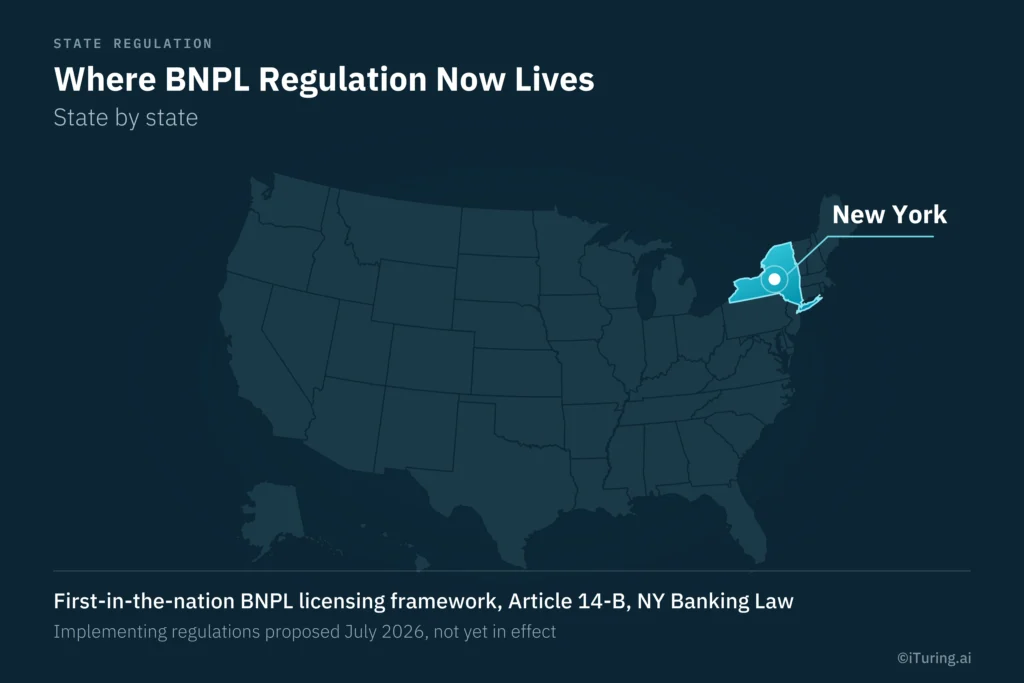
With the federal classification gone, states have stepped into the gap, and New York has moved fastest. Governor Hochul signed the Buy-Now-Pay-Later Act, Senate Bill S3008C, into law on May 9, 2025, codified as Article 14-B of the New York Banking Law. It’s the first state-level licensing and supervision framework built specifically for BNPL lenders.
The law requires BNPL lenders to obtain a license from the Department of Financial Services, imposes an interest rate cap in line with New York’s existing usury limits (not to exceed the equivalent of 16% per year under § 745), and directs the Superintendent to set maximum fee limits, including for origination and late fees. It also requires clear disclosure of loan terms, an ability-to-repay determination before extending credit, and dispute resolution and data privacy protections modeled on, though independently established from, Truth in Lending Act and Regulation Z requirements for credit cards.
As of this writing, the law is not yet fully in effect. NYDFS issued a formal notice of proposed rulemaking on July 15, 2026 to implement the statute’s licensing and compliance requirements, following a July 2025 request for information and a February 2026 draft comment period. The Act itself takes effect 180 days after DFS adopts final regulations, so BNPL lenders operating in New York should be building compliance infrastructure now, even though the enforceable date hasn’t arrived yet.
What Still Applies Regardless of Federal Classification
Independent of BNPL’s classification under any specific statute, general consumer protection principles apply to collections activity on any consumer debt, including BNPL balances. False, deceptive, or misleading representations in connection with collecting a debt, threatening action that won’t actually be taken, and misrepresenting the status or amount of a debt are prohibited conduct regardless of whether the underlying product is classified as a credit card, an installment loan, or something else entirely.
This baseline doesn’t require a BNPL-specific rule to exist. It’s the floor that applies to debt collection generally, and it means BNPL providers and their collections partners can’t treat the absence of a specific federal BNPL rule as an absence of collections-conduct obligations.
BNPL Delinquency Trends and Why Collections AI Still Matters Here
BNPL has grown into a meaningful share of consumer credit, and delinquency within BNPL portfolios is a real, current operational concern independent of any regulatory driver. The need for calibrated collections AI on BNPL accounts doesn’t come from a compliance mandate that no longer exists. It comes from the reality of managing a growing, product-specific delinquency problem well, distinguishing genuine hardship from routine non-payment on a product that’s often used for smaller-ticket, higher-frequency purchases than traditional installment credit.
Where iTuring Fits
iTuring’s collections platform is built to configure against the actual current compliance landscape rather than a single assumed federal classification. For BNPL specifically, that means state-by-state licensing and disclosure logic, keyed to a lender’s operating footprint, and dispute handling built to satisfy the baseline consumer protection standard regardless of how a given state or future federal action classifies the product.
Sources
- CFPB, notice of withdrawal of guidance documents including the BNPL Interpretive Rule, May 12, 2025
- CFPB status report, Financial Technology Association v. CFPB, June 2025
- New York Senate Bill S3008C, Buy-Now-Pay-Later Act, signed May 9, 2025, codified as Article 14-B, New York Banking Law
- New York Department of Financial Services, notice of proposed rulemaking implementing the BNPL Act, July 15, 2026
- 15 U.S.C. § 1692e (general FDCPA false/deceptive representation prohibition, applicable baseline)
- Current BNPL portfolio delinquency data (source specific current figures at time of drafting)