
Every Vendor Deck Leads With Cost and Speed. The Question That Actually Matters Is Who Answers to RBI When the Model Fails.
TL;DR
- RBI examination accountability sits with the regulated entity regardless of whether the collections model was built in-house, bought as a platform, or run through a managed partner
- Build, buy, and partner each have a genuine use case, but the decision should be weighted by RBI compliance ownership and governance fit first, then cost and speed
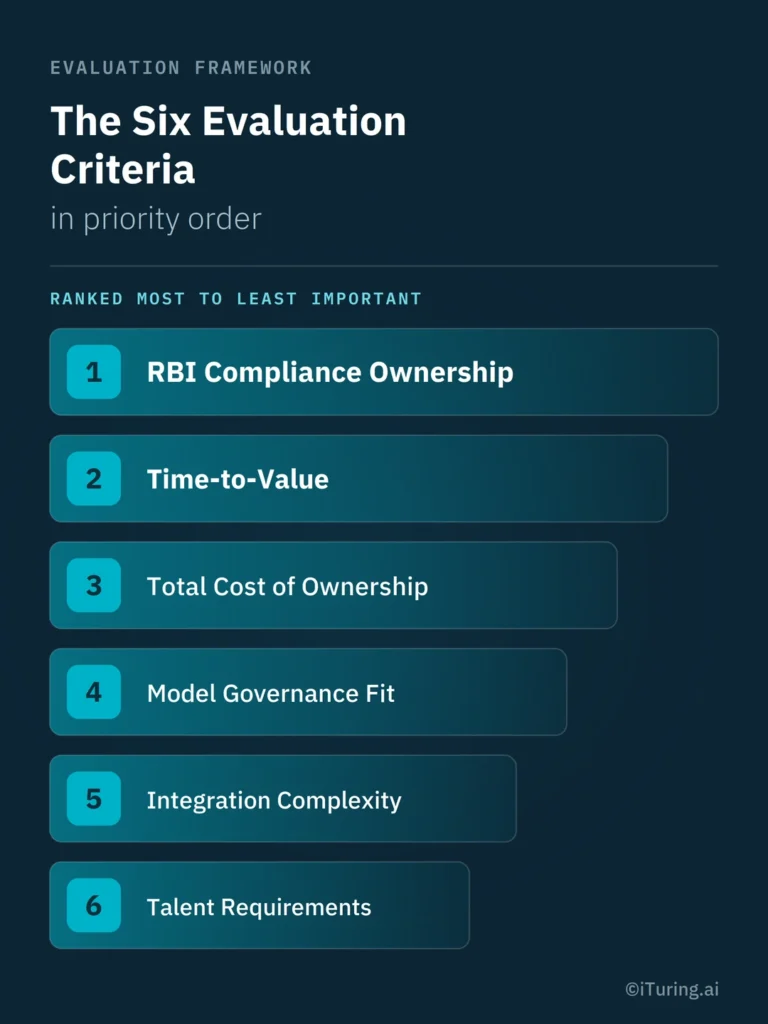
- Six evaluation criteria matter: time-to-value, RBI compliance ownership, total cost of ownership, model governance fit, integration complexity, and talent requirements, roughly in that order of importance
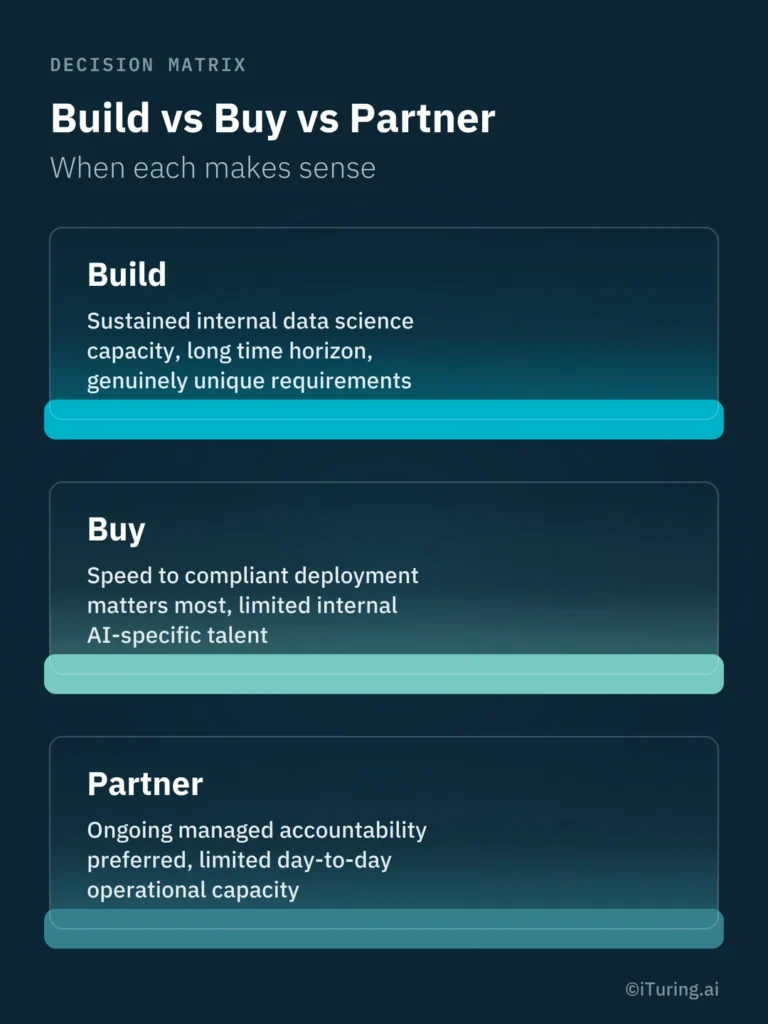
- Build makes sense when an institution has genuine, sustained data science capacity and a long enough time horizon to justify it. Buy makes sense when speed to a compliant, examination-ready system matters more than customisation. Partner makes sense when ongoing managed accountability is the priority
- The India AI collections vendor landscape has matured enough that build is rarely the fastest realistic path to an examination-ready system anymore, even for institutions with strong internal data science teams
Every vendor pitch for AI collections leads with the same two numbers: how much faster it is than building in-house, and how much cheaper it is over three years. Those numbers matter, but they’re not the first question a CTO or Head of Collections should be answering. The first question is who is accountable to the RBI when the model produces a bad outcome, a wrongful contact, a compliance gap, an examination finding, regardless of who built the model or who’s running it day to day.
Why This Is a Governance Decision Before It’s a Cost Decision
RBI accountability doesn’t transfer with the technology decision. Whether a bank builds its collections model with an internal data science team, licenses a platform from a vendor, or engages a managed service partner, the regulated entity remains the one accountable during an examination. A vendor contract can allocate cost, service levels, and even some liability between the parties, but it can’t reassign regulatory accountability itself.
This reframes the build vs buy vs partner question. It’s not primarily “which option is cheapest” or “which is fastest to deploy.” It’s “which option gives the institution the strongest position to demonstrate governance and answer for the model’s behaviour when RBI asks,” because that accountability sits with the bank or NBFC no matter which path is chosen.
The Six Evaluation Criteria, Weighted
RBI compliance ownership should be evaluated first: does the option produce a model inventory entry, validation documentation, and audit trail that the institution genuinely controls and understands, or does it depend on a vendor’s opaque internal processes that the institution can’t fully inspect during an examination.
Time-to-value matters next: how long until a compliant, working system is actually in production, not how long until a proof of concept looks promising.
Total cost of ownership should be evaluated over a realistic multi-year horizon, including the ongoing cost of maintaining talent, retraining models, and keeping governance documentation current, not just the upfront licensing or build cost.
Model governance fit asks whether the option integrates cleanly with the institution’s existing model risk management framework, or requires building a parallel governance process just for this one system.
Integration complexity covers how much work is required to connect the option to core banking, loan management, and existing data infrastructure.
Talent requirements close the list: does the institution have, or can it realistically build and retain, the specific data science and MLOps talent the option requires, particularly for the build path.
When Build Makes Sense
Building in-house makes sense for institutions with genuine, sustained data science capacity, not a project team assembled for this initiative, but an ongoing function that will still exist to maintain and retrain the model years from now, combined with a long enough time horizon and strategic reason to justify the investment. It also tends to make more sense for institutions with highly specific, proprietary requirements that a general platform genuinely can’t accommodate, rather than requirements that are simply unexplored assumptions about needing something custom.
When Buy Makes Sense
Buying a platform makes sense when speed to a compliant, examination-ready system matters more than deep customisation, and when the institution would rather inherit a vendor’s existing governance and documentation infrastructure than build one from scratch. This is increasingly the default-reasonable choice for institutions without a large, dedicated internal data science function, since the realistic alternative isn’t a faster in-house build, it’s a slower, less mature in-house build.
When Partner Makes Sense
A managed partnership makes sense when an institution wants ongoing accountability for outcomes, not just a licensed tool, particularly where internal capacity to operate and monitor a collections AI system day to day is limited. This shifts operational burden to the partner while the institution retains oversight responsibility, which suits institutions prioritising steady-state reliability over building internal AI operations capability.
The India Vendor Landscape in 2026
The India AI collections vendor landscape has matured meaningfully. Several vendors now offer platforms with RBI-specific governance features built in, model inventory, validation documentation, audit trails, rather than generic AI tooling adapted after the fact for Indian regulatory requirements. This maturity means the “build is the only way to get exactly what we need” argument holds up less often than it did even a few years ago. For most institutions outside the largest banks with dedicated, well-resourced data science functions, build is rarely the fastest realistic path to an examination-ready system today.
Where iTuring Fits
iTuring’s platform is built specifically around the RBI compliance ownership criterion this framework leads with: model inventory, validation documentation, and audit trails that the institution can inspect and control directly, not a vendor’s opaque internal process. For institutions evaluating build vs buy vs partner, this means the buy or partner path doesn’t require sacrificing the governance visibility that would otherwise be the strongest argument for building in-house.
Sources
- RBI guidance on third-party and outsourcing accountability for regulated entities
- RBI Outsourcing Directions and model risk management framework references
- Current India AI collections vendor landscape (verify current vendor positioning at time of publication)