
A NACH Failure Isn’t a Payments Glitch. It’s a Collections Trigger Most Workflows Miss.
TL;DR
- NACH mandate failure is routinely treated as a payments or IT retry problem rather than what it actually is, the exact moment passive, mandate-based recovery should become active collections outreach
- First-time NACH failure and repeat failure carry meaningfully different signal value, and treating them identically wastes the information the failure pattern itself provides
- RBI expectations around borrower communication apply once a mandate fails, not just once an account crosses into delinquency more broadly
- Moving from passive recovery, relying on the mandate, to active recovery, direct contact, changes the DPDP consent basis in play, and this shift needs to be handled deliberately rather than assumed
- NACH failure rates vary meaningfully by loan product, and benchmarking failure patterns by product type should inform how quickly and how intensively an account escalates
Every NBFC processing loans through NACH or ECS mandates has a queue of failed auto-debits sitting somewhere in the operational pipeline, usually being retried on a schedule with no real differentiation between a borrower whose payment failed once because of a timing mismatch and one whose mandate has now failed for the third consecutive cycle. That undifferentiated retry loop is the gap. The moment a mandate fails is exactly when the system has its clearest, earliest signal that something has changed, and most workflows respond to it with the least amount of attention.
Why NACH Failure Is a Collections Trigger, Not Just a Payments Event
A NACH mandate failure means an automated recovery mechanism the lender was relying on has stopped working for this specific borrower on this specific cycle. Treating that purely as a technical event to retry misses what the failure is actually telling the lender: passive recovery, the assumption that money will simply arrive because a mandate is in place, is no longer reliable for this account, at least for now.
This is a fundamentally different situation from a borrower who’s simply behind on payments with no automated mechanism ever attempted. The failure event itself is information, and a workflow that doesn’t treat it as a trigger for a different kind of attention is discarding that information by default.
First-Failure vs Repeat-Failure: Different Signals, Different Responses
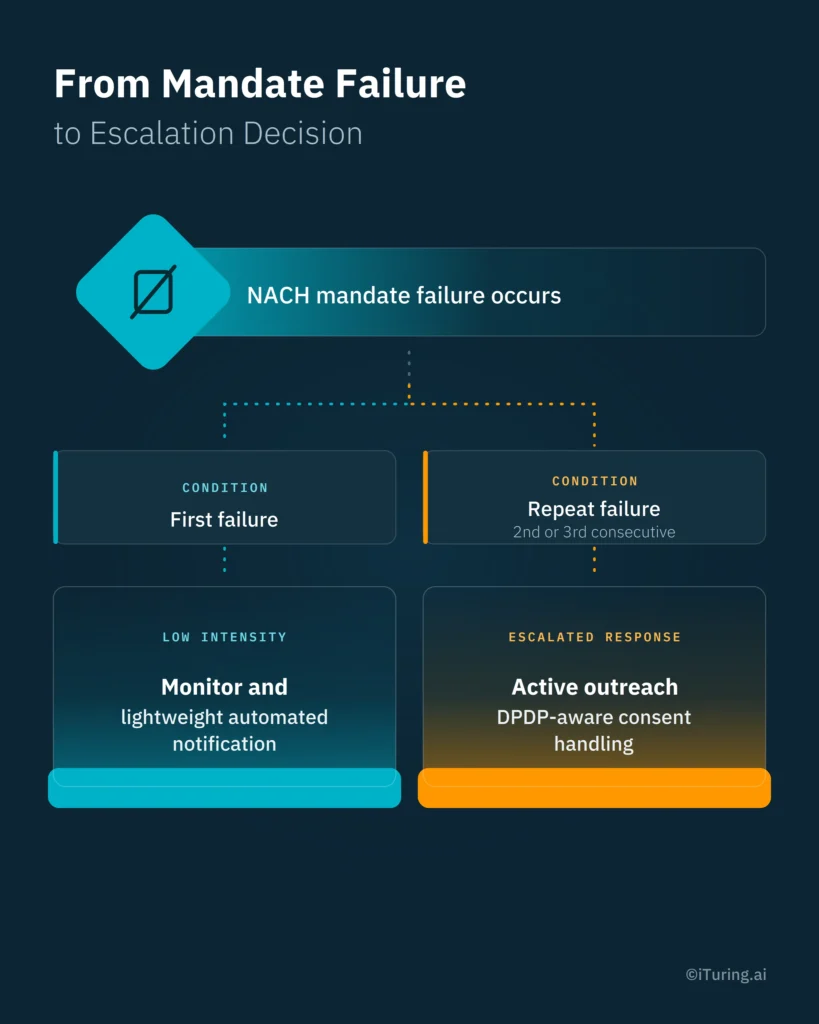
A single NACH failure, particularly one coinciding with a known reason like insufficient balance on a specific date, is a much weaker distress signal than a second or third consecutive failure on the same mandate. The first failure might reflect a simple timing mismatch between salary credit and debit date, resolved by the next cycle without any active intervention needed.
Repeat failure is a different signal entirely, indicating the passive mechanism has stopped working reliably for this borrower, not just once, but as a pattern. A workflow that escalates identically after any single failure either over-reacts to a timing mismatch or, more commonly, under-reacts by continuing to treat a third consecutive failure the same as a first one, missing the point where active intervention would actually help.
RBI Obligations Once a Mandate Fails
Borrower communication and disclosure obligations that apply broadly to collections conduct apply once a mandate failure has occurred, not only once an account has aged into a defined delinquency bucket. A lender’s obligation to communicate clearly about the status of an account and the steps being taken doesn’t wait for a formal delinquency threshold if a mandate failure has already changed the practical recovery situation for that borrower.
DPDP Consent Implications When Switching to Active Recovery
Passive recovery through a NACH mandate operates under the consent basis established at loan origination, the borrower authorised debits under specific terms. Active recovery, direct outreach, calls, messages, negotiation, is a different kind of data use and contact activity, and the DPDP Act’s purpose limitation principle means this shift shouldn’t be treated as automatically covered by the original mandate consent without deliberate consideration of what the active recovery contact actually requires.
This matters operationally: the workflow that escalates a repeat-failure account into active outreach needs to be built with DPDP-aware consent handling for that active phase specifically, not carried over unexamined from the mandate-based passive phase.
Building the Escalation Workflow: From Passive to Active
A well-built workflow differentiates the response at each stage: first failure triggers monitoring and a lightweight automated notification, repeat failure triggers active outreach with DPDP-aware consent handling, and the specific channel and message content adapt based on the failure pattern and product type. This is a workflow design problem as much as a data problem, since the gap most NBFCs have isn’t a lack of failure data, it’s a lack of differentiated response built around that data.
NACH Failure Rate Benchmarks by Product Type
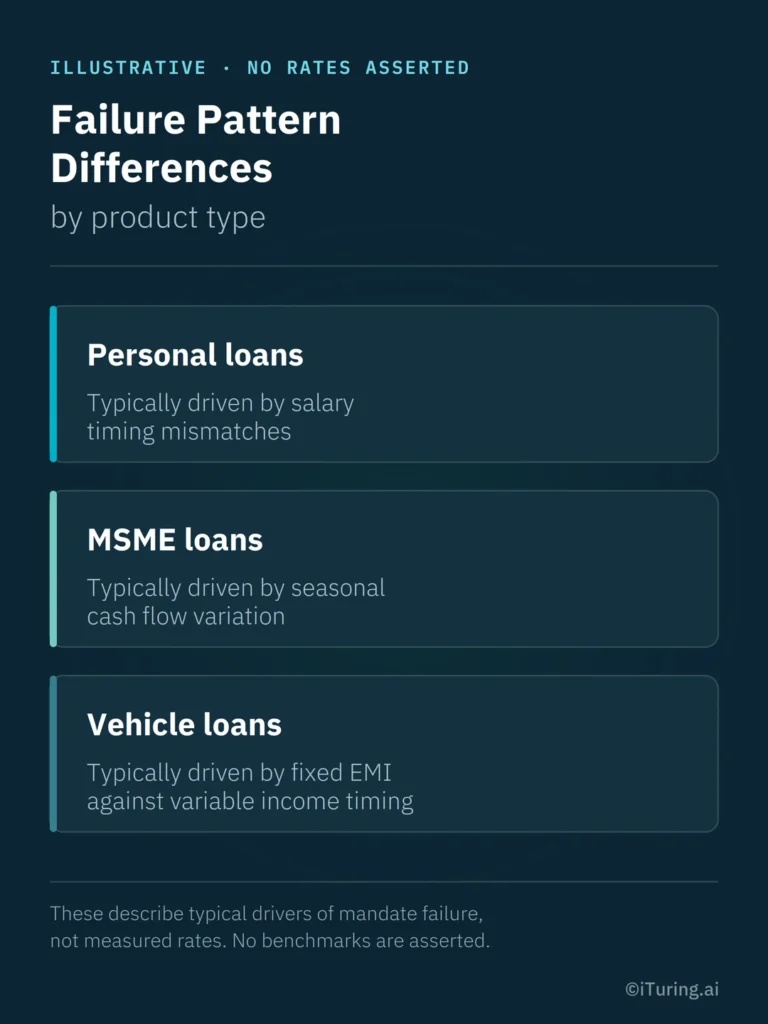
Failure rates and their underlying causes vary by loan product: personal loans, MSME loans, and vehicle loans each carry different typical failure patterns tied to the underlying borrower cash flow and repayment structure. Building failure-rate benchmarks specific to product type, rather than a single blended failure rate across the portfolio, allows a lender to calibrate how aggressively to escalate for a given product’s typical failure pattern rather than applying a one-size-fits-all threshold.
Where iTuring Fits
iTuring’s Collections & Recovery module treats NACH failure as a first-class signal feeding directly into escalation logic, differentiating first-failure from repeat-failure automatically, applying DPDP-aware consent handling when a workflow shifts from passive to active recovery, and calibrating escalation intensity to product-specific failure benchmarks rather than a single blended threshold across the portfolio.
Sources
- RBI guidelines on NACH/ECS mandate processing and NPCI NACH system documentation
- RBI guidance on borrower communication and collections conduct
- Digital Personal Data Protection Act, 2023, purpose limitation provisions
- Current NACH failure rate benchmarks by loan product type (source at time of publication, verify against current NPCI/industry data)