The Headline Number Says MSME Lending Is Healthier Than Ever. The RBI’s Own Report Says Look Closer.
TL;DR
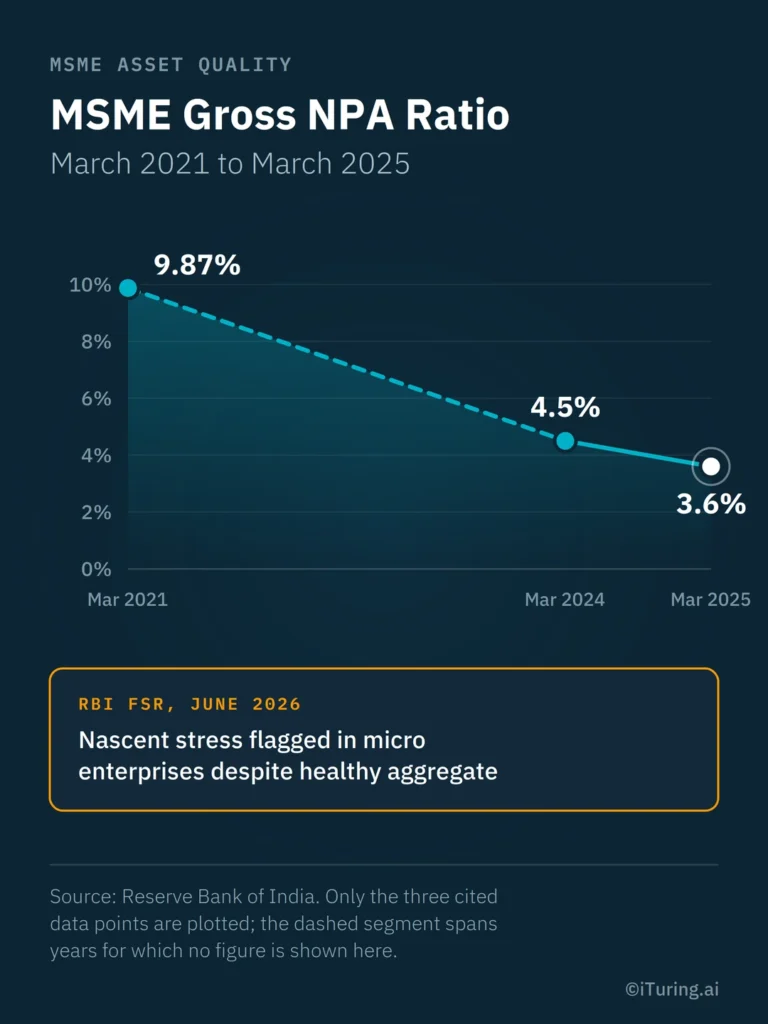
- MSME asset quality has genuinely improved: the gross NPA ratio for scheduled commercial banks’ MSME portfolios fell from 9.87% in March 2021 to 3.6% by March 2025, with subprime borrower share dropping from 33.5% to 23.3% over roughly the same period
- The RBI’s own Financial Stability Report, published June 2026, flags nascent stress specifically in micro enterprises even as the broader MSME loan book stays healthy, a distinction the aggregate NPA number doesn’t show
- MSME credit is growing fast, now 17.7% of non-food bank credit and over Rs 14.3 lakh crore outstanding, which means even a small blind spot in how micro-enterprise risk is scored compounds into meaningful absolute exposure as the book scales
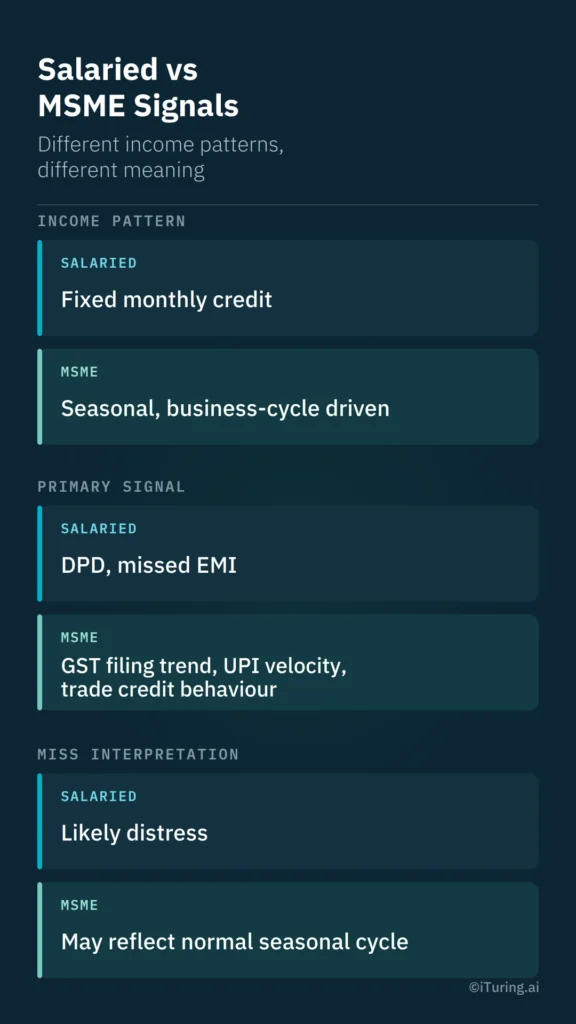
- A collections model built on salaried-borrower logic, fixed monthly income, DPD-only signals, structurally can’t see MSME-specific stress, because MSME income is seasonal and business-cycle driven, not a stable salary credit
- GST filing patterns, UPI transaction velocity, and trade credit behaviour are far stronger early signals for MSME accounts specifically than payment-history-only features
- Recovery economics for MSME accounts differ meaningfully from retail accounts, and treating them identically for cost-per-recovery planning misallocates collections effort
The system-wide MSME story is genuinely a good one, and it’s worth stating plainly rather than manufacturing a crisis that doesn’t exist. Gross NPAs in the MSME book have fallen sharply over the past several years, and the borrower quality mix has improved alongside it. That’s real progress, driven by better underwriting, government credit guarantee schemes, and a maturing lending ecosystem.
But the RBI’s own June 2026 Financial Stability Report adds a specific caveat to that good headline: stress is quietly building in micro enterprises specifically, even as the broader MSME book, which also includes small and medium enterprises with more resilient balance sheets, keeps the aggregate number looking clean. An aggregate NPA ratio built by blending micro, small, and medium enterprise risk together can mask exactly the segment where a lender most needs early warning.
What the Improvement Actually Shows, and What It Doesn’t
The improvement in MSME NPAs, from 9.87% in March 2021 down to 3.6% by March 2025, reflects genuinely better credit discipline: subprime borrower share in the portfolio dropped from 33.5% to 23.3% over roughly the same window, and the SMA-2 special mention account ratio, an indicator of incipient stress, moderated from 1.3% to 0.8%. These are real gains, not accounting artifacts.
What this aggregate improvement doesn’t show is where within the MSME category the risk sits. Micro enterprises, the smallest, least formalised end of the MSME spectrum, behave very differently from small and medium enterprises with more established banking relationships and steadier cash flow. When the RBI’s own supervisory report specifically calls out nascent stress in micro enterprises while the broader book stays healthy, that’s a direct signal that the aggregate number is doing exactly what aggregates do: averaging away the segment that actually needs attention.
Why the Growing Book Size Changes the Calculus
MSME credit now represents 17.7% of non-food bank credit, an all-time high, with outstanding MSME loans exceeding Rs 14.3 lakh crore as of mid-2025 and growing at 14.1%, faster than both retail and services credit. A lending book growing this fast, even one with an improving aggregate NPA ratio, means the absolute rupee exposure sitting in any under-monitored sub-segment grows right alongside it.
A collections and monitoring approach that’s adequate for a smaller, slower-growing MSME book can become inadequate simply because the book has scaled, not because underwriting quality has changed. This is the practical argument for building micro-enterprise-specific collections signals now, while the aggregate picture is still favourable, rather than waiting for the micro-enterprise stress the RBI has already flagged to show up as a genuine portfolio problem.
Why Salaried-Borrower Models Structurally Miss MSME Signals
A collections model built around salaried-borrower behaviour scores distance from a predictable monthly salary credit and a fixed EMI schedule. MSME income doesn’t work this way. A micro-enterprise owner’s cash flow follows business cycles, seasonal demand, payment terms from their own customers and suppliers, none of which resembles a salary credit landing on the same date each month.
Applied to this population, DPD-only scoring treats a seasonal cash flow gap the same way it treats a salaried borrower’s missed payment, when the two situations call for entirely different collections responses. The salaried borrower’s miss is more likely to reflect genuine distress. The MSME owner’s miss might simply reflect the normal rhythm of their business cycle, information a DPD-only model has no way to see.
GST Filing Patterns as an Early Signal
GST filing regularity and the trend in reported turnover offer a genuinely MSME-specific signal with no salaried-borrower equivalent. A business that begins filing late, or shows a declining turnover trend across consecutive filing periods, is signalling operational stress well before that stress shows up as a missed loan payment. This is a leading indicator a salaried-income model was never built to capture, because salaried borrowers don’t file GST returns as part of their income profile.
UPI Transaction Velocity and Seasonal Business Cycles
Transaction velocity through UPI, the rate and pattern of digital payment activity flowing through a business’s accounts, reflects real-time business activity in a way a monthly bank statement snapshot doesn’t. A slowdown in transaction velocity, adjusted for the business’s known seasonal pattern, can flag stress developing in close to real time, well before it would surface through a payment-history-only lens.
Trade Credit Behaviour as an Early Warning Signal
How a business manages payment terms with its own suppliers and customers, extending or shortening trade credit cycles, is itself a signal collections models rarely use but which correlates closely with underlying cash flow health. A business increasingly stretching payment terms with suppliers is often managing a liquidity gap before that gap becomes visible in loan repayment behaviour.
India-Specific MSME Recovery Benchmarks and Cost-Per-Recovery
Recovery economics for MSME accounts differ from retail accounts in ways that should shape contact strategy and resourcing, not just scoring. MSME accounts often justify more relationship-based, structured engagement given typically higher ticket sizes relative to retail unsecured lending, while the seasonal nature of MSME cash flow means timing of contact matters more than it does for a salaried borrower with predictable monthly income. Building cost-per-recovery benchmarks specific to the MSME segment, rather than inheriting retail collections economics, is a prerequisite for allocating collections effort sensibly across a growing book.
Where iTuring Fits
iTuring’s Data Accelerator and AutoML+ modules build MSME-specific feature families, GST filing signals, UPI transaction velocity, trade credit behaviour, directly into the collections model rather than requiring months of manual feature engineering to bolt them onto a salaried-borrower scorecard. As the RBI’s own reporting shows stress emerging specifically in the micro-enterprise segment, this is the moment to build that segment-specific visibility, not after it surfaces as a portfolio-level problem.
Sources
- Reserve Bank of India, Financial Stability Report, June 2026
- RBI data cited via Ministry of Finance/Government of India press releases on MSME and retail NPA trends, December 2025
- IBEF, “MSMEs are the new engine of credit growth for banks,” citing RBI data, July 2025
- Press Information Bureau, “MSME Sector Sees Continued Growth as NPAs Decline Sharply,” citing RBI data through FY2025
- Current MSME credit growth and outstanding balance figures (verify most recent quarter at time of publication, this segment moves quickly)