TL;DR
- What it is: MLOps services keep a model working correctly after it reaches production: monitoring, retraining, metadata upkeep and recurring reporting. That is a different job from an MLOps consulting engagement, which builds the pipeline and then ends.
- The core problem: A model that goes live without an ongoing service behind it stops being watched the day the project team moves to its next client, even though RBI’s own draft framework treats monitoring as a continuing lifecycle stage.
- What changes: What an ongoing MLOps service actually has to keep running every month, and how that is different from paying for a project that stops at handoff.
- What doesn’t change: A bank still has a real choice between running this in-house and buying it as a service. The question is whether the option chosen has the standing bandwidth to run indefinitely, not which one costs less on day one.
- Honest caveat: RBI’s draft guidance referenced below is still under review and not yet in force, so treat its lifecycle language as the direction ongoing model governance is heading, not a finalized mandate.
A bank that just finished deploying a model usually has a working pipeline, a monitoring dashboard, and a project team about to move on to its next engagement. What it often doesn’t have is anyone whose job continues past that point.
MLOps services are the work that keeps happening after deployment: watching for drift, deciding when to retrain, keeping metadata current, and producing the reports a board or examiner expects on a schedule, not on request. That is a different job from an MLOps consulting engagement, which is scoped, priced and delivered once.
This page covers what MLOps services actually means as distinct from consulting, why RBI’s own draft framework treats monitoring as an ongoing lifecycle stage rather than a deliverable, what an ongoing service has to keep running month to month, and how to weigh running this in-house against buying it as a standing service.
What “MLOps services” means, and how it differs from an MLOps consulting engagement
MLOps services are the ongoing operational work that keeps a model correct once it is in production: monitoring, retraining, metadata upkeep and recurring reporting. An MLOps consulting engagement is a scoped project that builds the pipeline and hands it off. One runs indefinitely. The other has a defined end date.
Our own piece on MLOps consulting services covers what a build-focused engagement’s scope of work should name before signing. This page picks up where that one ends: what happens after the handover, once the consulting team has moved to its next client.
A service that only lasts as long as the build leaves a bank holding a working pipeline and no one whose job it is to watch it. Whether that gap gets filled by an internal hire, a standing vendor contract, or nothing at all is the actual decision this page is about.
Some vendors sell both under one label, and some banks assume a consulting engagement quietly includes ongoing coverage. Neither assumption is safe without checking what the contract actually names.
Why monitoring is a continuing obligation, not a one-time deliverable
RBI’s draft Guidance on Regulatory Principles for Model Risk Management names deployment and monitoring as one continuous lifecycle stage a model risk management framework has to cover, not two separate events. The Risk Management Committee of the Board oversees that monitoring on a standing basis, not once at go-live.
A project-based engagement that ends at go-live technically completes the deployment half of that lifecycle stage. It does not automatically start the monitoring half unless a specific party is contracted, or internally assigned, to keep doing it after the project team leaves.
Deployment and monitoring named as one stage matters because it removes the option of treating monitoring as optional follow-up work. Under this draft framework, a model that is live but unwatched has not completed its lifecycle obligation, regardless of how well the initial deployment went.
The guidance also requires a documented change-management process with a defined material-change threshold, and that threshold cannot be evaluated by anyone who is not actively watching the model’s live performance. A monitoring function that exists on paper but has no active service behind it cannot actually trigger this process when a change becomes material.
What an ongoing MLOps service actually has to keep running month to month
An ongoing MLOps service has four standing jobs: drift monitoring against a defined baseline, a retraining decision process when drift crosses a threshold, metadata and lineage upkeep as data and models change, and recurring reports timed to a fixed schedule rather than produced on request.
RBI’s draft Guidance on Regulatory Expectations for Data Governance requires metadata to be maintained across a model’s full data lifecycle, not only captured once at build time. It separately requires data quality reports to reach the Data Governance Committee at quarterly or more frequent intervals, which only happens if someone is actually assembling that report every quarter.
Drift monitoring without a defined retraining decision is just a dashboard nobody acts on. The service has to include the decision process, who reviews a drift alert, what evidence justifies retraining, and who approves the retrained model before it replaces the one in production, not only the alert itself.
A quarterly report that gets built fresh each time is a different cost and a different risk than one that gets generated from a system already tracking the underlying metrics continuously. The first depends on someone remembering to do the work. The second is a byproduct of the service actually running.
In-house team versus an ongoing MLOps service: the real trade-off
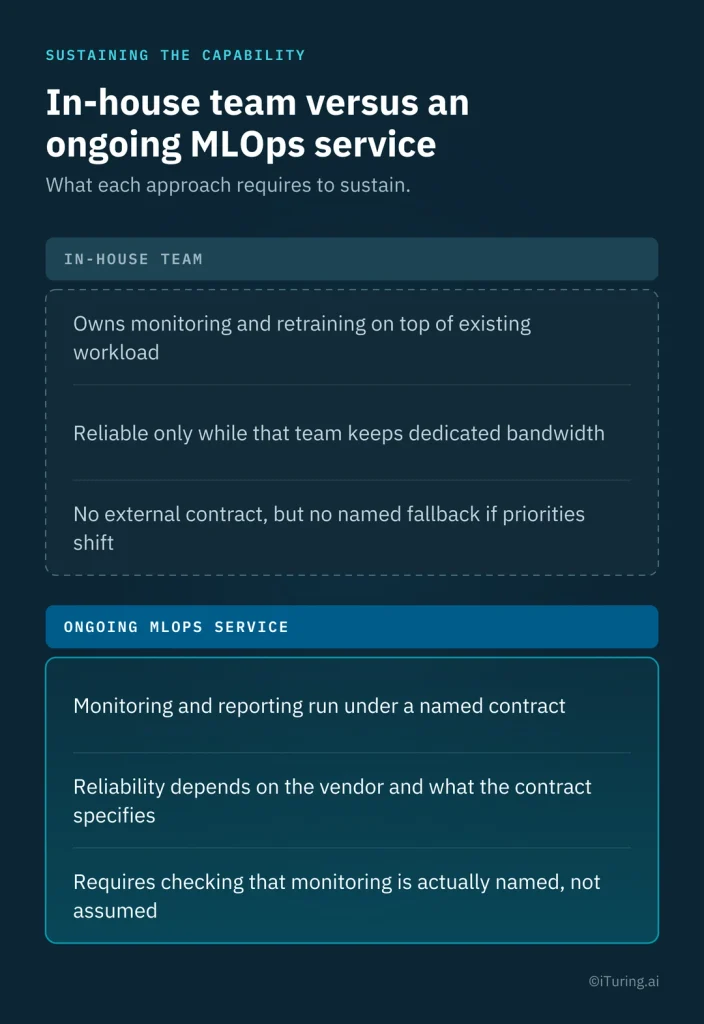
Running this in-house means a bank’s own team owns drift monitoring, retraining decisions and quarterly reporting indefinitely, on top of whatever else that team is already responsible for. That works when the team has dedicated bandwidth for it. It becomes a gap the moment that bandwidth gets reassigned to the next priority, which is a common failure mode once the excitement of a new deployment fades.
Buying an ongoing MLOps service moves that standing responsibility to a vendor under a contract that names what gets monitored, how often, and what triggers a retraining review. The trade-off is that the bank now depends on that vendor’s own reliability and on the contract actually naming these obligations rather than leaving them implied.
Neither path is automatically cheaper or safer. An in-house team that already has monitoring built into its normal workload costs nothing extra to sustain. A vendor contract that only names the deployment work and leaves monitoring as an assumption costs the same as having nothing behind the model at all.
What a properly run ongoing service actually delivers
A properly run ongoing service produces two outcomes at once: a model that keeps performing close to its original accuracy, and an audit-ready record of why it still does. iTuring’s own platform-native monitoring and reporting shipped as part of a live NBFC collections deployment.
That deployment reached production in two weeks, with maker-checker approval and audit trail running from day one rather than added afterward.
That engagement delivered a 116% improvement in collections recovery rate and 86% predictive accuracy, sustained because the monitoring and retraining decisions kept running past the initial deployment rather than stopping once the model went live. The reporting a board or examiner would ask for came from the same system generating the monitoring data, not a separate exercise assembled after the fact.
If your current MLOps arrangement covers deployment but goes quiet after go-live, book a working session with our team to see what an ongoing service should actually include.
Questions to ask before signing an ongoing MLOps services contract
Before signing, confirm exactly what continues after deployment and what triggers action along the way.
- What is monitored, and how often is it checked? Ask for the specific metrics tracked and the review cadence, not a general assurance that “monitoring is included.”
- Who decides when a model needs retraining, and on what evidence? A drift alert without a named decision-maker and a documented threshold is not a retraining process.
- Who approves a retrained model before it replaces the one in production? This should be a function separate from whoever built or retrained the model, matching RBI’s independent-validation expectation.
- What reports get produced, on what schedule, and in what format? Ask to see a sample report, not a description of one.
- What happens if the vendor relationship ends? Confirm whether metadata, monitoring history and reporting templates transfer to the bank or stay with the vendor.
Sources
- Reserve Bank of India, “RBI issues draft ‘Guidance on Regulatory Principles for Model Risk Management’,” Press Release 2026-2027/528, 24 June 2026. https://www.rbi.org.in/scripts/BS_PressReleaseDisplay.aspx?prid=63006
- Reserve Bank of India, Draft Guidance on Regulatory Principles for Model Risk Management (guidance document), paragraphs 10, 12, 38-42. https://www.rbi.org.in/Scripts/bs_viewcontent.aspx?Id=5089
- Reserve Bank of India, “RBI issues draft ‘Guidance on Regulatory Expectations for Data Governance’,” Press Release 2026-2027/677, 15 July 2026. https://www.rbi.org.in/Scripts/BS_PressReleaseDisplay.aspx?prid=63155
- Reserve Bank of India, Draft Guidance on Regulatory Expectations for Data Governance (guidance document), paragraphs 47-51, 56-59. https://www.rbi.org.in/Scripts/bs_viewcontent.aspx?Id=5114
- iTuring case study, “Improve Collections and Optimize Efforts” (leading NBFC in India): 116% collections improvement, 86% predictive accuracy, two-week deployment. https://ituring.ai/case-study/improve-collections-and-optimize-efforts/
- iTuring.ai, ModelOps platform page. https://ituring.ai/platforms/model-ops/